The best manometer kits make HVAC and gas-pressure testing faster, clearer, and more repeatable. The right choice depends on the pressure range, connection type, measurement units, and whether you need a standalone gauge or wireless probes.
We compared 10 options for technicians, installers, maintenance professionals, and serious DIY users, focusing on usability, compatibility, portability, and everyday testing needs.
Best 10 Manometer Kits Picks for 2026
Wireless HVAC Pro
Fieldpiece Job Link Dual-Port Kit

- 1,000-foot wireless range
- Records up to eight readings
- Includes probes, adapters, hoses, and case
Best For: HVACR professionals needing flexible multi-point measurements
Versatile Digital Tester

- Measures differential pressure to ±5 PSI
- Offers 12 selectable pressure units
- Includes hoses, batteries, and carrying bag
Best For: HVAC and general pressure-testing tasks
Switch Testing Specialist
Fieldpiece SDMN6 Pressure Switch Tester
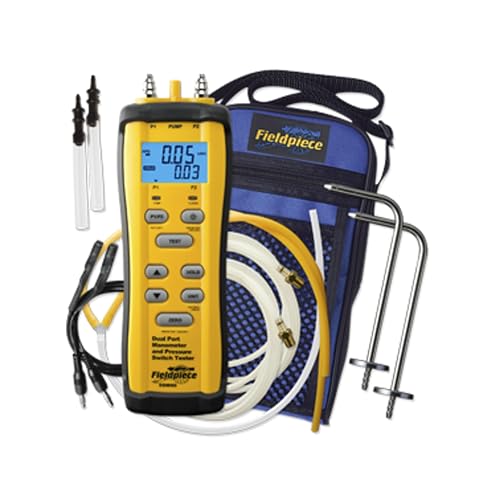
- Measures gas, static, and differential pressure
- Built for pressure-switch testing
- Includes probes, adapters, hoses, and accessories
Best For: HVAC pressure-switch diagnosis and adjustment
Airflow Balancing Pick
Fieldpiece SDMN5 Dual-Port Manometer

- Dual-port duct-pressure measurement
- -60.0 to 60.0 in. WC range
- Resolution down to 0.01 in. WC
Best For: Duct-pressure measurement and airflow balancing
Extended-Reach Gas Testing

- 0-35 in. WC measurement range
- 40-inch hose for added reach
- Multiple NPT fittings included
Best For: Natural- or LP-gas pressure testing with flexible connections
HVAC Probe Accessory

- Magnetic flange for hands-free use
- T fitting supports three tubing sizes
- Fits several listed digital manometers
Best For: HVAC users needing a compatible probe and adapter
Simple LP Gas Measurement

- 0-35 in. WC pressure range
- 40-inch flexible hose
- 1/8-inch NPT barbed connection
Best For: Basic LP-gas pressure checks in tight spaces
Best Overall
Klein Tools ET180 Digital Manometer

- Dual-port static and differential pressure testing
- ±60 inH2O range with 11 selectable units
- Backlit display, magnet, tubing, pouch, and batteries included
Best For: Routine HVAC air and gas system troubleshooting
Best Feature Set

- Seven adapters support varied tubing diameters
- Stores up to 29 readings with min/max review
- -100 to +200 kPa range plus backlit screen and flashlight
Best For: Versatile HVAC testing with stored measurements
Best for Basic HVAC Checks
QX-1201 Dual-Port HVAC Manometer

- Dual-port readings for static and differential pressure
- 12 units with data hold and on-device storage
- 0.001 kPa and psi display resolution within its range
Best For: Routine HVAC static-pressure and filter checks
Wireless HVAC Pro – Fieldpiece Job Link Dual-Port Kit
For HVACR professionals who need flexible readings, this Fieldpiece kit is one of the more capable manometer kits available. Its wireless probes can measure from convenient system locations without long hose runs, while supporting static, gas, and draft pressure work.
Best For: HVACR technicians who need wireless, multi-point pressure measurements and real-time data visibility.
Pros:
- Up to 1,000 feet of wireless range.
- Displays and records up to eight readings in real time.
- Supports single-, dual-, or multi-port measurements with independent sensors.
- Includes static probes, gas adapters, hoses, batteries, and a padded case.
Cons:
- Its specialized wireless design may be more capability than occasional users need.
- The kit is focused on HVACR applications rather than general-purpose pressure testing.
The untethered setup and included accessories make this a strong choice when accurate probe placement and reduced hose clutter matter. It is particularly useful for diagnosing complex systems or collecting several readings at once.
Versatile Digital Tester – POROMETISTO DMT01 Manometer
The POROMETISTO DMT01 is a practical option among manometer kits for users who want a compact differential-pressure tester with multiple display and recording functions. It measures up to ±5 PSI, offers 12 selectable pressure units, and includes the basic hoses and batteries to get started.
Best For: HVAC, automotive, and boiler-pressure testing where flexible units and basic data tracking are useful.
Pros:
- Provides ±5 PSI differential-pressure measurement with stated accuracy up to ±0.3% FS.
- Supports 12 pressure units, including PSI, kPa, mbar, and inH₂O.
- Offers maximum, minimum, average, data hold, and relative-time displays.
- Includes two hoses, three AAA batteries, a cloth bag, and a one-year replacement service for quality issues.
Cons:
- Its ±5 PSI range may not suit applications requiring a wider pressure range.
- Manual calibration and custom-zero functions may require more setup than a basic gauge.
With a backlit LCD, adjustable auto shutoff, and one-key zero reset, the DMT01 emphasizes straightforward field use. Consider it when unit flexibility and simple min/max/average tracking are more important than wireless connectivity.
Switch Testing Specialist – Fieldpiece SDMN6 Pressure Switch Tester
The Fieldpiece SDMN6 is a focused choice among manometer kits for technicians who test and adjust pressure switches. It measures gas, static, and differential pressure, and its included probes, adapters, hoses, and accessories support common HVAC diagnostic tasks.
Best For: HVAC technicians testing pressure switches and checking gas or static pressure in the field.
Pros:
- Measures gas, static, and differential pressure.
- Designed for testing and adjusting pressure switches.
- Features a backlit dual display, zero adjustment, magnetic hanger, and auto power-off.
- Includes static probes, gas adapters, quick-connect leads, hoses, a Y-splitter, and pump bleed accessory.
Cons:
- Its pressure-switch focus may be less suitable for users seeking a simple general-purpose gauge.
- At 1.9 pounds, it is heavier than some handheld alternatives in this roundup.
The rugged rubber boot and magnetic hanger are useful for hands-on service work, while the dual display helps during pressure checks. This is a sensible kit for technicians who regularly need pressure-switch testing rather than only occasional measurements.
Airflow Balancing Pick – Fieldpiece SDMN5 Dual-Port Manometer
The Fieldpiece SDMN5 is a straightforward dual-port option among manometer kits, especially for measuring duct pressure and balancing airflow. Its range runs from -60.0 to 60.0 inches of water column, with resolution down to 0.01 inches of water column for static-pressure work.
Best For: HVAC technicians measuring duct pressure and balancing airflow with a compact dual-port meter.
Pros:
- Dual-port design supports comparative pressure measurements.
- Measures from -60.0 to 60.0 inches of water column.
- Offers resolution down to 0.01 inches of water column for static pressure.
- Includes tube adapters, an installed 9-volt battery, and an operator’s manual.
Cons:
- The supplied notes do not indicate wireless connectivity or advanced data-recording features.
- Its listed accessories are more limited than those of the SDMN6 pressure-switch kit.
With a compact 6.9-ounce meter and dual ports, the SDMN5 keeps the emphasis on core duct-pressure measurements. Choose it when airflow balancing and static-pressure resolution are the priority, without needing the broader accessory package of a pressure-switch tester.
Extended-Reach Gas Testing – 0-35" WC Manifold Kit
For technicians comparing manometer kits for natural gas or LP gas work, the MEANLIN MEASURE manifold kit combines a 0-35 in. WC range with a 40-inch hose. Its included fittings support several connection configurations, while the adjustable zero setting helps prepare the gauge for use.
Best For: Gas-pressure testing where extra hose reach and multiple NPT connection options are useful.
Pros:
- Measures from 0 to 35 in. WC.
- Includes a 40-inch hose for added reach.
- Comes with a barbed 1/8-inch NPT fitting plus 1/8 x 1/4-inch and 1/8 x 3/8-inch NPT hex bushings.
- Features a 2-1/4-inch dial face and adjustable zero setting.
Cons:
- It is an analog dial gauge rather than a digital display.
- The NPT size is nominal, so users should verify actual connection requirements.
This is a practical choice when a longer hose and adaptable fittings matter more than a compact, digital format. Confirm the required thread sizes before ordering.
HVAC Probe Accessory – JL3MN Manometer Probe Kit
Among manometer kits, the ZIBOO JL3MN is an accessory-focused option for compatible differential manometers and HVAC pressure testing. Its magnetic flange supports hands-free placement on metal surfaces, while the included TF100 T fitting accepts three common pressure-tubing sizes.
Best For: HVAC technicians who need a replacement or supplemental probe and tubing adapter for compatible digital manometers.
Pros:
- Magnetic flange helps secure the probe to metal surfaces.
- TF100 T fitting works with 1/16-inch, 1/8-inch, or 1/4-inch pressure tubing.
- Listed as compatible with models from Fieldpiece, Klein Tools, UEI, Extech, and Testo.
Cons:
- This is a probe kit, not a complete standalone manometer.
- Compatibility should be checked against the exact instrument model before purchase.
The JL3MN makes the most sense for users who already own a compatible dual-port manometer and want easier positioning or broader tubing flexibility. It is less suitable if you need the meter itself.
Simple LP Gas Measurement – 0-35" WC LP Gas Manometer
The UHARBOUR LP gas tester is one of the straightforward manometer kits for checking gas pressure from 0 to 35 inches of water column. A 40-inch hose helps reach confined areas, and the 1/8-inch NPT barbed connection is designed for a secure attachment to compatible gas systems.
Best For: Professionals or DIY users who need a simple LP-gas pressure tester with a clear analog gauge and extended hose.
Pros:
- Provides a 0-35 in. WC measurement range.
- Includes a 40-inch hose for hard-to-reach spaces.
- Uses a 1/8-inch NPT fitting with a barbed connection.
- Clear gauge markings are intended for straightforward readings.
Cons:
- The supplied notes identify it specifically as an LP-gas tester, limiting its stated scope.
- It uses an analog gauge rather than a digital readout.
- Users should confirm that the 1/8-inch NPT connection matches their system.
Choose this model when basic gas-pressure measurement and hose reach are the priorities. Its simple design may appeal to occasional users, while connection compatibility remains the key purchase check.
Best Overall – Klein Tools ET180 Digital Manometer
The Klein Tools ET180 is a practical choice among manometer kits for HVAC technicians who need dependable static and differential pressure readings. Its dual ports, broad unit selection, backlit display, and built-in magnet make it well suited to routine air and gas system troubleshooting.
Best For: HVAC service calls, duct and system pressure checks, and hands-free measurements in dim work areas.
Pros:
- Measures static and differential pressure across two ports.
- Offers an approximately ±60 inH2O range with ±1.5% full-scale accuracy.
- Includes 11 measurement units, a backlit LCD, and a strong rear magnet.
- Comes with silicone tubing, batteries, a storage pouch, and instructions.
Cons:
- Its stated accuracy and range may be less suitable for applications requiring tighter specifications.
- Includes 1/8-inch ID tubing, so additional fittings may be needed for some systems.
Choose the ET180 if you value a straightforward, portable tester with useful accessories and easy-to-read measurements. Auto-power-off and data-hold functions also help conserve batteries and preserve readings during service work.
Best Feature Set – LUTIFIX PT520 HVAC Manometer
The LUTIFIX PT520 stands out among manometer kits for its included adapter set and built-in data functions. With a -100 to +200 kPa range, multiple pressure units, record storage, and a backlit screen with flashlight, it is designed for varied testing jobs.
Best For: Technicians who need flexible hose connections, stored readings, and support for both positive- and negative-pressure testing.
Pros:
- Includes seven adapters for several tubing and pipeline diameters.
- Switches among 10 pressure units and measures from -100 to +200 kPa.
- Records up to 29 data sets and supports data locking, zeroing, and storage.
- Large backlit LCD and flashlight improve visibility during field work.
Cons:
- The 0.54 kg weight is higher than some compact handheld manometers.
- The many adapters and recording functions may be unnecessary for simple pressure checks.
The PT520 is a strong pick when one instrument needs to handle varied connections and preserve measurement history. Its three-year warranty promise for non-human-caused damage adds additional support for regular professional use.
Best for Basic HVAC Checks – QX-1201 Dual-Port HVAC Manometer
The QX-1201 is a focused option among manometer kits for measuring HVAC static, differential, and low-pressure readings. Its dual-port design, 12 selectable units, data hold, and on-device storage make it useful for routine diagnostics when you do not need data export or timestamped logging.
Best For: HVAC static-pressure checks, filter differential testing, blower troubleshooting, ventilation maintenance, and laboratory vacuum readings within its rated range.
Pros:
- Supports single-point or P1–P2 differential measurements through two ports.
- Displays pressure in 12 units, including kPa, psi, inH2O, mbar, and bar.
- Offers data hold and storage for reviewing saved readings on the device.
- Provides 0.001 kPa and 0.001 psi display resolution within its rated range.
Cons:
- It is not designed for timestamped logging or data export.
- Only one adapter is included in this configuration; some test ports may require an additional fitting.
- Its usable range is limited to approximately ±20.68 kPa (±2.999 psi).
This model makes sense for technicians who want clear low-pressure readings and simple on-device history review. Check your test-port thread and tubing requirements before ordering, and remember that it measures pressure rather than detecting gas leaks or identifying gas composition.
How We Picked These Manometer Kits
We focused on the features that matter during real pressure-testing work: measurement range, accuracy, dual-port capability, display readability, calibration or zeroing controls, hose and fitting compatibility, and overall portability. We also considered whether each kit is designed for HVAC, natural gas, LP gas, draft measurement, pressure-switch testing, or multiple applications.
Wireless probe systems and traditional handheld gauges serve different workflows, so we included both. Compatibility with common service tools and replacement accessories was also important, particularly for technicians who already use Fieldpiece or Klein Tools equipment.
Quick Comparison
| Best For | Look For |
|---|---|
| Professional HVAC service | Dual ports, broad ranges, durable housing, and reliable zeroing |
| Wireless measurements | Long-range probes and app or tool integration |
| Gas appliance testing | Inch water column readings, suitable hoses, and 1/8-inch NPT fittings |
| Pressure-switch diagnosis | Stable readings, easy connections, and test-friendly controls |
| Occasional home maintenance | Simple display, included adapters, and straightforward calibration |
Key Buying Factors for Manometer Kits
Pressure Range and Resolution
Match the range to the systems you will test. Gas appliances commonly use inches of water column, while HVAC diagnostics may require differential pressure readings across filters, coils, or switches. A wider range is not automatically better if it reduces useful resolution at low pressures.
Single-Port Versus Dual-Port Design
Single-port models measure pressure relative to ambient air. Dual-port manometers measure the difference between two connection points, making them more useful for differential pressure, static pressure, and many HVAC diagnostics.
Connections, Hoses, and Adapters
Check the fitting size and thread type before buying. Kits with hoses and multiple adapters are more convenient, but verify that their materials and included connectors suit the gas or HVAC equipment being tested.
Controls and Documentation
Useful features include manual zeroing, selectable units, data hold, backlighting, data storage, and automatic shutoff. Calibration procedures should be clear, especially when measurements will be used for commissioning or troubleshooting.
Durability and Portability
Technicians who work across multiple sites should prioritize protective cases, compact probes, readable displays, and controls that are easy to operate while wearing gloves. Wireless systems can reduce hose clutter but may require compatible apps or service platforms.
Who Should Buy Which Manometer Kits?
Choose a wireless dual-port probe kit if you are a professional HVAC technician who wants remote readings, fewer hoses, and integration with an existing diagnostic workflow. A rugged handheld dual-port unit is a better fit for technicians who want a straightforward instrument that works independently.
For furnace, boiler, fireplace, or appliance service, select a gas-focused kit with inch water column measurements, suitable tubing, and the correct NPT fitting. If pressure-switch testing is your main task, prioritize a model designed for stable differential readings and quick connection changes.
For occasional maintenance or DIY troubleshooting, a compact digital manometer with a clear backlit display and included adapters is usually the most practical choice. Before testing gas equipment, follow manufacturer procedures and local safety requirements, and never rely on an unfamiliar instrument without confirming its range and calibration.