Choosing the best commercial dehumidifier for a basement means matching moisture-removal capacity, drainage options, coverage, and operating conditions to the space. Commercial-grade units can help manage damp air in large basements, crawl spaces, storage areas, and workspaces.
This roundup compares 10 high-capacity models with features such as built-in pumps, continuous drainage, auto-defrost systems, and Energy Star efficiency. Use the guide below to narrow your options by basement size, humidity level, installation needs, and budget.
Best 10 Commercial Dehumidifier for Basement Picks for 2026
Best Overall
Waykar 150-Pint Basement Dehumidifier

- 150-pint capacity for spaces up to 7,000 sq. ft.
- Built-in pump and multiple drainage options
- 2025 ENERGY STAR, quiet mode, and auto controls
Best For: Large basements and flexible whole-area moisture control
Best Compact Commercial Model
Airecoler GT-X5 125-Pint Dehumidifier
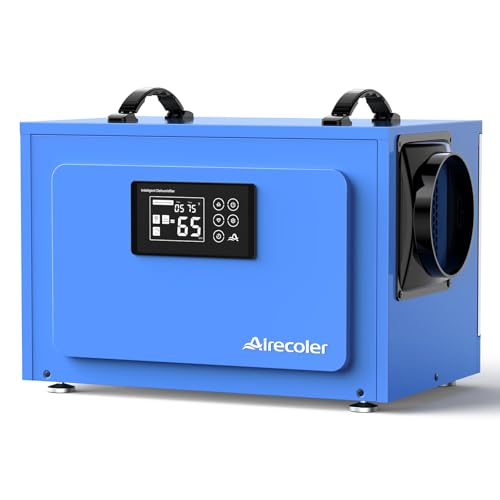
- 125-pint maximum capacity with 6,000-sq.-ft. coverage
- Compact design for crawl spaces and tight basements
- Auto drain, defrost, restart, and a five-year coverage plan
Best For: Permanent installation in low-clearance or compact areas
Best for Efficiency
AEOCKY RHEA-002 Commercial Dehumidifier

- ENERGY STAR Most Efficient 2024 designation
- Up to 105 pints per day in specified humid conditions
- Smart humidity sensing and power-off memory
Best For: Large basements where energy efficiency is a priority
Best for Large Residential Basements

- 150-pint capacity and 7,500-sq.-ft. coverage
- Front humidity display with display-off sleep mode
- Tank or continuous drainage, plus auto restart and defrost
Best For: Large homes needing simple monitoring and mobility
Best Compact Pro-Grade Pick

- 70-pint maximum removal capacity
- Built-in pump with 19.6-foot lift
- Six-year limited warranty
Best For: Crawl spaces and basements up to 1,000 square feet
Best Large-Space Value
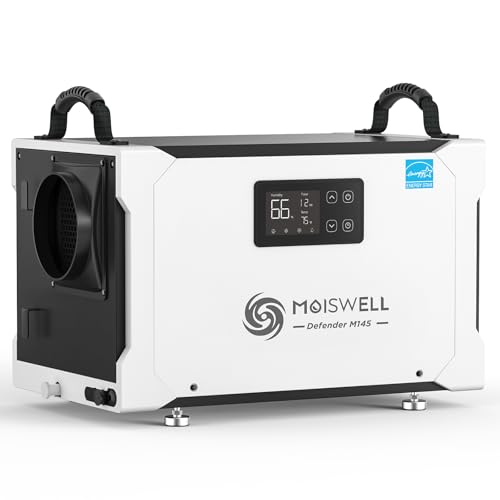
- Up to 155 pints per day
- Rated for areas up to 6,000 square feet
- Horizontal design for tight spaces
Best For: Large basements and low-clearance crawl spaces
Best for Extreme Drying Jobs
Moiswell VP320 Commercial Dehumidifier

- Up to 305 pints per day
- 412 CFM airflow for up to 8,500 square feet
- Built-in pump with 16.4-foot reach
Best For: Large basements and commercial restoration work
Best High-Capacity Pick
160-Pint Commercial Dehumidifier

- Up to 160 pints per day and 7,000 sq. ft. coverage
- Built-in pump lifts water up to 16.4 feet
- Large wheels and detachable handles aid transport
Best For: Large basements and demanding commercial spaces
Best Crawl-Space Pick

- Rated up to 180 PPD, with 85 PPD at AHAM conditions
- 19.6-foot hose and built-in pump support difficult drainage
- Auto-defrost operation down to 36°F
Best For: Basements, crawl spaces, and restoration jobs
Best Precision-Control Pick

- RH and GPP modes provide precise humidity adjustment
- Pump and gravity-drain hoses are included
- Automatic defrost and 5-year limited warranty
Best For: Medium basements needing precise humidity management
Best Overall – Waykar 150-Pint Basement Dehumidifier
If you need a commercial dehumidifier for basement spaces, the Waykar 150-pint model is a versatile choice for large areas. It covers up to 7,000 square feet, offers adjustable humidity control, and includes a built-in pump for basement drainage setups without a convenient floor drain.
Best For: Large basements, homes, storage rooms, and light commercial spaces needing quiet operation and flexible drainage.
Pros:
- Rated to remove up to 150 pints of moisture per day and cover 7,000 square feet.
- Built-in pump, included drain hoses, and a removable tank support multiple drainage options.
- 2025 ENERGY STAR certification, washable filter, auto-defrost, and overflow protection.
- Low-speed operation is rated at 40 dB, with automatic comfort-mode humidity control.
Cons:
- The 150-pint rating is based on high-temperature, high-humidity test conditions.
- A garden hose for extended drainage is not included.
Its combination of large-area coverage, pump-assisted drainage, quiet operation, and automatic controls makes the Waykar a strong all-around option when basement convenience matters as much as capacity.
Best Compact Commercial Model – Airecoler GT-X5 125-Pint Dehumidifier
The Airecoler GT-X5 is a practical commercial dehumidifier for basement or crawl-space installations where clearance is limited. Its compact metal housing, continuous-drain setup, and commercial-oriented controls make it suitable for damp residential, industrial, and restoration environments.
Best For: Low-clearance crawl spaces, tight basements, garages, warehouses, and commercial areas.
Pros:
- Removes up to 125 pints daily, with a listed 60-pint AHAM capacity.
- Compact 19.2-by-12.2-by-13.4-inch design can fit tight spaces or be suspended between floor joists.
- Includes auto drain, auto defrost, timer, automatic restart, and a 6.56-foot drain hose.
- Backed by coverage described as two years for the unit plus three additional years for the dehumidification system.
Cons:
- Its 6,000-square-foot coverage is lower than some larger 150-pint models.
- At 50 pounds, it is less convenient to move frequently than lighter residential units.
Choose the GT-X5 when installation flexibility is a priority. Its compact footprint and long-term coverage are especially useful for permanent basement or crawl-space moisture management.
Best for Efficiency – AEOCKY RHEA-002 Commercial Dehumidifier
For buyers prioritizing operating efficiency, the AEOCKY RHEA-002 is a compelling commercial dehumidifier for basement use. It is designed for spaces up to 6,000 square feet and carries the ENERGY STAR Most Efficient 2024 designation, while its high-capacity compressor system targets demanding warm, damp conditions.
Best For: Large basements and homeowners who expect extended operation and want a high-efficiency certified model.
Pros:
- ENERGY STAR Most Efficient 2024 certification is intended to identify especially efficient performance.
- Listed capacity reaches 105 pints per day in very humid summer conditions and 83 pints in a warm, damp basement.
- Uses a high-efficiency compressor, copper tubing, and enhanced heat-exchange components.
- Smart humidity detection and power-off memory help maintain settings and control moisture automatically.
Cons:
- Its listed coverage is 6,000 square feet, less than some 7,000- and 7,500-square-foot alternatives.
- The supplied notes do not specify a built-in pump or included drain hose, so drainage requirements should be checked before purchase.
The RHEA-002 stands out for buyers focused on certified efficiency and sustained performance. Confirm the drainage arrangement for your basement before choosing it over a model with an integrated pump.
Best for Large Residential Basements – Kesnos 150-Pint Dehumidifier
The Kesnos 150-pint model is a straightforward commercial dehumidifier for basement spaces up to 7,500 square feet. It combines high moisture-removal capacity with a front humidity display, continuous-drain capability, mobility features, and automatic restart for convenient everyday use.
Best For: Large residential basements, offices, stockrooms, and other areas needing broad coverage and easy monitoring.
Pros:
- Removes up to 150 pints per day and is rated for areas up to 7,500 square feet.
- Front display shows current humidity, while MIRAGE Sleep Mode turns off the display during operation.
- Offers a removable 2.12-gallon tank or continuous drainage through the included hose.
- Auto defrost, memory restart, overload protection, safety lock, casters, and hidden handles support convenient use.
Cons:
- The supplied upper temperature rating is 90°F, which may limit use in hotter conditions.
- The listed airflow capacity is 159 CFM, lower than the Airecoler GT-X5’s 265 CFM specification.
- It has a one-year warranty, with extended coverage available as an option.
Kesnos is a good fit when you want broad basement coverage with clear humidity feedback and easy room-to-room movement. Its display, sleep mode, and restart memory make it especially user-friendly for ongoing household operation.
Best Compact Pro-Grade Pick – ALORAIR Helios MP35
If you need a commercial dehumidifier for basement, crawl-space, garage, or similar areas up to 1,000 square feet, the ALORAIR Helios MP35 offers strong performance in a compact package. Its corrosion-resistant casing, automatic operation, and built-in pump make it practical for damp, hard-to-monitor spaces.
Best For: Crawl spaces and basements needing compact, continuous moisture control with flexible drainage.
Pros:
- Removes up to 70 pints per day under saturated conditions, or 35 pints at AHAM conditions.
- Built-in pump can discharge water vertically up to 19.6 feet; a gravity drain hose is also included.
- Automatic defrost, GPP mode, pump mode, and restart-after-outage memory support low-maintenance operation.
- Corrosion-resistant casing and a six-year limited warranty support demanding environments.
Cons:
- Its stated coverage is limited to up to 1,000 square feet, so it is not intended for very large commercial spaces.
- The remote control, hanging kit, washable filters, and stable installation kit are optional accessories sold separately.
The Helios MP35 is a sensible choice when installation flexibility and durability matter more than maximum capacity. Its integrated pump is particularly useful where a nearby floor drain is unavailable.
Best Large-Space Value – Moiswell Defender M145
For a commercial dehumidifier for basement areas, crawl spaces, or larger rooms, the Moiswell Defender M145 combines high airflow with a horizontal design suited to confined installations. It can remove up to 155 pints per day under maximum conditions and is rated for spaces up to 6,000 square feet.
Best For: Large basements, low-clearance crawl spaces, and commercial or residential areas requiring gravity drainage.
Pros:
- 265 CFM airflow and up to 155 pints of daily moisture removal provide substantial drying capacity.
- Compact horizontal form can fit between floor joists, in low-clearance crawl spaces, or in tight basements.
- Energy Star certification, adjustable humidity control, auto defrost, and auto restart improve everyday usability.
- Includes continuous gravity draining and a five-year limited warranty.
Cons:
- It relies on gravity drainage rather than an integrated pump, so the installation needs a suitable drain path.
- At 63 pounds, it is less convenient to reposition than a smaller portable unit.
The Defender M145 stands out for buyers who need broad coverage and a crawl-space-friendly shape. Confirm that gravity drainage works for your installation before choosing it.
Best for Extreme Drying Jobs – Moiswell VP320 Commercial Dehumidifier
When a commercial dehumidifier for basement use must handle severe moisture or fast-drying work, the Moiswell VP320 delivers much higher capacity than compact units. It combines up to 305 pints per day of removal, 412 CFM airflow, and a built-in pump for spaces and restoration tasks up to 8,500 square feet.
Best For: Large basements, warehouses, workshops, and time-sensitive water-damage or construction drying.
Pros:
- Up to 305 pints per day maximum capacity and 130 PPD at AHAM conditions handle demanding moisture loads.
- Built-in pump supports continuous drainage up to 16.4 feet vertically or horizontally.
- Automatic humidity control, defrost, continuous drainage, and power-outage restart reduce supervision.
- Four swivel casters, an ergonomic handle, and recessed side handles aid movement between job sites.
Cons:
- Its 106.4-pound weight and larger footprint make it less suitable for casual residential use.
- The NEMA 5-20 plug requires a 20-amp receptacle, which may require checking the installation beforehand.
- Its 1,700-watt power draw is substantially higher than smaller dehumidifiers.
The VP320 is the strongest option here for high-volume drying, but its electrical requirement, size, and weight should be part of the buying decision. It makes the most sense for commercial environments and demanding restoration work.
Best High-Capacity Pick – 160-Pint Commercial Dehumidifier
For very large, damp areas, this commercial dehumidifier for basement use combines a stated maximum capacity of 160 pints per day with 265 CFM airflow and coverage up to 7,000 square feet. Its built-in pump, long hose, and large wheels make it practical for demanding residential or commercial spaces.
Best For: Large basements, warehouses, offices, construction sites, and industrial areas that need high-capacity moisture removal.
Pros:
- Rated for up to 160 pints per day and areas up to 7,000 square feet.
- Built-in pump can move water up to 16.4 feet, with a matching drain hose included.
- Automatic defrost, adjustable humidity control, continuous drainage, and automatic shutoff support unattended operation.
- Large 10-inch wheels and detachable handles improve portability across rough or sloped surfaces.
Cons:
- At 67 pounds, it is heavier than compact basement dehumidifiers.
- Its larger capacity and commercial-grade design may be more than smaller rooms require.
This is the strongest fit when basement size, heavy moisture, and flexible drainage are the priorities. For smaller spaces, its commercial scale may be unnecessary.
Best Crawl-Space Pick – Abestorm 180 PPD Dehumidifier
This commercial dehumidifier for basement and crawl-space applications emphasizes continuous drainage, compact storage, and low-temperature operation. It is rated at up to 180 pints per day at saturation, 85 PPD at AHAM conditions, and covers up to 2,300 square feet.
Best For: Basements, crawl spaces, attics, garages, and water-damage restoration areas where compact handling and reliable drainage matter.
Pros:
- Built-in pump and included 19.6-foot hose support drainage in long or narrow spaces.
- Auto-defrost operation is designed to work at temperatures as low as 36°F.
- Auto-restart resumes operation after a power interruption.
- Removable wheels, built-in handles, and a compact layout make it easier to move and store.
Cons:
- Coverage is limited to 2,300 square feet, less than the largest unit in this roundup.
- The listed Wi-Fi panel is for future development; this model does not include Wi-Fi functionality.
Choose this model when a basement or crawl space has awkward drainage access or colder conditions. Its straightforward controls and portable design also suit restoration work.
Best Precision-Control Pick – 110-Pint LGR Dehumidifier
For buyers who want more control than basic humidity settings provide, this commercial dehumidifier for basement use offers both RH and GPP modes. The 50C model covers up to 1,300 square feet, includes pump and gravity-drain options, and is designed for continuous operation in commercial or residential settings.
Best For: Medium-size basements, workshops, storage areas, and water-damage restoration applications requiring precise humidity control.
Pros:
- RH mode adjusts from 35% to 90%, while GPP mode supports more precise moisture control.
- High-lift pump hose and gravity-drain hose provide two drainage setups.
- Power-failure memory, automatic defrost, and automatic humidity-based operation support unattended use.
- Includes a 5-year limited warranty.
Cons:
- Maximum stated coverage is 1,300 square feet.
- The 50C model’s maximum 110-pint figure is specified at 90°F and 90% relative humidity; its listed AHAM-style capacity is 50 pints per day.
- The unit is 26.85 inches tall, which may affect placement in low-clearance areas.
This model stands out for settings flexibility and drainage options rather than maximum coverage. It is a sensible choice when maintaining a specific humidity level is more important than drying the largest possible space.
How We Picked the Best Commercial Dehumidifier for Basement
We focused on models designed for demanding moisture-control environments rather than small residential rooms. The selection includes units ranging from approximately 70 to 305 pints of daily moisture removal, giving shoppers options for compact crawl spaces, large basements, commercial properties, and heavily damp areas.
We also considered drainage flexibility, pump availability, hose compatibility, coverage claims, portability, low-temperature performance, energy efficiency, and practical controls. Because manufacturer capacity ratings can vary by test conditions, treat stated pint output and square-foot coverage as comparison points—not guarantees for every basement.
Quick Comparison
- Smaller crawl spaces: A 70-pint class unit may be sufficient when moisture levels are moderate and the area is relatively contained.
- Typical large basements: Models rated from 110 to 160 pints offer a useful balance of capacity, drainage convenience, and flexibility.
- Very damp or expansive spaces: Units rated from 180 to 305 pints are better suited to severe humidity, restoration work, or large commercial areas.
- Hands-off drainage: Choose a model with a built-in pump when the drain is elevated or gravity drainage is impractical.
- Energy-conscious operation: Look for Energy Star or similar efficiency claims, but also check operating conditions and rated power consumption.
Key Buying Factors for a Commercial Dehumidifier for Basement
Capacity and Coverage
Estimate the basement’s square footage, ceiling height, humidity level, and moisture source. A finished basement with occasional dampness needs less capacity than an unfinished space with seepage, condensation, or recent water damage. Oversizing can improve moisture removal, but the unit should still have appropriate humidity controls to avoid unnecessary operation.
Drainage and Pump Design
Continuous drainage is usually more convenient than relying on a collection tank. A gravity drain works when the hose can slope consistently toward a floor drain. If the drain is higher than the unit or far away, a built-in condensate pump can reduce installation work. Confirm hose length, fittings, pump lift, and whether the drain hose is included.
Low-Temperature Operation and Durability
Basements and crawl spaces can become cold, especially in winter. Auto-defrost helps prevent excessive ice buildup on the coils, while a rugged housing and reliable wheels make frequent repositioning easier. For restoration or industrial use, prioritize continuous-duty design and accessible filters.
Noise, Power, and Controls
Commercial units are often louder and draw more power than household models. Check the stated decibel level, voltage requirements, amperage, timer functions, humidity setpoint controls, and restart behavior after a power outage. These details matter if the dehumidifier will operate near living areas or on a dedicated circuit.
Who Should Buy Which Commercial Dehumidifier for Basement?
For a moderately damp basement or crawl space: Choose a mid-capacity model with continuous drainage and a manageable footprint. A built-in pump is helpful when gravity drainage is unavailable.
For a large finished or unfinished basement: Consider a 125- to 160-pint unit with automatic humidity control, a washable filter, and dependable hose drainage. This range offers strong general-purpose performance without jumping immediately to the largest equipment.
For severe moisture, restoration, or commercial use: Look toward 180-pint and higher models, particularly if the space is expansive, poorly ventilated, or affected by water intrusion. Confirm electrical requirements and provide adequate airflow around the unit.
For energy-conscious buyers: Favor an efficiently rated model with programmable controls, but compare real-world power draw and operating schedule rather than relying on the efficiency label alone. Whichever unit you choose, address leaks, condensation, and inadequate ventilation so the dehumidifier is not compensating for an unresolved structural problem.