Portable solar panels can keep essential devices, lights, communication equipment, and backup batteries running when the grid is unavailable. The right setup depends on more than panel wattage: battery capacity, inverter output, charging speed, portability, and weather exposure all matter.
This roundup includes complete solar-generator kits and standalone panels, from compact emergency options to higher-output systems designed to support larger backup power stations.
Best 10 Portable Solar Panels for Home Backup Picks for 2026
Best Whole-Home Backup

- 3,600W output and 3,584Wh capacity
- Includes 2x200W solar panels
- Expandable storage and dual-voltage capability
Best For: High-demand household outage backup
Best Compact Built-In Solar Design

- Built-in 40W solar panel with MPPT controller
- 1,600W output and 1,024Wh capacity
- Eight ports and a 26-pound body
Best For: Portable emergency and camping power
Best Fast-Charging Home Backup

- 3,072Wh capacity with 3,600W output
- Includes 2x200W solar panels
- 20ms UPS and rapid hybrid charging
Best For: Essential appliances and outage continuity
Best Standalone Solar Panel

- 400W foldable panel with 23% efficiency
- IP67 weather-resistant construction
- Uses MC4 cables and supports compatible power stations
Best For: Expanding solar input for existing systems
Top Pick for Whole-Home Backup
Jackery Explorer 2000 v2 Solar Generator

- 2,042Wh capacity with 2,200W AC output
- Includes two 200W solar panels
- 20ms UPS switching for outage protection
Best For: Home backup and high-demand emergency power
Best Foldable Panel
Renogy 200W Portable Solar Panel

- 200W output with 25% cell efficiency
- Folds compactly and weighs 13.9 pounds
- USB-C and USB-A ports charge devices directly
Best For: Portable solar input for compatible power stations
Best Budget Emergency Kit
MARBERO 155Wh Solar Generator Kit

- Includes a 30W solar panel and power converter
- 155Wh capacity with extensive device outputs
- Built-in flashlight with three lighting modes
Best For: Small electronics, lighting, and short outages
High-Output Pick
ZOUPW 480W Bifacial Portable Solar Panel
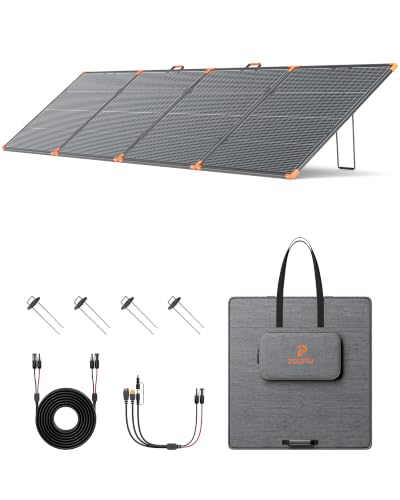
- 480W N-Type bifacial panel
- 22.5-pound lightweight composite design
- Includes cables, stakes, bag, and 36-month warranty
Best For: RV setups and larger home emergency power stations
Compact Complete Kit
Jackery Solar Generator 1000 v2

- 1,070Wh battery with 1,500W AC output
- Includes a 200W solar panel
- App control and multiple charging options
Best For: Essential home backup, camping, and road trips
High-Capacity Backup
EBL 2400W Portable Power Station
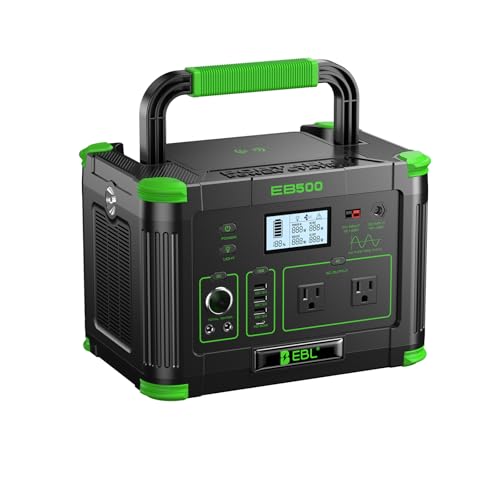
- 1,843.2Wh LiFePO4 battery
- 2,400W output and 12-device charging
- Includes a 200W panel rated up to 23.5% efficiency
Best For: Longer-duration backup and high-demand appliances
Best Whole-Home Backup – Jackery HomePower 3600 Plus
For shoppers comparing portable solar panels for home backup, the Jackery HomePower 3600 Plus is a high-capacity solar generator bundle built for demanding household loads. Its 3,584Wh battery and 3,600W output can support appliances such as pumps, heaters, and dryers, while the included 2x200W solar panels provide a renewable charging option.
Best For: Households that need substantial outage coverage, high output, and expandable storage.
Pros:
- 3,600W output with 7,200W capability when units are used in parallel
- 3,584Wh capacity expandable to 21kWh per unit or 43kWh with multiple units
- Supports AC, hybrid AC+DC, solar, and gas-generator charging
- Wheeled luggage-style design with a telescopic handle
Cons:
- At 77.2 pounds, it is portable but not especially easy to lift
- Large capacity and high output may exceed the needs of basic emergency charging
The HomePower 3600 Plus stands out when backup power needs extend beyond phones and lights. Its dual-voltage capability, long-life LFP battery, and five-year manufacturer warranty make it a strong option for serious home preparedness, though its size and price are likely more than casual users need.
Best Compact Built-In Solar Design – BROWEY 1600W Power Station
The BROWEY DS-S1600 is a compact choice for shoppers seeking portable solar panels for home backup without a separate folding panel setup. Its built-in 40W solar panel, 1,024Wh capacity, and 1,600W pure sine wave output can handle devices such as refrigerators, CPAP machines, and tools.
Best For: Emergency backup, camping, RV use, and users who prioritize a lightweight integrated design.
Pros:
- Built-in solar panel and MPPT controller simplify solar charging
- 1,600W output with 3,200W peak capacity
- Eight ports, including USB-C PD 100W, AC, and DC connections
- 26-pound design is relatively easy to transport
Cons:
- The built-in 40W solar panel is much smaller than the external arrays included with larger systems
- Its 1,024Wh capacity is better suited to essential loads than extended whole-home backup
- Listed battery details identify lithium-polymer cells rather than the LiFePO4 cells described in the feature claims
The BROWEY is appealing when portability and convenience matter more than maximum runtime. It can also connect to other solar panels, but its compact capacity makes it a better fit for selected essentials than for powering an entire household through a prolonged outage.
Best Fast-Charging Home Backup – Jackery HomePower 3000
The Jackery HomePower 3000 is designed for shoppers comparing portable solar panels for home backup around essential appliances. With 3,072Wh of capacity, 3,600W output, and two included 200W solar panels, it can run items such as refrigerators, fans, lights, and Wi-Fi equipment while offering fast hybrid recharging.
Best For: Families needing substantial essential-load backup with UPS protection and flexible charging.
Pros:
- 3,600W output with 7,200W surge capacity
- UL-certified UPS switches within 20ms for supported essential equipment
- Recharges in 1.7 hours through hybrid AC and DC charging
- Includes versatile AC, USB-C, USB-A, DC, and TT-30 RV ports
Cons:
- The included solar panels take up to nine hours to charge the unit to 80% under the stated conditions
- At 59.5 pounds, it is less convenient to carry than smaller power stations
- The 4,000-cycle battery rating retains 70% capacity, rather than the original full capacity
With strong output, a fast UPS response, and a broad selection of ports, the HomePower 3000 is a practical middle ground for home essentials. It offers less capacity than the 3600 Plus, but its smaller, lighter design and rapid hybrid charging may be more convenient for many outage scenarios.
Best Standalone Solar Panel – Renogy 400W Portable Panel
The Renogy 400W panel is a standalone option for shoppers building a portable solar panels for home backup setup around an existing power station. Its foldable suitcase design, 23% efficiency rating, MC4 output cables, and included carry case make it practical for blackout backup, RV use, and off-grid charging.
Best For: Owners of compatible power stations who want a higher-wattage, foldable solar input.
Pros:
- 400W maximum output with 23% stated efficiency
- Foldable design and carry case simplify transport and storage
- IP67 waterproof construction with ETFE coating and fiberglass reinforcement
- Parallel wiring helps reduce the impact of partial shading
Cons:
- Power station, adapter cables, and charge controller are not included
- Compatibility depends on matching voltage, current, and connector requirements
- At 30.2 pounds, it is lighter than many rigid panels but still substantial for frequent carrying
This panel is best viewed as an expandable charging component rather than a complete backup system. Confirm your power station’s input limits and connector type before buying, and remember that real-world output varies with shade, sun angle, temperature, and cable length.
Top Pick for Whole-Home Backup – Jackery Explorer 2000 v2 Solar Generator
For shoppers comparing portable solar panels for home backup, this Jackery bundle offers a high-capacity power station with two 200W solar panels. Its 2,042Wh battery, 2,200W AC output, three AC ports, and UPS functionality make it suited to essential devices during outages, while its battery-powered design avoids fuel and fumes.
Best For: Home backup, emergency preparedness, camping, and users who need substantial battery capacity with solar charging.
Pros:
- 2,042Wh capacity and 2,200W output support demanding home and recreational loads.
- Includes two 200W solar panels for a stated six-hour solar charging time.
- 20ms UPS switching helps keep connected devices powered during interruptions.
- LiFePO4 battery, temperature control, and silent charging support indoor use.
Cons:
- The complete setup weighs about 66.8 pounds according to the supplied details.
- Solar-panel connection requires using the correct straight DC8020 plug.
This is the strongest option here for serious backup capacity rather than lightweight portability. Choose it if you want a large battery, meaningful AC output, and included solar panels; its size and weight are the main trade-offs.
Best Foldable Panel – Renogy 200W Portable Solar Panel
If you already own a compatible power station, this Renogy panel is a practical way to add solar input for home backup, camping, or RV use. It delivers up to 200W, uses 25%-efficient N-type cells, folds for storage, and includes USB outputs for charging smaller devices directly.
Best For: Power-station owners who want a portable, high-efficiency panel for backup charging, travel, or off-grid use.
Pros:
- 25% efficiency and 200W maximum output provide strong charging potential in available sunlight.
- Folds to approximately 23.72 x 22.99 x 1.97 inches and weighs 13.9 pounds.
- USB-C PD 45W and dual USB-A ports can charge phones, tablets, laptops, GPS units, and cameras.
- Four kickstands and multiple angle positions help with outdoor setup.
Cons:
- It has MC4 output only; the 4-in-1 adapter is sold separately.
- Compatibility depends on the power station meeting the panel’s requirements.
This panel is a flexible add-on rather than a complete backup system. It makes the most sense when you already have a compatible power station and value foldability, direct USB charging, and easier transport.
Best Budget Emergency Kit – MARBERO 155Wh Solar Generator Kit
For basic emergency readiness, this MARBERO kit combines a compact 155Wh power station with a 30W solar panel and power converter. It is much smaller than high-capacity home backup systems, but its many USB, DC, car, and AC outputs make it useful for keeping small electronics and lights running during short outages.
Best For: Short-duration emergencies, phones, lights, camping, roadside use, and shoppers seeking an all-in-one solar kit.
Pros:
- Includes the power station, 30W panel, converter, wall charger, and car charger.
- 155Wh capacity and multiple USB, DC, car, and AC outputs support varied small devices.
- The 6.5-foot cable helps place the panel in sunlight while keeping the station shaded.
- Built-in flashlight offers steady, SOS, and strobe modes for outages and emergencies.
Cons:
- 155Wh capacity and 100W running output are limited for larger home appliances.
- The included 30W panel can take approximately six to seven hours to charge the station.
This is a convenient entry-level backup kit, not a solution for whole-home power. Its compact 3.7-pound design and included accessories make it a good fit for lights, phones, and small electronics when portability matters more than runtime.
High-Output Pick – ZOUPW 480W Bifacial Portable Solar Panel
For shoppers comparing portable solar panels for home backup, the ZOUPW 480W stands out when panel output and compact deployment matter more than an all-in-one battery system. Its bifacial N-Type design, 42.5V architecture, and included extension cable make it suited to larger power stations and emergency setups.
Best For: RV owners, off-grid users, and home emergency kits that need a high-wattage panel with a relatively lightweight design.
Pros:
- 480W output with N-Type 16BB cells and a claimed 25% conversion rate.
- Bifacial construction can capture additional reflected light from snow or sand.
- At 22.5 pounds, it is lighter than traditional glass panels of similar use.
- Includes a storage bag, connector cables, ground stakes, and a 36-month warranty.
Cons:
- It is a solar panel only, so a compatible power station is required for stored backup power.
- The manufacturer advises against long-term fixed, series, or parallel connections.
- Partial shading, dirt, or debris can reduce output and cause heat buildup.
The ZOUPW is a strong option when you want to collect substantial solar power without carrying several smaller glass panels. Its bifacial gains depend on useful reflected light and placement, so it is most compelling for buyers who can position it in open, bright conditions.
Compact Complete Kit – Jackery Solar Generator 1000 v2
The Jackery Solar Generator 1000 v2 pairs a 1,070Wh power station with a 200W solar panel, offering a simpler starting point for portable solar panels for home backup. It combines battery storage, multiple outputs, app controls, and several charging methods in one portable package.
Best For: Households, campers, and road-trip users who want a ready-to-use backup kit for smaller appliances, electronics, and essential devices.
Pros:
- Provides 1,500W AC output with a 3,000W surge peak for devices such as refrigerators and electric pots.
- The 1,070Wh LFP battery is rated for over 4,000 cycles while retaining more than 70% capacity.
- Offers three pure sine wave AC ports, USB ports, a car port, LED lights, and 100W USB-C charging.
- Supports solar, AC, and alternator charging, with app-controlled charging modes.
Cons:
- The included 200W panel may take up to six hours to charge the unit to 80% in the stated conditions.
- One-hour charging requires enabling emergency charging in the Jackery app.
- Its capacity and output are better suited to essential loads than whole-home operation.
This Jackery kit is a practical, approachable choice for emergency preparedness because the battery and panel arrive together. The modest 200W solar input favors maintaining essential electronics and appliances rather than rapidly replenishing a large household energy reserve.
High-Capacity Backup – EBL 2400W Portable Power Station
For buyers who need more stored energy and higher output, the EBL 2400W kit combines a 1,843.2Wh LiFePO4 battery with a 200W solar panel. It is one of the more substantial portable solar panels for home backup packages here, with enough rated output for many high-demand devices while remaining usable for RV and camping power.
Best For: Users who need extended battery capacity, many simultaneous connections, and support for demanding devices such as air conditioners or microwaves.
Pros:
- 1,843.2Wh capacity and 2,400W output support more than 99% of electric devices according to the supplied notes.
- Can power up to 12 devices simultaneously through AC, USB, wireless, car, and DC outputs.
- The included monocrystalline panel is rated at up to 23.5% efficiency.
- Supports AC, solar, and combined charging, with bidirectional charging and discharging.
Cons:
- At 55 pounds, the power station is considerably less portable than smaller kits.
- The included 200W panel may require 6–14 hours for a full charge under the stated conditions.
- The solar panel and power station ship separately.
The EBL is the capacity-focused choice in this roundup. Its large battery and 2,400W output are useful for heavier backup loads, but the included 200W panel is better for gradual replenishment than rapid recovery after a major outage.
How We Picked the Best Portable Solar Panels for Home Backup
We evaluated these 10 options by looking at usable power potential, compatibility with home-backup power stations, portability, included accessories, charging flexibility, and the balance between output and practical storage. Complete kits were considered alongside standalone panels because many shoppers need a panel-and-battery solution rather than a panel alone.
Claims such as peak wattage, panel efficiency, and inverter output are useful for comparison, but real-world solar production varies with sun angle, shade, temperature, cable losses, and battery charge limits. Treat listed wattage as a maximum, not a guaranteed continuous result.
Quick Comparison
| Best For | What to Prioritize | Options in This Roundup |
|---|---|---|
| Whole-day emergency essentials | Large battery and high inverter output | Jackery HomePower 3600 Plus, Jackery HomePower 3000 |
| General home backup | Balanced capacity, output, and portability | Jackery Explorer 2000 v2, EBL 2400W |
| Compact backup power | Lower weight and simple setup | Jackery Solar Generator 1000 v2, BROWEY 1600W |
| Panel-only expansion | Power-station compatibility and folding design | Renogy 200W, Renogy 400W, ZOUPW 480W |
| Small electronics and light loads | Low cost and maximum portability | MARBERO 155Wh kit |
Key Buying Factors for Portable Solar Panels for Home Backup
Panel Output and Charging Conditions
A 200W panel will not continuously deliver 200W in ordinary conditions. Look for realistic charging expectations, and consider a 400W or 480W panel when faster recovery is important. Bifacial designs may produce more in suitable reflective environments, but placement still has a major effect.
Battery Capacity and Inverter Output
Battery capacity, measured in watt-hours, indicates how much energy a station stores. Inverter output, measured in watts, determines which appliances it can run. A large battery is not enough if the inverter cannot handle a refrigerator startup surge, medical device, pump, or other demanding load.
Compatibility and Expansion
Check the panel’s connector type, voltage range, maximum solar input, and whether the power station supports multiple panels. A high-wattage panel can be underused or incompatible if the station has a low solar-input limit.
Portability, Durability, and Weather
Folding panels are easier to transport and store, while larger models can be heavier and slower to position. Confirm operating and storage guidance before leaving equipment outdoors. Most portable panels should be protected from standing water, severe weather, and unnecessary heat.
Who Should Buy Which Portable Solar Panels for Home Backup?
Choose a large Jackery HomePower kit if you want a ready-to-use system for extended outages and higher-demand essentials. The Jackery Explorer 2000 v2 or EBL 2400W options fit shoppers seeking a strong middle ground between capacity and mobility.
For lighter emergency loads, the Jackery Solar Generator 1000 v2 or BROWEY system is easier to manage. Choose Renogy or ZOUPW when you already own a compatible power station and primarily need more solar input. The MARBERO kit is best for phones, lights, small electronics, and short-duration emergency use rather than appliance backup.