Excess moisture can damage building materials, encourage mold growth, and create uncomfortable conditions in large or enclosed spaces. The right commercial dehumidifier provides dependable moisture removal, continuous drainage, and coverage suited to the job.
This roundup compares 10 high-capacity options for basements, crawl spaces, restoration projects, and other demanding applications. Use the guide below to match capacity, drainage, controls, and durability to your space.
Best 10 Commercial Dehumidifiers Picks for 2026
Efficiency Leader
AEOCKY 8000-Sq.-Ft. Commercial Dehumidifier

- Up to 140 pints per day in extreme humidity
- ENERGY STAR Most Efficient 2025 certified
- Smart humidity control with power-off memory
Best For: Large, energy-conscious spaces needing precise humidity control
Compact Workhorse
Airecoler GT-X5 125-Pint Commercial Dehumidifier
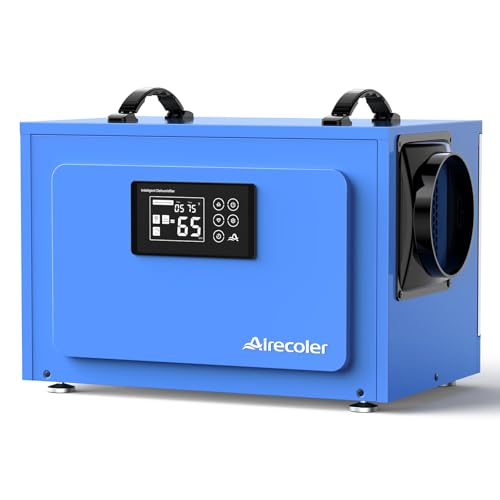
- Compact design for low-clearance spaces
- 265 CFM airflow with continuous operation
- Auto drain, defrost, restart, and timer included
Best For: Crawl spaces and basements with limited installation room
Restoration Ready
ALORAIR Storm LGR Extreme Dehumidifier

- Up to 180 pints per day at saturation
- Built-in pump with 14.7-foot vertical lift
- 210 CFM airflow for drying applications
Best For: Water-damage restoration and commercial drying jobs
Crawl-Space Specialist
Moiswell Defender M145 Commercial Dehumidifier
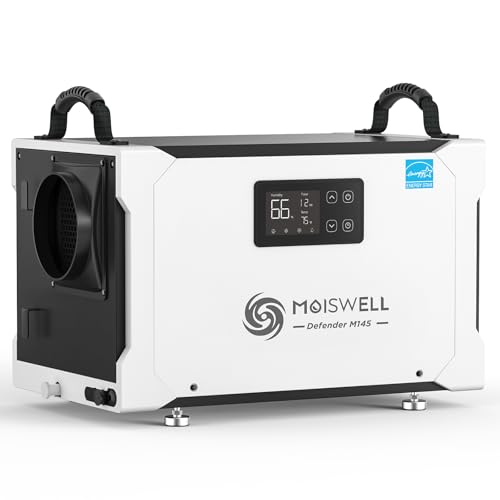
- Horizontal design fits between floor joists
- Up to 155 pints per day maximum capacity
- 265 CFM airflow with auto drain and restart
Best For: Low-clearance crawl spaces and tight basements
Maximum-Capacity Pick
305-Pint Commercial Dehumidifier

- 305-pint capacity with 412 CFM airflow
- 16.4-foot built-in pump drainage
- Automatic controls and mobile job-site design
Best For: Large facilities, restoration, and extreme humidity
Efficiency Pick
155-Pint Energy Star Commercial Dehumidifier

- Energy Star certified at 860 watts
- Built-in pump with 16.4-foot drainage
- Auto defrost and set-and-forget controls
Best For: Long-duration basement, crawl-space, and office use
Mobility Pick
200-Pint Commercial Dehumidifier

- 200-pint capacity with built-in pump
- Large 8-inch wheels and detachable handles
- Automatic defrost for demanding environments
Best For: Construction sites and frequently relocated drying jobs
Top Pick
Waykar 150 Pint Commercial Dehumidifier

- Covers spaces up to 7,000 sq. ft.
- Built-in pump plus gravity-drain options
- Energy Star, auto-defrost, and self-drying
Best For: Large basements and flexible drainage setups
Maximum Coverage
Sijipt POWER 260 Commercial Dehumidifier

- Covers up to 8,500 sq. ft.
- 425 CFM airflow for rapid drying
- 16.4-foot pump lift and heavy-duty wheels
Best For: Large facilities and restoration projects
Best Simple Pick
Pioneer-XI 160 Pint Commercial Dehumidifier

- 160-pint rating for spaces up to 7,000 sq. ft.
- 16.4-foot pump hose included
- 10-inch wheels and detachable handles
Best For: Mobile drying on construction sites and rough floors
Efficiency Leader – AEOCKY 8000-Sq.-Ft. Commercial Dehumidifier
For buyers comparing commercial dehumidifiers for large homes, basements, or demanding moisture conditions, the AEOCKY RHEA-003 stands out for its ENERGY STAR Most Efficient 2025 certification and high stated extraction capacity. Its smart humidity control, power-off memory, and low-temperature operation add flexibility for continuous use.
Best For: Large spaces requiring high capacity, energy-conscious operation, and precise humidity management.
Pros:
- Rated for up to 140 pints per day in very humid conditions and 95 pints per day in a warm, damp basement.
- ENERGY STAR Most Efficient 2025 certification is designed to support lower energy use.
- Includes dynamic humidity detection, humidity compensation, and power-off memory.
- Designed to continue operating in lower-temperature environments with automatic defrost sensing.
Cons:
- The supplied notes do not specify the unit’s dimensions, weight, or drainage setup.
- Its advanced capacity may be more than smaller rooms require.
Choose this model when efficiency and high-capacity moisture removal are priorities. Verify installation and drainage requirements before placing it in a basement, crawl space, or other specialized area.
Compact Workhorse – Airecoler GT-X5 125-Pint Commercial Dehumidifier
The Airecoler GT-X5 is one of the more practical commercial dehumidifiers for tight crawl spaces and basements. Its compact footprint, 265 CFM airflow, continuous-drain hose, and automatic restart features make it suited to set-and-forget moisture control in residential, commercial, or industrial areas.
Best For: Low-clearance crawl spaces, basements, garages, warehouses, and other areas needing compact continuous drainage.
Pros:
- Removes up to 125 pints per day at maximum rating and 60 pints at AHAM conditions.
- Compact 19.2-by-12.2-by-13.4-inch design supports flexible placement, including suspension between floor joists.
- Includes a 6.56-foot drain hose, auto drain, auto defrost, timer, and auto restart.
- R32 system is designed for efficient operation, and coverage includes a five-year warranty structure.
Cons:
- The maximum extraction rating is substantially higher than its 60-pint AHAM rating.
- At 50 pounds, it may still require careful handling in overhead or confined installations.
With a compact housing and useful automation, the GT-X5 is a strong fit where installation space is limited. Its included hose simplifies drainage, but buyers should confirm that the hose length and gravity-drain arrangement suit the location.
Restoration Ready – ALORAIR Storm LGR Extreme Dehumidifier
The ALORAIR Storm LGR Extreme is built for restoration work and other demanding applications where commercial dehumidifiers need strong airflow and automatic water removal. Its integrated pump, long drain hose, and automatic defrost make it especially useful for job sites, crawl spaces, warehouses, and water-damage drying.
Best For: Water-damage restoration, commercial drying, and confined spaces requiring pumped condensate removal.
Pros:
- Rated to remove up to 180 pints per day at saturation and 85 PPD at AHAM conditions.
- Provides 210 CFM airflow to support drying performance.
- Built-in pump, 19.6-foot drain hose, and 14.7-foot vertical lift simplify drainage.
- Automatic defrost, auto-restart, memory starting, and a six-year refrigeration-system parts warranty support reduced supervision.
Cons:
- Its 2,300-square-foot stated coverage is smaller than some competing models in this roundup.
- At 64.3 pounds, it is relatively heavy for frequent repositioning.
- The warranty coverage varies by component and service period.
This is the most specialized choice for restoration-oriented work. The integrated pump and long hose are valuable when a nearby floor drain is unavailable, while automatic defrost helps maintain operation in cooler conditions.
Crawl-Space Specialist – Moiswell Defender M145 Commercial Dehumidifier
The Moiswell Defender M145 is a capable option among commercial dehumidifiers for crawl spaces and low-clearance installations. Its horizontal form factor can fit between floor joists, while 265 CFM airflow, automatic drainage, and humidity-based cycling support hands-off moisture control in spaces up to 6,000 square feet.
Best For: Crawl spaces, tight basements, and large residential or light commercial areas needing compact horizontal installation.
Pros:
- Removes up to 155 pints per day at maximum rating and 70 pints per day at AHAM conditions.
- Horizontal 22.5-by-14-by-14.7-inch design supports floor or overhead installation.
- Includes 265 CFM airflow, auto drain, auto defrost, auto restart, and a 24-hour timer.
- ENERGY STAR certified and backed by a five-year limited warranty.
Cons:
- Gravity drainage may require careful positioning and a suitable drain location.
- At 63 pounds, overhead installation may require additional planning or assistance.
- The stated performance varies considerably between maximum and AHAM conditions.
The Defender M145 makes the most sense when a horizontal layout is more important than portability. Its controls and automatic features reduce routine attention, but installation should account for gravity drainage and the unit’s substantial weight.
Maximum-Capacity Pick – 305-Pint Commercial Dehumidifier
For demanding restoration work and very large facilities, this commercial dehumidifier combines a stated 305-pint daily capacity with 412 CFM airflow. Its built-in pump, automatic controls, and job-site mobility make it suited to sustained professional drying.
Best For: Warehouses, factories, large basements, data centers, and water-damage restoration projects requiring high-output moisture removal.
Pros:
- Up to 305 pints per day and 412 CFM airflow for spaces up to 8,500 square feet.
- Built-in pump can drain up to 16.4 feet vertically or horizontally.
- Automatic defrost, auto restart, humidity control, and continuous drainage support unattended operation.
- Swivel casters and multiple handles help with transport between work areas.
Cons:
- At 106.4 pounds, it is substantially heavier than the other options here.
- Requires a 20-amp receptacle and uses a NEMA 5-20 plug.
This is the strongest choice when maximum stated capacity and airflow matter most, provided the installation has the required electrical supply and room for a heavy commercial unit.
Efficiency Pick – 155-Pint Energy Star Commercial Dehumidifier
This commercial dehumidifier offers a practical balance of capacity, energy use, and remote-operation features. It removes up to 155 pints per day under nearly saturated conditions, includes a built-in pump, and is Energy Star certified.
Best For: Basements, crawl spaces, attics, offices, garages, and commercial areas up to 7,500 square feet where efficient long-duration operation is important.
Pros:
- Energy Star certified and rated at 860 watts.
- Built-in pump drains up to 16.4 feet, with an included gravity-drain hose.
- Auto defrost, auto drain, automatic restart, and screen lock support set-and-forget use.
- Compact 59-pound design with a duct collar for flexible applications.
Cons:
- Its 220 CFM airflow and 155-pint capacity are lower than the higher-output models in this roundup.
- The pump and gravity-drain hose have different stated drainage configurations, so installation planning is needed.
Choose this model when energy-conscious operation and convenient automation are higher priorities than maximum drying output.
Mobility Pick – 200-Pint Commercial Dehumidifier
Among these commercial dehumidifiers, the Pioneer-XII stands out for transport-friendly construction. It pairs a stated 200-pint capacity with a built-in pump, large 8-inch wheels, and detachable handles for moving across rough surfaces and job sites.
Best For: Construction sites, warehouses, basements, garages, and water-damage restoration work where the unit must be relocated frequently.
Pros:
- Removes up to 200 pints per day, with a 90-pint AHAM rating.
- Built-in pump and included 16.4-foot hose support flexible drainage.
- Large 8-inch wheels and detachable handles improve portability over uneven terrain.
- Automatic defrost and continuous-drainage mode support extended operation.
Cons:
- At 78 pounds, it is still a substantial unit to lift or carry.
- The supplied details do not state an airflow rating or a specific square-foot coverage figure beyond the listed 7,500-square-foot floor area.
This model makes the most sense for users who need strong moisture removal but expect to move the dehumidifier between rooms, buildings, or demanding outdoor-adjacent work areas.
Top Pick – Waykar 150 Pint Commercial Dehumidifier
For large basements and other sizable indoor spaces, this Waykar is one of the more flexible commercial dehumidifiers in the lineup. It is rated for areas up to 7,000 square feet and offers multiple drainage methods, including a built-in pump, gravity drainage, and its removable water tank.
Best For: Basements, garages, wine cellars, crawl spaces, and other areas up to 7,000 square feet where flexible drainage and automatic humidity control are useful.
Pros:
- Rated to remove up to 150 pints of moisture per day under stated test conditions.
- Built-in pump can lift water up to 9.84 feet, with a drain hose included.
- Energy Star certification, auto-defrost, self-drying, timer, and memory restart.
- Casters, a top handle, swing function, and cord storage support portability.
Cons:
- The 9.84-foot pump lift is lower than some competing models.
- Its 1.85-gallon tank may require frequent emptying when continuous drainage is unavailable.
- The listed 150-pint capacity is based on 95°F and 90% relative humidity conditions.
The Waykar stands out when you want broad coverage without giving up convenient controls or drainage flexibility. It is a practical choice for unattended areas, especially when a floor drain is not immediately available.
Maximum Coverage – Sijipt POWER 260 Commercial Dehumidifier
This Sijipt model is built for especially large or demanding drying jobs. Among these commercial dehumidifiers, it offers the highest stated coverage at up to 8,500 square feet, along with 425 CFM airflow and a pump designed for substantial vertical drainage.
Best For: Large basements, warehouses, gyms, pools, spas, industrial facilities, and restoration or construction-drying projects.
Pros:
- Rated for up to 8,500 square feet with a stated 260-pint saturation capacity.
- Built-in pump lifts water vertically up to 16.4 feet.
- 425 CFM airflow is designed to speed drying and reach moisture in building materials.
- Large pneumatic wheels, universal casters, and a sturdy handle support job-site mobility.
Cons:
- At 94 pounds, it is heavier than the other listed models.
- Its larger commercial footprint may be less convenient in tight residential spaces.
- Capacity specifications vary by testing condition, so real-world output may differ from the saturation rating.
The POWER 260 is the strongest fit when coverage, airflow, and pump lift matter more than compactness. Its heavy-duty wheels and automatic functions make it particularly suited to repeated restoration or industrial use.
Best Simple Pick – Pioneer-XI 160 Pint Commercial Dehumidifier
The Pioneer-XI combines commercial capacity with a relatively manageable 67-pound body. For buyers comparing commercial dehumidifiers for warehouses, construction sites, and basements, its built-in pump, 265 CFM airflow, and large wheels make relocation and continuous drainage straightforward.
Best For: Basements, warehouses, offices, construction sites, and commercial or residential spaces up to 7,000 square feet.
Pros:
- Rated to remove up to 160 pints per day and cover up to 7,000 square feet.
- Built-in pump and included 16.4-foot hose support flexible water removal.
- Large 10-inch rear wheels and detachable handles help with transport over rough or sloped surfaces.
- Automatic defrost and continuous drainage support extended operation.
Cons:
- Its 265 CFM airflow is lower than the 425 CFM rating of the larger POWER 260.
- It does not list Energy Star certification in the supplied specifications.
- The 160-pint rating is provided alongside a lower AHAM capacity, reflecting differing test conditions.
This model is a sensible middle ground for buyers who need commercial-grade drying but expect to move the unit frequently. Its wheels, detachable handles, and long pump hose are especially useful on active work sites.
How We Picked the Best Commercial Dehumidifiers
We focused on the features that matter most in demanding moisture-control environments: stated pint capacity, recommended coverage, pump and drain options, automatic defrost, portability, energy efficiency, controls, and warranty support. Models were selected to represent a range of capacities and use cases, from enclosed crawl spaces to large basements and restoration work.
Capacity claims are typically based on specific temperature and humidity conditions, so they should be treated as comparison points rather than guarantees. Actual performance depends on room temperature, ventilation, insulation, moisture sources, and drainage setup.
Quick Comparison
- For smaller enclosed areas: Consider 125- to 160-pint units when the space is relatively contained and moisture levels are moderate to high.
- For large basements: Models rated from 180 to 260 pints can provide more headroom when the area has persistent moisture or several connected rooms.
- For severe moisture or restoration: A 305-pint model may be appropriate for major water events, very damp structures, or rapid drying needs.
- For unattended operation: Choose a model with a built-in condensate pump, continuous drain connection, automatic restart, and a humidistat.
Key Buying Factors for Commercial Dehumidifiers
Capacity and Coverage
Choose capacity based on both square footage and moisture severity. A poorly sealed basement, wet crawl space, or recently flooded building may need substantially more capacity than a dry, finished area of the same size. Oversizing can help with difficult conditions, but confirm that the unit supports your electrical service and drainage plan.
Drainage and Pump Design
Continuous drainage is usually more practical than relying on a collection tank. A gravity drain works when a floor drain or lower outlet is nearby. A built-in pump is preferable when condensate must travel upward or across the room. Check hose length, fitting size, pump lift, and whether the pump can run continuously.
Operating Conditions and Defrosting
Cold basements and crawl spaces can cause frost to form on the coils. Automatic defrost helps maintain operation in lower temperatures, but it does not make every unit suitable for unheated winter conditions. Review the specified operating range before placing a unit in a cold space.
Controls, Mobility, and Efficiency
A built-in humidistat lets the unit cycle automatically toward a target relative humidity, while automatic restart is useful after a power interruption. Wheels, handles, and a manageable footprint make frequent repositioning easier. Energy-efficient models can reduce operating costs when the dehumidifier runs for long periods.
Warranty and Maintenance
Look for clear warranty terms, accessible filters, washable components, and responsive support. Clean the filter regularly, keep airflow openings unobstructed, inspect drain lines for kinks, and verify that the pump operates correctly before leaving the unit unattended.
Who Should Buy Which Commercial Dehumidifiers?
Homeowners with damp basements should prioritize a humidistat, continuous drainage, automatic restart, and enough capacity for the full connected area. Crawl-space owners should favor compact units with reliable pumps or gravity-drain compatibility and low-temperature operating features.
Contractors and restoration professionals should look for higher pint ratings, rugged portability, rapid moisture removal, and dependable operation during long work cycles. Property managers may benefit from energy-efficient models with simple controls and strong warranty coverage, especially when units will operate unattended across multiple buildings.