Choosing the right commercial reverse osmosis system means balancing purified-water demand, installation space, operating efficiency, and maintenance requirements. The models in this roundup range from compact tankless units for small businesses to high-capacity systems for demanding production environments.
Use the guide below to compare output, recovery ratios, pumping requirements, certifications, and overall fit before you buy.
Best 10 Commercial Reverse Osmosis System Picks for 2026
High-Capacity Pick

- 1,000 GPD commercial output
- Tankless rolling frame with gauges
- Four-stage filtration
Best For: Small businesses needing high-volume purified water
Space-Saving Pick

- 450 GPD tankless output
- Eight-stage filtration with auto-flush
- Under-sink or wall-mounted installation
Best For: Compact installations with convenient automated maintenance
Low-Waste Pick
- 500 GPD commercial capacity
- 1.5:1 pure-to-drain ratio
- Built-in booster pump and pressure gauge
Best For: Light commercial users managing pressure and wastewater
Hydroponics Pick

- Up to 1,000 GPD production
- Two high-flow RO membranes
- Flexible 2:1 or 1:1 waste ratio
Best For: Hydroponic growers and gardeners needing high-volume RO water
Best Light-Commercial Tankless RO

- Up to 300 GPD output
- 1.5:1 pure-to-drain ratio
- Booster pump and stainless frame
Best For: Restaurants, salons, labs, and offices with moderate RO demand
Best Simple Under-Sink RO Value

- Five-stage filtration
- No electricity required
- Tank, leak detector, and extra filters included
Best For: Lower-volume kitchens, offices, and budget-conscious buyers
Best High-Output Commercial RO
- Up to 2,000 GPD output
- Dual booster pumps and pressure gauges
- Auto-rinsing and wheeled stainless frame
Best For: Restaurants, coffee shops, and high-demand commercial installations
Best Certified Space Saver

- NSF/ANSI-certified filtration
- 600 GPD output with 2:1 drain ratio
- Smart faucet and compact tankless design
Best For: Certified, high-capacity filtration where under-sink space is limited
Best High-Output Workhorse
- Up to 1000 GPD capacity
- Booster pump supports low-pressure conditions
- Five-stage filtration for residential or light commercial use
Best For: High daily water demand in offices, busy homes, and light commercial settings
High-Capacity Pick – iSpring CRO1000
The iSpring CRO1000 is a commercial reverse osmosis system built for high-volume water production in restaurants, offices, coffee shops, and other small-business settings. Its tankless, freestanding design delivers up to 1,000 gallons per day at a stated 0.7 GPM flow rate, while built-in gauges help monitor pressure.
Best For: Small businesses and light commercial applications needing high output and mobile, freestanding installation.
Pros:
- Produces up to 1,000 GPD with a commercial-size RO membrane.
- Four-stage filtration includes sediment, dual carbon block, and RO membrane stages.
- Frame with wheels and locking brakes supports convenient positioning and stability.
- Can connect to dispensers, ice makers, refrigerators, espresso machines, and more.
Cons:
- May require the optional booster pump when water pressure is below 80 psi.
- Its 23.5-inch length and freestanding frame require more space than an under-sink unit.
- Filter replacement intervals vary with water quality and require ongoing maintenance.
Choose this model when output and commercial-grade construction matter more than a compact under-counter footprint. The pressure gauges and rolling frame are particularly useful for installations where monitoring and repositioning are practical priorities.
Space-Saving Pick – Waterdrop T3-C
The Waterdrop T3-C is a compact commercial reverse osmosis system for under-sink or wall-mounted installation. It combines 450 GPD output with eight-stage filtration, smart filter alerts, automatic flushing, and a 2:1 pure-to-drain ratio for users who want a streamlined, electrically powered setup.
Best For: Offices, small service areas, and installations where compact sizing, automated maintenance reminders, and water efficiency are important.
Pros:
- Compact tankless design can be installed under a sink or mounted on a wall.
- Eight-stage filtration uses a 0.0001μm RO membrane and targets heavy metals, chlorine, PFOA, and PFOS.
- Smart alerts and quick all-in-one cartridge replacement simplify maintenance.
- Automatic flushing and a 2:1 pure-to-drain ratio support convenient, efficient operation.
Cons:
- Requires an electrical connection to operate.
- Faucet installation requires drilling a countertop hole.
- At 450 GPD, it offers less stated capacity than the higher-output commercial units in this roundup.
This is a practical choice for a space-conscious installation that can accommodate a plug-in system. Its alerts, auto-flush function, and compact footprint reduce some of the routine effort associated with maintaining an RO setup.
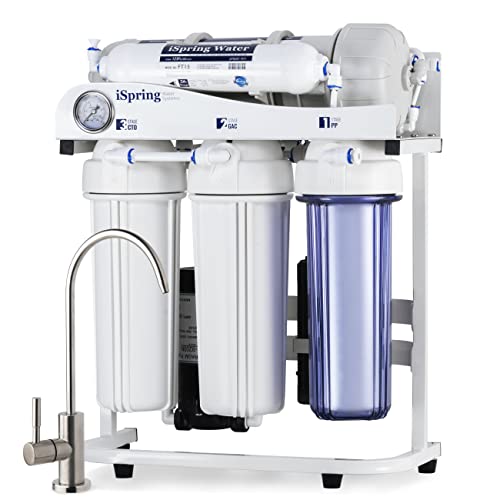
Low-Waste Pick – iSpring RCS5T
The iSpring RCS5T is a commercial reverse osmosis system designed for light commercial use in restaurants, salons, laboratories, and offices. Its 500 GPD capacity, built-in booster pump, pressure gauge, and 1.5:1 pure-to-drain ratio make it suited to users who want steady production with reduced water waste.
Best For: Light commercial under-sink installations with variable water pressure and a focus on water conservation.
Pros:
- 500 GPD membrane and a 1.5:1 pure-to-drain ratio help limit wastewater.
- Built-in booster pump supports RO production when incoming pressure is low.
- Five-stage filtration addresses sediment, chlorine, PFAS, heavy metals, pesticide residues, tastes, and odors.
- Includes a swivel faucet and easy-to-read pressure gauge.
Cons:
- Its stated 0.3 GPM flow rate is lower than some higher-flow alternatives.
- Under-sink installation may require more planning for the 14-by-11-by-18-inch system.
- The supplied warranty description is limited to 30 days against manufacturer defects.
The RCS5T stands out when a built-in pump and lower-waste operation are more important than maximum output. It is a sensible fit for light commercial users who also want visible pressure monitoring and a dedicated drinking-water faucet.
Hydroponics Pick – HydroLogic Evolution RO
The HydroLogic Evolution RO is a high-flow commercial reverse osmosis system intended especially for hydroponic water filtration and gardening. It can produce up to 1,000 gallons per day, reduces total dissolved solids by more than 95%, and includes a KDF/catalytic carbon pre-filter for several common contaminants.
Best For: Hydroponic growers and gardeners needing high-volume purified water with flexible waste-water settings.
Pros:
- Produces up to 1,000 GPD, or approximately 42 gallons per hour, at standard line pressure.
- Two high-flow RO membranes support high-volume production.
- Custom KDF/catalytic carbon filtration targets chlorine, chloramines, iron, sulfur, and heavy metals.
- Includes a 2:1 waste-to-product option and an optional 1:1 ratio for reduced waste.
Cons:
- The supplied information emphasizes TDS reduction rather than a specific percentage removal for individual contaminants.
- Its 23-by-13-by-13-inch form factor may require dedicated installation space.
- The system is corded electric and may be less convenient where power is unavailable.
For growers, the Evolution RO pairs high throughput with pre-filtration suited to challenging source water. Its included fittings, pressure gauge, and alternative waste-water configuration add flexibility for garden and hydroponic workflows.
Best Light-Commercial Tankless RO – iSpring RCB3P 300 GPD
For buyers comparing a commercial reverse osmosis system for a restaurant, salon, lab, or office, the iSpring RCB3P emphasizes efficient production in a compact under-sink format. Its booster pump supports up to 300 gallons per day and a 1.5:1 pure-to-drain ratio, while the system reduces up to 99% of more than 1,000 listed contaminants.
Best For: Light-commercial locations needing high-capacity under-sink RO water without a storage tank included.
Pros:
- Produces up to 300 gallons of purified water per day.
- Booster pump helps increase production by raising water pressure.
- 1.5:1 pure-to-drain ratio helps limit wastewater.
- Freestanding stainless steel frame and metal bracket simplify installation and filter changes.
Cons:
- Storage tank is not included.
- Designed for residential and light-commercial use rather than the highest-volume commercial demands.
The RCB3P is a practical middle ground when a standard under-sink RO unit is too limited but a large freestanding commercial system is unnecessary. Confirm that its 300 GPD capacity and tank compatibility fit your water-demand schedule.
Best Simple Under-Sink RO Value – Express Water 50 GPD
If you need a commercial reverse osmosis system for a small workplace or primarily residential use, the Express Water five-stage system offers a straightforward, pressure-powered design. It produces up to 50 gallons per day, includes a 3.2-gallon tank and extra filters, and requires no electricity.
Best For: Lower-volume users who want an easy-to-install under-sink RO system with included accessories and upgrade options.
Pros:
- Five-stage filtration reduces up to 99.99% of listed impurities, including lead, PFAS/PFOs, fluoride, and arsenic.
- Runs on water pressure without electricity.
- Includes a chrome faucet, 3.2-gallon tank, leak detector, and extra filter set.
- Quick-connect design supports customization with optional UV, alkaline, or deionization attachments.
Cons:
- 50 GPD capacity is substantially lower than commercial high-output systems.
- Under-sink tank design uses more cabinet space than a tankless unit.
This system is best viewed as an accessible, lower-capacity option rather than a heavy-duty commercial water source. Its no-electricity design and included extras make it appealing when installation simplicity and value matter more than maximum throughput.
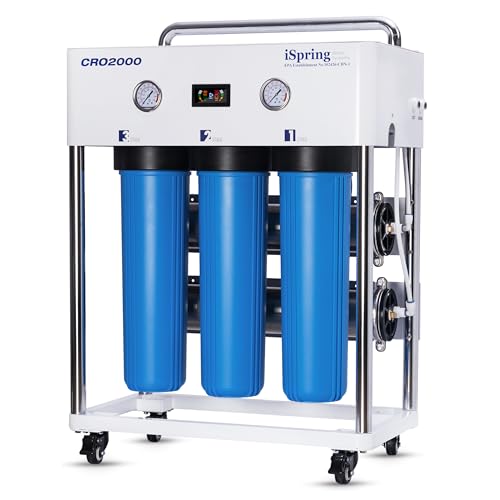
Best High-Output Commercial RO – iSpring CRO2000 2000 GPD
For demanding commercial applications, the iSpring CRO2000 is the most capable commercial reverse osmosis system in this roundup. Its four-stage design delivers up to 2,000 gallons per day at up to 1.4 GPM, while dual booster pumps, pressure gauges, and auto-rinsing support consistent operation and maintenance.
Best For: Restaurants, coffee shops, and other commercial settings requiring high daily RO output and a freestanding installation.
Pros:
- Up to 2,000 gallons per day with a 2:1 pure-to-waste ratio.
- Dual booster pumps help address low water pressure below 45 psi.
- Auto-rinsing helps flush the membrane and may extend membrane life up to three years.
- Pressure gauges, overload protection, wheels, and locking brakes support monitoring and mobility.
Cons:
- Large freestanding design requires substantially more space than an under-sink system.
- Ships in two separate packages.
- Its 40–70 psi operating range and 500 ppm maximum supported TDS should be checked against site conditions.
The CRO2000 is the clear choice when production capacity and commercial controls outweigh compactness. Its stainless-steel wheeled frame and automated membrane rinsing make it especially practical for facilities that need a movable, serviceable high-output system.
Best Certified Space Saver – Waterdrop G3P600 Tankless RO
The Waterdrop G3P600 is a strong commercial reverse osmosis system option for kitchens, offices, or other settings that need high output without a storage tank. Its 600 GPD capacity, smart faucet, and 2:1 pure-to-drain ratio balance performance with efficient under-sink use.
Best For: Buyers who want certified filtration, fast dispensing, and a compact tankless design.
Pros:
- NSF/ANSI 58, 372, and 42 certifications cover TDS reduction, lead-free materials, chlorine, taste, and odor.
- 600 GPD capacity and an 8-ounce fill time of about 8 seconds support frequent use.
- Smart faucet displays TDS and filter life, while tool-free filter changes simplify maintenance.
- Tankless construction saves approximately 70% of under-sink space.
Cons:
- Requires under-sink electricity.
- Cabinet space must accommodate its 18.12 by 5.67 by 17.72-inch footprint.
Choose this model when certifications, monitoring, and space efficiency matter as much as output. Its 600 GPD rating suits demanding home or light commercial use, though the electrical requirement should be confirmed before installation.
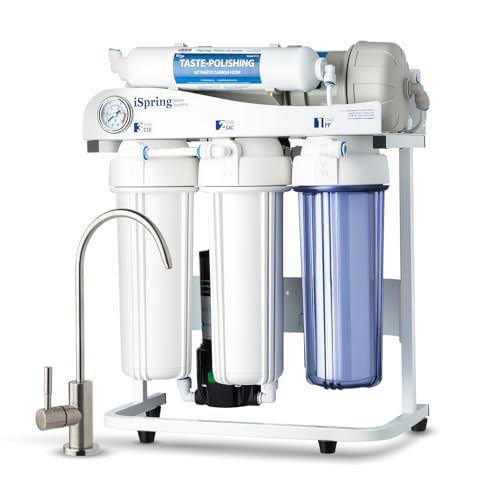
Best High-Output Workhorse – iSpring RCS10T 1000 GPD RO
The iSpring RCS10T is a high-output commercial reverse osmosis system designed for residential kitchens, offices, and light commercial applications. Its 1000 GPD capacity, booster pump, and tankless format are aimed at users with steady daily water demand.
Best For: Offices, busy households, and light commercial settings needing maximum listed capacity.
Pros:
- Produces up to 1000 gallons per day for higher-demand applications.
- Five-stage filtration is designed to reduce up to 99% of more than 1,000 common contaminants.
- High-efficiency booster pump helps maintain performance in low water pressure conditions.
- Quick-fitting connections, manuals, and setup videos support DIY installation.
Cons:
- Its 15.55 by 8.66 by 19.29-inch size may require careful cabinet planning.
- Maximum supported feed-water TDS is listed as 300 ppm.
The RCS10T stands out when production capacity is the priority. The booster pump adds useful flexibility for lower-pressure installations, while the documented filter replacement schedule helps plan ongoing maintenance.
Best Water-Saving Choice – ANGEL X2 700 GPD Tankless RO
The ANGEL X2 is a compact commercial reverse osmosis system for buyers who want fast dispensing and a lower pure-to-drain ratio. It combines 700 GPD output with seven-stage filtration, a slim 4.72-inch profile, and tool-free filter replacement.
Best For: Space-conscious households or small workplaces prioritizing flow speed and reduced wastewater.
Pros:
- CSA-tested to meet NSF/ANSI 58, 42, and 372 standards for filtration performance and material safety.
- 2.5:1 pure-to-drain ratio is designed to reduce water waste compared with 2:1 systems.
- 700 GPD capacity and a stated 0.5 GPM flow rate can fill a 6-ounce glass in about 5 seconds.
- Filters can be replaced in as little as 2 seconds without tools or moving the unit.
Cons:
- Installation requires an under-sink drain outlet and countertop faucet hole.
- The slim unit still needs cabinet dimensions of approximately 14.17 by 4.72 by 14.49 inches.
This ANGEL model is especially compelling where wastewater reduction and cabinet space are important. Its included faucet and installation accessories simplify setup, but confirm the drain and faucet-hole requirements first.
How We Picked These Commercial Reverse Osmosis Systems
We selected systems representing a range of commercial and high-demand applications, including restaurants, offices, light industrial use, hydroponics, and residential-commercial installations. Our comparison emphasizes stated daily production, filtration design, pure-to-drain ratios, pump configuration, installation format, and practical maintenance considerations.
Capacity claims are important, but real-world output can vary with feed-water temperature, pressure, quality, and incoming total dissolved solids. We also considered whether each system is tankless, whether it requires a dedicated electrical connection, and how easily replacement filters and membranes can be sourced.
Quick Comparison
| Best For | Recommended Type | What to Prioritize |
|---|---|---|
| Small restaurants and offices | 300–600 GPD tankless unit | Compact design, booster pump, easy filter changes |
| Higher-volume food service | 1,000–2,000 GPD commercial system | Flow rate, pressure gauges, dual pumps, recovery ratio |
| Hydroponic or production use | High-flow dedicated RO system | Output consistency, pretreatment, membrane availability |
| Drinking-water installation | Multi-stage under-sink RO system | Certification, faucet compatibility, included filters |
Key Buying Factors for a Commercial Reverse Osmosis System
Capacity and Peak Demand
Choose a system based on your busiest operating period, not average daily use. A restaurant, café, or workspace may need reserve capacity for simultaneous beverage service, food preparation, and ice production. Higher-rated systems can also recover more quickly after heavy use.
Water Efficiency
Check the stated pure-to-drain ratio. A 1.5:1 ratio generally wastes less water than older designs, although actual performance depends on feed pressure and water conditions. Where wastewater matters, compare recovery claims rather than looking only at GPD.
Pressure and Electrical Requirements
Booster pumps help maintain membrane performance when incoming pressure is low or inconsistent. Confirm voltage, plug requirements, installation clearance, and whether the unit needs a dedicated outlet before ordering.
Filtration, Certification, and Maintenance
Look for appropriate sediment and carbon prefilters, a membrane sized for the application, and clearly available replacement cartridges. NSF certification or component-level certification can be valuable when compliance and verified contaminant reduction matter. Follow the manufacturer’s replacement schedule and sanitize storage or delivery components as recommended.
Who Should Buy Which Commercial Reverse Osmosis System?
Choose a Compact Tankless Model
Tankless 300–600 GPD systems suit offices, households with high consumption, cafés, and small businesses that want on-demand water without a large storage tank.
Choose a High-Capacity Commercial Unit
Restaurants, food-service operations, and light-production users should favor 1,000 GPD or higher systems with pressure monitoring and robust pumping when demand is continuous or variable.
Choose a High-Flow Specialty System
Hydroponic growers and water-dependent production setups should prioritize dependable throughput, suitable pretreatment, and replacement membranes over countertop convenience.
Choose a Certified Under-Sink System
For drinking and cooking water with moderate demand, a certified multi-stage under-sink system can provide strong filtration in a smaller installation. Always verify that the selected model’s output and connection hardware match your plumbing and usage needs.