Choosing the right sander can make automotive prep work faster, smoother, and easier to control. The best orbital sanders for automotive work balance finish quality, vibration, pad size, power source, and compatibility with your shop setup.
This roundup compares 10 options for everything from panel preparation and primer sanding to detail work and polishing, with choices for home garages, mobile repairs, and professional body shops.
Best 10 Orbital Sanders for Automotive Work Picks for 2026
Professional Air Power
- 0.28 HP motor reaches 12,000 rpm
- Balanced, low-profile ergonomic design
- Includes Stikit adhesive-disc pad
Best For: Professional automotive shops with compressed air
Cordless Shop Flexibility

- Brushless motor with 8,000–12,000 OPM control
- Low-profile body and comfortable overmold grip
- Tool-only package with dust-collection support
Best For: DEWALT 20V MAX users needing portable sanding
Accessory-Packed Pneumatic Value

- Includes 5- and 6-inch backing plates
- Speed control up to 10,000 rpm
- Supplied with abrasives, polishing pads, and dust bag
Best For: DIY refinishing and multipurpose air-tool projects
Reliable Corded Control
DEWALT 5-Inch Orbital Sander Kit
- 3-amp motor provides 12,000 OPM
- Counterweight helps reduce vibration
- Includes dust bag and carrying bag
Best For: Garage and shop users wanting consistent corded power
Lightweight Air Workhorse
Professional 6-Inch Air Random Orbital Sander

- 12,000 RPM pneumatic motor
- Low-vibration, balanced design
- Lightweight for overhead sanding
Best For: Extended automotive sanding and surface preparation
Vacuum-Ready Pro Pick
Ingersoll Rand 4152 Random Orbital Air Sander

- Vacuum-ready 6-inch pad
- 12,000 RPM with 3/16-inch orbit
- Lightweight, low-vibration composite body
Best For: Dust-controlled automotive preparation and finishing
Compact Adjustable Option
5-Inch Air Palm Random Orbital Sander

- 10,000 RPM adjustable-speed motor
- 5-inch hook-and-loop pad
- Dual-action palm-grip design
Best For: Compact automotive body prep and finishing
Best Kit for Full-Size Auto Prep
5-Inch Air Random Orbital Sander Kit

- Includes sanding, polishing, and wool pads
- Semi-industrial design for extended use
- Requires 12 CFM airflow for continuous operation
Best For: Auto-body preparation and sanding-to-polishing workflows
Best Heavy-Duty Palm Sander
Professional Air Random Orbital Palm Sander

- 12,000 RPM free speed with a 5-inch pad
- Built-in regulator for speed control
- Lighter assembly suits vertical and overhead sanding
Best For: Heavy-duty auto sanding with an existing air system
Best for Tight Automotive Areas
Mini 1/2/3-Inch Air Orbital Sander

- Three backing plates cover 1-, 2-, and 3-inch work
- Includes 60 sanding and polishing pieces
- Uses 3–5 CFM at 90 PSI
Best For: Detail work and sanding in confined automotive areas
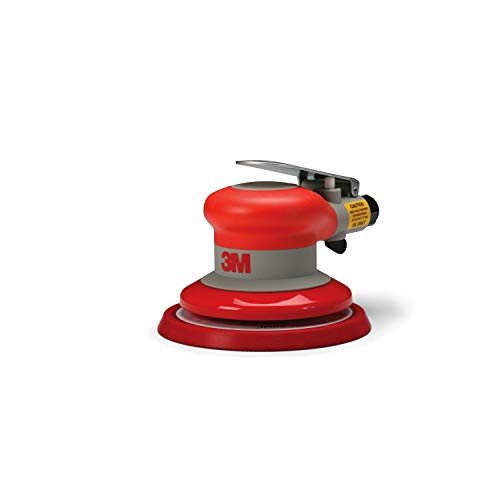
Professional Air Power – 3M 5-Inch Pneumatic Sander
For automotive work that demands extended sanding and finishing, the 3M 20317 is a professional pneumatic option with a 5-inch pad and 3/16-inch orbit. Its balanced, low-profile design is intended to support control and comfort while working on metal, composites, and painted surfaces.
Best For: Automotive professionals with a suitable compressed-air setup who need a durable sander for sustained surface preparation and finishing.
Pros:
- Powerful 0.28 HP motor and up to 12,000 rpm for sanding and finishing applications.
- Precision-balanced motor, low-profile body, and composite cover support smoother, more comfortable operation.
- Includes a 3M Stikit disc pad for adhesive-backed sanding discs.
- Aluminum body is designed for durability in demanding work environments.
Cons:
- Requires an air supply rather than operating from a battery or standard electrical outlet.
- Non-vacuum design does not provide integrated dust extraction.
- Listed for industrial or occupational use, not consumer sale or use.
The 3M 20317 is a focused choice among orbital sanders for automotive work when pneumatic power, durability, and smooth handling matter more than cordless convenience or built-in vacuum collection.
Cordless Shop Flexibility – DEWALT 20V MAX Orbital Sander
DEWALT 20V MAX Orbital Sander, Tool Only (DCW210B) | Brushless motor, dust collection
Check Price On AmazonThe DEWALT DCW210B is a cordless 5-inch random orbital sander for automotive work where mobility and quick setup are priorities. Its brushless motor, variable speed, and low-profile body make it adaptable to different sanding applications, though the tool-only package requires a compatible 20V MAX battery and charger.
Best For: Users who already own DEWALT 20V MAX batteries and want a portable sander for work around a vehicle or shop.
Pros:
- Brushless motor is designed for runtime and efficiency.
- Variable speed from 8,000 to 12,000 OPM helps match sanding speed to the application.
- Low-profile design and rubber overmold grip support close, comfortable work.
- Dust-sealed switch and dust-collection options improve long-term usability.
Cons:
- Sold as a tool only; battery and charger are not included.
- Dust collectors and the universal hose connector may require separate purchases.
- Battery operation can require charging or spare batteries during extended jobs.
For cordless convenience, the DCW210B is one of the more flexible orbital sanders for automotive work, especially in a DEWALT battery system. Its adjustable speed and dust-port compatibility broaden its usefulness beyond basic spot sanding.
Accessory-Packed Pneumatic Value – ZFE 5/6-Inch Air Sander Kit
The ZFE pneumatic random orbital sander is a versatile option for automotive work involving paint surfaces, metal, fiberglass, and general refinishing. It includes both 5- and 6-inch backing plates, sanding discs, polishing pads, and a dust bag, giving project-focused buyers a broad starting kit.
Best For: DIY users and workshops that want one pneumatic kit for sanding, polishing, deburring, and light surface-restoration tasks.
Pros:
- Includes 5- and 6-inch backing plates for added pad-size flexibility.
- Integrated regulator supports speed control up to 10,000 rpm.
- Lightweight 1.5-pound design and ergonomic palm form can reduce hand fatigue.
- Accessory set includes 24 sandpapers, polishing pads, microfiber cloths, and a dust bag with hose.
Cons:
- Requires a pneumatic air source.
- Maximum speed is lower than the 12,000-rpm models in this roundup.
- The included accessory mix may be less specialized than buying automotive-specific abrasives separately.
The ZFE stands out among orbital sanders for automotive work as a cost-conscious, multipurpose kit. Its included accessories and two backing plates are useful for getting started, while the pneumatic design suits users already equipped for air tools.
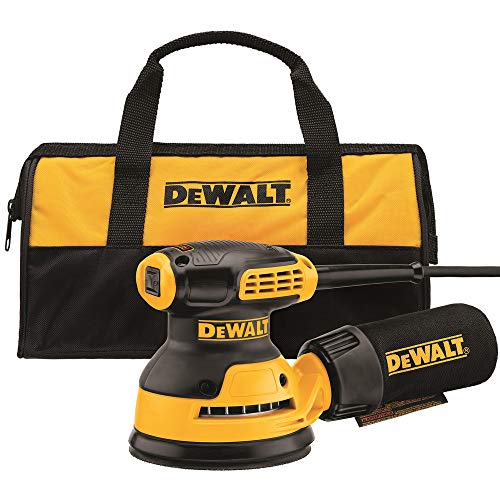
Reliable Corded Control – DEWALT 5-Inch Orbital Sander Kit
The DEWALT DWE6421K is a corded 5-inch random orbital sander for automotive work where consistent power and straightforward operation are more important than battery mobility. Its 3-amp motor delivers 12,000 OPM, while vibration-reduction features and a dust-sealed switch support longer sanding sessions.
Best For: Garage and shop users who want dependable corded performance with a carrying bag and dust bag included.
Pros:
- 3-amp motor delivers a consistent 12,000 OPM.
- Shorter height helps bring the user closer to the work surface.
- Separate counterweight and rubber overmold areas help improve comfort and control.
- Dust collection works with the included locking dust bag and compatible DEWALT dust collectors.
Cons:
- Corded operation limits mobility around a vehicle.
- One fixed top speed offers less adjustment than variable-speed models.
- Connection to other vacuum systems may require the DWV9000 universal quick connector.
The DWE6421K is a practical middle ground among orbital sanders for automotive work: it avoids battery-management concerns while offering strong 12,000-OPM performance, vibration control, and useful dust-collection compatibility.
Lightweight Air Workhorse – Professional 6-Inch Air Random Orbital Sander
For automotive work, this professional 6-inch air random orbital sander emphasizes low vibration, balance, and easy handling. Its 12,000 RPM motor and lightweight air-motor assembly make it suitable for extended sanding, including vertical and overhead applications.
Best For: Automotive surface preparation and extended sanding where low vibration and balanced handling matter.
Pros:
- Lightweight 1 kg design with a low center of gravity.
- 12,000 RPM operation and a 6-inch sanding pad support efficient coverage.
- Low-vibration construction is designed to help produce swirl-free finishes.
- Heat-treated cast steel cylinder offers durability and power strength.
Cons:
- Requires an air compressor rather than operating on battery power.
- Its 6-inch format may be less convenient for tight or highly contoured areas than a smaller sander.
This is a practical choice when you want broad pad coverage, pneumatic power, and reduced vibration without a heavy tool. Confirm that your compressor and air setup are appropriate before buying.
Vacuum-Ready Pro Pick – Ingersoll Rand 4152 Random Orbital Air Sander
The Ingersoll Rand 4152 is a strong option among orbital sanders for automotive work when dust extraction and finish quality are priorities. Its 6-inch pad, 12,000 RPM motor, and 3/16-inch orbit are paired with a precision-ground counterbalance to improve control and reduce vibration.
Best For: Professional-style automotive prep where vacuum compatibility, smooth finishing, and comfort are important.
Pros:
- Vacuum-ready design connects with central or portable vacuum systems.
- 12,000 RPM motor and 3/16-inch orbit are intended for fast, smooth preparation.
- Lightweight composite construction weighs less than 2 pounds.
- Precision-ground counterbalance helps reduce vibration and improve control.
Cons:
- Air-powered operation requires a suitable compressor.
- The 6-inch pad is less suited to very small or confined sanding areas.
Choose this model if integrated dust-management capability and ergonomic control are more important than cordless convenience. Its stated durability testing and one-year warranty add useful reassurance for regular use.
Compact Adjustable Option – 5-Inch Air Palm Random Orbital Sander
This 5-inch pneumatic sander is a compact choice for orbital sanders for automotive work, combining a dual-action motion with adjustable speed and a standard hook-and-loop pad. Its 10,000 RPM motor and 8 CFM air consumption suit auto-body preparation, metal work, and finishing tasks.
Best For: Automotive body prep and finishing where a smaller 5-inch pad and palm-grip handling are useful.
Pros:
- Dual-action random orbit is designed for swirl-free sanding and polishing.
- Standard 5-inch hook-and-loop pad accepts common sandpaper.
- Lightweight composite palm-grip housing helps reduce fatigue.
- 1/4-inch air inlet and stated 8 CFM consumption support compatibility with many compressors.
Cons:
- Its 10,000 RPM maximum is lower than the 12,000 RPM speed of the other listed models.
- Uses compressed air and therefore depends on an appropriate compressor.
- A 5-inch pad covers less area per pass than a 6-inch model.
This model makes sense when maneuverability and a standard 5-inch abrasive format outweigh maximum coverage. The adjustable speed can also be useful when moving between more aggressive preparation and finer finishing work.
Best Kit for Full-Size Auto Prep – 5-Inch Air Random Orbital Sander Kit
For shoppers comparing orbital sanders for automotive work, this 5-inch pneumatic kit combines a semi-industrial-grade air sander with sanding discs, polishing sponges, and wool pads. Its 3/16-inch orbit and 10,000 RPM free speed suit car repair, body preparation, and finishing tasks, provided you have adequate compressor capacity.
Best For: Auto-body preparation, car repair, and combined sanding and polishing work.
Pros:
- Includes 10 120-grit sandpapers plus 10 sanding and polishing pads.
- Semi-industrial-grade design supports continuous use for several hours.
- Can accept optional 6-inch or PSA backing pads with the appropriate purchase.
- Offers a 10,000 RPM free speed for efficient material removal.
Cons:
- Its 12 CFM airflow requirement calls for a substantial compressor for continuous use.
- The optional 6-inch and PSA pads are not included.
This is a practical choice when you want one air-powered tool for both automotive sanding and polishing. The included accessories add value, but compressor sizing is an important part of the buying decision.
Best Heavy-Duty Palm Sander – Professional Air Random Orbital Palm Sander
Professional Air Random Orbital Palm Sander, Dual Action Pneumatic Sander, Low Vibration, Heavy Duty
Check Price On AmazonThis professional pneumatic palm sander is a focused option among orbital sanders for automotive work. It pairs a 12,000 RPM free speed with a 5-inch hook-and-loop pad, built-in speed regulation, and a lighter air-motor assembly for sanding on vertical or overhead surfaces.
Best For: Heavy-duty automotive sanding where low vibration and maneuverability matter.
Pros:
- 12,000 RPM free speed supports fast sanding.
- Built-in regulator allows speed control during different tasks.
- Lighter air-motor assembly is suited to vertical and overhead applications.
- Rear exhaust and a 5-inch hook-and-loop pad provide a practical shop setup.
Cons:
- Requires a compressed-air supply at 90 PSI and averages 10.5 CFM.
- The supplied specifications identify a sanding pad but do not list included abrasives.
Choose this model if you already have a capable compressor and prefer a straightforward, heavy-duty palm sander. Its regulator and lighter motor assembly make it more adaptable than a fixed-speed design for varied bodywork positions.
Best for Tight Automotive Areas – Mini 1/2/3-Inch Air Orbital Sander
When automotive work involves frames, motorcycle components, or other confined areas, this mini pneumatic sander offers three backing-plate sizes from 1 to 3 inches. It reaches 15,000 RPM, includes 60 assorted sanding and polishing pieces, and uses 3 to 5 CFM at 90 PSI.
Best For: Detail sanding, spot repair, rust removal, and polishing in tight spaces.
Pros:
- Includes 1-, 2-, and 3-inch backing plates for different work areas.
- Comes with 60 pieces in 80, 180, 240, and 320 grits.
- Compact design helps reach automotive frames and motorcycle components.
- 3 to 5 CFM air consumption is relatively modest for a pneumatic tool.
Cons:
- Small plates are less suited to covering broad body panels quickly.
- Its 15,000 RPM speed may require careful adjustment for delicate polishing work.
This is the most specialized option here: its interchangeable mini plates prioritize access and precision over large-area productivity. The included grits and polishing pads make it a flexible choice for detail-oriented automotive tasks.
How We Picked the Best Orbital Sanders for Automotive Work
We selected these sanders based on the features that matter most during automotive repair and refinishing: orbit action, pad size, speed control, vibration management, ergonomics, durability, and power requirements. The list includes pneumatic models suited to compressor-equipped shops, plus corded and cordless sanders for users who prioritize portability or simple setup.
We also considered whether each tool is best suited to broad panel work, primer and paint preparation, metal smoothing, polishing, or detail sanding. Included accessories can add value, but consumable quality and long-term serviceability remain more important than a large accessory count.
Quick Comparison
| Type | Best For | Main Advantage | Watch For |
|---|---|---|---|
| Pneumatic 5-inch | General bodywork | Lightweight, continuous runtime | Requires a suitable compressor |
| Pneumatic 6-inch | Large panels | Greater coverage per pass | Higher air demand and bulk |
| Corded electric | Garages and occasional repairs | Consistent power without batteries | Power cord management |
| Cordless electric | Mobile and remote work | Maximum portability | Battery runtime and added weight |
| Mini pneumatic | Spot repairs and tight areas | Precise access | Not ideal for full panels |
Key Buying Factors for Automotive Sanders
Orbit Size and Pad Diameter
A 5-inch sander is a versatile choice for most automotive panels and easier to control around edges. Six-inch models cover more surface quickly, while smaller one-, two-, or three-inch tools are better for localized repairs and difficult contours. A larger orbit can remove material faster, but a smaller orbit generally offers more controlled finishing.
Air Supply, Power, and Runtime
Pneumatic sanders are often favored in body shops because they are light and can run continuously. Check the tool’s air-consumption rating against your compressor’s delivered CFM at the required PSI; tank size alone is not enough. Corded models provide reliable workshop power, while cordless units are convenient where outlets or air lines are unavailable.
Dust Collection and Vibration
Dust extraction is especially valuable when sanding primer, paint, and filler. Confirm whether the sander supports vacuum-assisted operation or uses a non-vacuum design. Low vibration improves control and reduces fatigue during long sessions, but correct grip pressure and fresh abrasives matter just as much.
Speed Control and Accessories
Variable speed helps when switching between aggressive material removal and final surface preparation. Match the backing plate and abrasive discs to the job, and verify whether replacement pads, hook-and-loop discs, polishing accessories, and fittings are readily available.
Who Should Buy Which Orbital Sanders for Automotive Work?
Choose a pneumatic 5-inch model if you already own a capable compressor and want a lightweight everyday tool for bodywork. A 6-inch pneumatic sander makes more sense for frequent work on large panels. Pick a corded electric model for a straightforward home-garage setup, or a cordless model when portability is the priority.
For spot repairs, wheel-arch work, and tight contours, a mini pneumatic sander can be more useful than a full-size tool. Whichever option you choose, use automotive-rated abrasives, wear appropriate respiratory and eye protection, and follow the manufacturer’s air-pressure, pad, and dust-control requirements.