Choosing the best smart lock for an office means balancing secure access with simple day-to-day management. Keypad, fingerprint, app, and Wi-Fi features can reduce lost-key problems while making it easier to grant or remove access.
This roundup compares 10 office-ready smart locks and multifunction entry systems, followed by practical buying advice for selecting the right fit for your door, staff, and security priorities.
Best 10 Smart Lock for Office Picks for 2026
Best Flexible Entry

- Multiple entry methods
- Optional remote management
- Reversible handle and DIY install
Best For: Small offices and shared spaces
Best Built-In Wi-Fi Knob

- Built-in Wi-Fi control
- Fingerprint and passcode entry
- Up to 8-month battery life
Best For: Private offices and side-entry doors
Best for Access Codes

- Supports up to 200 codes
- App activity monitoring
- No-drilling standard-size installation
Best For: Small offices with rotating users
Best Complete Handle Set
- No hub needed for 2.4GHz Wi-Fi
- Recurring and one-time PINs
- Handle set included
Best For: Small offices needing scheduled access
Best Wi-Fi Fingerprint Pick
- 0.3-second fingerprint unlocking
- Built-in Wi-Fi for remote management
- Five-plus months of battery life
Best For: Interior office doors needing fast biometric access
Best Multi-Method Option

- Five entry methods for flexible access
- Supports up to 300 users
- Gateway enables remote Wi-Fi control
Best For: Shared offices with varied user access needs
Best Keypad Entry Pick

- Fingerprint, passcode, and app access
- Built-in Wi-Fi with event history
- No-drill installation for left- or right-hand doors
Best For: Office doors needing keypad access and remote notifications
Best All-Around Pick
Philips Wi-Fi Fingerprint Smart Lock

- Fingerprint, app, PIN, voice, and key access
- Up to 100 passcodes with scheduling options
- Built-in Wi-Fi with remote access logs
Best For: Small offices needing flexible, remotely managed access
Best Simple Installation

- No app, Wi-Fi, or Bluetooth required
- Supports up to 20 personalized access codes
- Quick screwdriver installation with reversible handle
Best For: Small offices wanting simple PIN-based entry
Best for Flexible Credentials

- Eight access methods, including fingerprints and IC cards
- App logs and remote control available with G2 gateway
- IP64-rated, reversible, screwdriver installation
Best For: Offices and property managers needing varied credentials
Best Flexible Entry – Sifely Fingerprint Smart Lock
For shoppers comparing a smart lock for office use, the Sifely model combines fingerprint entry, passcodes, app control, key cards, fobs, and physical keys. Its optional Wi-Fi gateway adds remote management, while the reversible handle and no-extra-drilling installation support a range of standard doors.
Best For: Small offices, rental properties, and shared spaces needing several access methods.
Pros:
- Supports fingerprints, passcodes, app access, fobs, key cards, and keys.
- App and optional Wi-Fi gateway support remote access logs and user management.
- DIY installation is designed for most standard doors, with a reversible handle.
Cons:
- Remote access and voice-control features require the optional Sifely Wi-Fi Gateway.
- The product is described as a deadbolt-style lock, so door compatibility should be checked before purchase.
This is a versatile choice when an office needs flexible credentials and remote administration, but buyers should confirm the existing door setup and budget for the gateway if off-site control is important.
Best Built-In Wi-Fi Knob – DESLOC D212 Smart Lock
The DESLOC D212 is a practical smart lock for office interiors, side-entry doors, and private workspaces. Its built-in Wi-Fi enables remote app control without relying on a separate gateway, while fingerprint, passcode, and key access accommodate different users.
Best For: Private offices, home offices, and side-entry doors where a knob-style replacement is appropriate.
Pros:
- Built-in Wi-Fi supports remote locking, unlocking, activity records, temporary codes, and permissions.
- Offers fingerprint, passcode, app, and backup-key entry.
- Aluminum alloy construction, tempered glass keypad, IPX4 resistance, and BHMA Grade 3 certification.
- Auto-lock can be set from 5 to 120 seconds.
Cons:
- The knob format may not suit doors requiring a conventional deadbolt.
- Its listed recommended uses focus on personal and side-entry spaces rather than larger commercial access systems.
With long stated battery life and built-in Wi-Fi, the D212 offers a streamlined setup for a small office or private workspace. Verify that the existing door accepts its integrated knob design before ordering.
Best for Access Codes – Tapo DL100 Smart Deadbolt
The Tapo DL100 is a strong smart lock for office doors where administrators need multiple codes and activity visibility. It supports up to 200 customizable passcodes, app-based access management, remote control, and tactile buttons that are easy to use without carrying keys.
Best For: Small offices, visitor access, and teams that need numerous customizable entry codes.
Pros:
- Stores up to 200 customizable codes and supports user groups in the app.
- Provides real-time alerts, door-status checks, remote control, and timestamped activity history.
- Offers Bluetooth, Wi-Fi, voice control with PIN verification, and two backup keys.
- Includes auto-lock, PIN-attempt limiting, USB-C emergency power, and a backlit keypad.
Cons:
- Uses a deadbolt format, so compatibility with the office door must be confirmed.
- Battery life is stated as up to 200 days in Wi-Fi mode or 300 days in Bluetooth mode, depending on use.
The DL100 stands out for code capacity and access tracking, making it well suited to a small team or rotating visitors. Its standard lock-hole compatibility and no-drilling installation can simplify replacement, provided the measurements match.
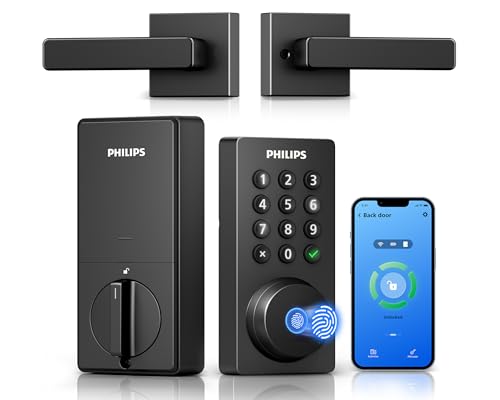
Best Complete Handle Set – Philips Wi-Fi Keypad Deadbolt
The Philips 4200 Series is a smart lock for office entry when you want a complete deadbolt-and-handle set with direct 2.4GHz Wi-Fi. Its app supports remote control, access history, fingerprints, and several types of PIN codes, including recurring and one-time options.
Best For: Small offices and front-entry upgrades needing recurring codes and a matching handle.
Pros:
- Built-in Wi-Fi connects directly to a 2.4GHz network without a hub.
- Supports permanent, one-time, periodic, and recurring PIN codes.
- Offers fingerprint unlocking, app access history, remote control, and voice-assistant compatibility.
- Includes a matching handle set and supports auto-lock settings from 0 to 180 seconds.
Cons:
- Batteries are not included, and the manufacturer recommends standard 1.5V alkaline batteries.
- Wi-Fi connection guidance calls for placement within 33 feet of the router.
- It is designed for right-opening doors by default and may require resetting for left-opening doors.
This Philips model is appealing when the office needs flexible scheduled access and a coordinated handle set. Check door thickness, swing direction, and router placement during planning.
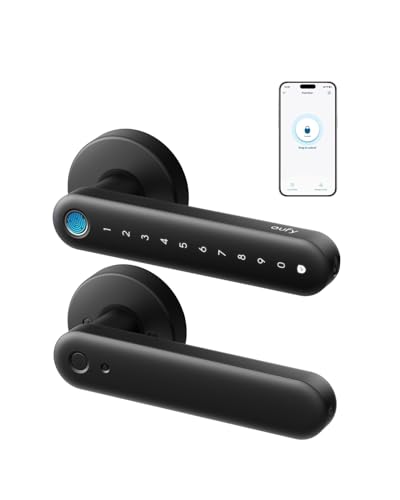
Best Wi-Fi Fingerprint Pick – eufy FamiLock C32
For an interior office door, the eufy Security FamiLock C32 is a practical smart lock for office use when fast fingerprint entry and remote management are priorities. Its built-in Wi-Fi supports app-based authorization and management without requiring a separate gateway.
Best For: Interior office doors, storerooms, and teams that want quick biometric access with remote control.
Pros:
- Unlocks by fingerprint in about 0.3 seconds and supports self-learning recognition.
- Built-in 2.4 GHz Wi-Fi enables remote authorization and lock management.
- Four AA batteries last over five months, with USB-C emergency backup power.
- Installs in about 15 minutes using only a screwdriver.
Cons:
- Not recommended for front doors.
- Rekeying is not supported.
- Uses four AA batteries rather than a rechargeable battery.
The C32 stands out for offices needing quick, low-friction entry and remote oversight. Its interior-door focus makes it better suited to private rooms, storage areas, and workplace side entrances than exposed front-door applications.
Best Multi-Method Option – Harfo 5-in-1 Smart Door Lock
The Harfo 5-in-1 lock is a flexible smart lock for office settings where different users need different ways to enter. Fingerprints, passcodes, IC cards, app control, and physical keys provide multiple access options, while optional gateway pairing adds remote Wi-Fi management.
Best For: Offices with multiple users, varied access preferences, and reversible left- or right-handed doors.
Pros:
- Offers five entry methods: fingerprint, passcode, IC card, app, and physical key.
- Supports up to 300 users across fingerprints, passcodes, and IC cards.
- Can create permanent, one-time, or customized passcodes.
- Fits doors 35–55 mm thick and installs with a Phillips screwdriver.
Cons:
- Remote Wi-Fi access requires a Harfo gateway sold separately.
- Four AA alkaline batteries are required but not included.
- Rechargeable batteries are not recommended.
This model is especially adaptable for shared offices because administrators can combine cards, codes, and biometrics. Budget separately for the gateway if remote access, records, or voice control are essential.
Best Keypad Entry Pick – eufy Security C33
The eufy Security C33 is a convenient smart lock for office doors that need keypad, fingerprint, and app access in one unit. Built-in Wi-Fi supports remote control, notifications, access management, and event history, while the handle-integrated fingerprint reader keeps everyday entry simple.
Best For: Office, garage, side, or basement doors where keypad access and remote activity tracking are useful.
Pros:
- Combines fingerprint, passcode, and app-based access.
- Built-in Wi-Fi provides remote control, notifications, and event history.
- Installs in about 15 minutes without drilling and works with left- or right-hand doors.
- Includes auto-lock, anti-peeping password, and a backlit keypad.
Cons:
- Uses eight AA batteries.
- Its listed recommended uses emphasize residential and utility doors rather than dedicated commercial entry systems.
- It is a deadbolt-style lock, which may not suit every office door setup.
The C33 is a strong fit when an office needs straightforward code entry plus remote visibility. Confirm that the existing door accepts its deadbolt format before purchase, especially for specialized commercial hardware.
Best All-Around Pick – Philips Wi-Fi Fingerprint Smart Lock
If you need a versatile smart lock for office use, the Philips Upgraded Wi-Fi Smart Lock combines fingerprint access, passcodes, app control, and a physical key backup. Built-in 2.4GHz Wi-Fi enables remote management without a separate hub, while scheduled and temporary codes make it practical for shared access.
Best For: Small offices, rental properties, and households that need multiple access methods and remote code management.
Pros:
- Supports fingerprints, app control, passwords, voice commands, and a physical key.
- Stores up to 50 fingerprints and 100 passcodes, including scheduled and one-time codes.
- Built-in Wi-Fi supports remote locking, unlocking, access logs, and code management without a hub.
- Offers adjustable auto-lock timing, passage mode, and privacy mode.
Cons:
- Requires eight AA alkaline batteries, which are not included.
- Door measurements and clearance must be checked carefully before installation.
- Requires a 2.4GHz Wi-Fi network for connected features.
This is the most feature-rich option here for an office that needs flexible credentials and remote oversight. Its larger code capacity is useful for teams, though the installation requirements and battery count deserve attention before purchase.
Best Simple Installation – NICE DIGI Keypad Handle Lock
For a straightforward smart lock for office setup, this NICE DIGI keypad lock avoids app, Wi-Fi, and Bluetooth requirements. It provides code-based entry, a reversible handle, and a quick screwdriver installation for standard wooden doors.
Best For: Small offices that want shared PIN access without connected features or complicated installation.
Pros:
- Creates up to 20 personalized four- to eight-digit access codes.
- Includes temporary one-time codes and two backup physical keys.
- Offers auto-lock from five to 99 seconds and a passage mode for busy periods.
- Backlit keypad, anti-peeping password entry, and reversible handle support everyday use.
Cons:
- Does not provide app, Wi-Fi, or Bluetooth control.
- Supports fewer codes than the Philips model.
- Four AA batteries are required and are not included.
This lock is a practical choice when the priority is dependable keypad entry rather than remote monitoring. It is especially appealing for offices with a small group of users and standard wooden doors.
Best for Flexible Credentials – MSR X6 Fingerprint Smart Lock
The MSR X6 is a flexible smart lock for office access, offering fingerprints, keypad codes, IC cards, shared eKeys, auto-unlock, and mechanical keys. App-based remote control and Alexa voice control are available when paired with the separately sold G2 Wi-Fi Gateway.
Best For: Offices, rental hosts, and property managers who need varied credentials and may benefit from centralized access management.
Pros:
- Provides eight access methods, including fingerprint, keypad, IC card, eKey, app, and physical key entry.
- TTLock app supports access authorization and real-time unlocking records when connected through the gateway.
- IP64 water resistance and a stated operating range of -35°F to 122°F support varied environments.
- Designed for screwdriver installation without extra drilling, with a reversible handle.
Cons:
- Remote app control and Alexa voice control require the separately sold G2 Wi-Fi Gateway.
- Its many access methods may require more setup and user management than a basic keypad lock.
- Gateway-dependent features add an extra purchase for full connected functionality.
This model stands out when an office needs more than PIN access, especially for managing employees, tenants, or multiple properties. Factor in the gateway cost if remote control and access logs are essential.
How We Picked the Best Smart Lock for Office
We focused on the features that matter most in a workplace: dependable keyless entry, useful access methods, remote management, battery practicality, installation compatibility, and emergency access. The selected models include keypad, fingerprint, app-controlled, Wi-Fi, and combination systems so you can compare different approaches rather than one-size-fits-all designs.
Because office doors vary, verify the product’s dimensions, backset, door thickness requirements, lock type, and handle configuration before ordering. A lock designed for a standard residential deadbolt may not replace a commercial mortise lock or specialized access-control hardware.
Quick Comparison
| Access method | Best for | What to check |
|---|---|---|
| Keypad | Shared offices and teams | Code management, temporary codes, and privacy mode |
| Fingerprint | Frequent users who want fast entry | Enrollment capacity and sensor reliability |
| App and Wi-Fi | Managers needing remote control | Hub requirements, network security, and notifications |
| Key plus electronic access | Users who want a backup option | Key override design and lockout protection |
Key Buying Factors for a Smart Lock for Office
Access Control and User Management
Look for individual PINs or fingerprints when possible instead of sharing one permanent code. Temporary codes, scheduled access, activity logs, and the ability to revoke users are especially useful for contractors, cleaners, and former employees.
Connectivity and Remote Administration
Bluetooth may be sufficient for local unlocking, while built-in Wi-Fi is more convenient for remote control and alerts. Confirm whether the lock connects directly to Wi-Fi or requires a separate hub, and use strong account credentials with two-factor authentication when supported.
Power, Reliability, and Emergency Entry
Check expected battery life, low-battery warnings, and whether the lock supports USB emergency power. A physical key override can be valuable, but store backup keys securely rather than leaving them near the entrance.
Installation and Door Compatibility
Measure the existing bore hole, backset, door thickness, strike alignment, and available clearance. Handles and deadbolts may require different installation steps. If the office has a fire-rated, glass, metal, or commercial-grade door, confirm compatibility or consult a locksmith.
Who Should Buy Which Smart Lock for Office?
Choose a keypad model for a small office with several regular users and no need for biometric entry. A fingerprint lock suits a team that wants quick access without remembering codes, provided every authorized user can enroll reliably. Pick a Wi-Fi model for an owner or administrator who needs remote unlocking, status checks, or access notifications.
If employees, vendors, or guests change frequently, prioritize temporary codes, user revocation, and event history over extra unlocking methods. For a low-tech environment or a door where connectivity is unreliable, select a model with dependable local keypad or fingerprint operation and a clearly defined mechanical or USB backup. Finally, match the lock to the door hardware first; the most feature-rich Smart Lock for Office use is not useful if it cannot be installed securely.