The best battery-powered smart locks make it easier to secure your home without carrying keys. This lineup includes fingerprint, keypad, app-controlled, and smart-home-compatible options for different budgets and entry preferences.
Before choosing, consider battery life, backup access, installation requirements, connectivity, and whether you need remote control or simple keyless entry. The guide below explains the practical differences that matter most.
Best 10 Battery Powered Smart Locks Picks for 2026
Best Adaptive Fingerprint Lock

- Fast fingerprint unlocking with an AI learning scanner
- Built-in Wi-Fi for remote app management
- Up to 8 months of AA-battery use
Best For: Homeowners wanting biometric entry and Wyze app control
Best Hands-Free Apple Smart Lock

- UWB hands-free unlocking for compatible Apple devices
- Matter over Thread supports multiple ecosystems
- Rechargeable battery lasts up to 6 months
Best For: Apple households wanting hands-free smart access
Best Simple Keypad Deadbolt

- Supports 20 user codes plus a one-time guest PIN
- Up to 365 days from four AA batteries
- No app or wireless connectivity required
Best For: Families and rentals wanting offline code access
Best Long-Lasting Rechargeable Lock

- Six access methods, including fingerprint and Wi-Fi
- Up to one year of rechargeable battery life
- Stores up to 100 fingerprints and supports guest codes
Best For: Connected households wanting low-maintenance biometric access
Simple Keypad Pick

- Up to 20 programmable entry codes
- Auto-lock and backlit keypad
- No app, Wi-Fi, or phone setup
Best For: Simple keyless entry without connected features
Fingerprint Smart Pick

- Six unlocking methods, including fingerprint
- Built-in Wi-Fi with remote app control
- Around eight months of battery life
Best For: Connected homes wanting biometric and remote access
High-Capacity Access Pick
Tapo Smart Wi-Fi Deadbolt DL100

- Up to 200 customizable access codes
- Wi-Fi, Bluetooth, app, and voice control
- USB-C emergency power and activity logs
Best For: Shared-access homes needing many codes and monitoring
Best Versatility
Yamiry 5-in-1 Fingerprint Keypad Knob

- Five entry methods: fingerprint, app, code, key fob, and key
- Stores up to 50 passwords, fingerprints, and key fobs
- Optional Wi-Fi gateway supports remote and voice control
Best For: Households wanting flexible access options
Best Heavy-Duty Pick
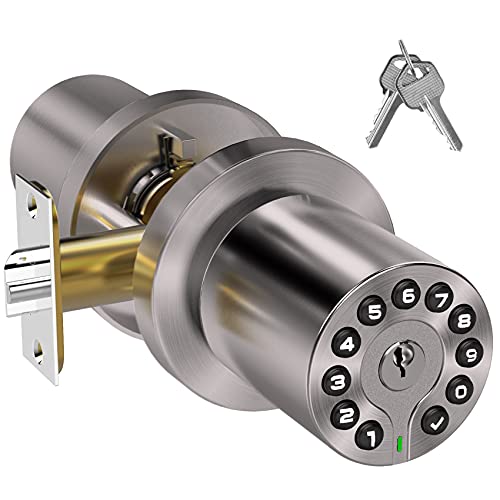
- Stores one master code and up to 50 user codes
- Backlit keypad includes auto-lock and password disguise
- USB-C backup helps when batteries run out
Best For: Homes, offices, bedrooms, and garages needing code entry
Best Indoor Biometric
Foxgard 5-in-1 Fingerprint Lock
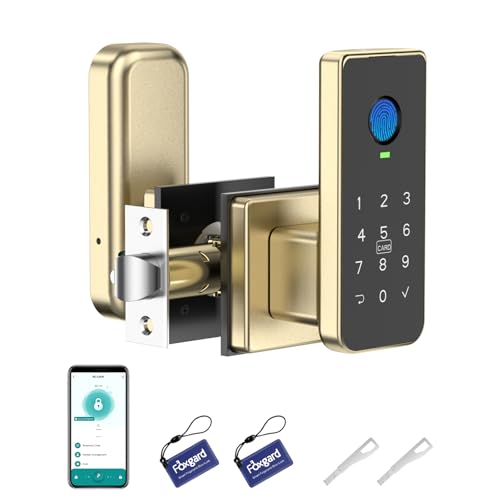
- Unlocks by fingerprint, keypad, app, IC card, or key
- Offers temporary passcodes, access logs, and privacy lock
- Runs on four AA batteries with low-battery alerts
Best For: Bedrooms, offices, rentals, and indoor privacy
Best Adaptive Fingerprint Lock – Wyze Auto-Lock Bolt v2
For shoppers comparing battery powered smart locks, the Wyze Auto-Lock Bolt v2 stands out for fast fingerprint entry, built-in Wi-Fi, and multiple backup methods. Its AI learning scanner is designed to improve recognition over time, while the included AA batteries provide up to eight months of use.
Best For: Homeowners who want fingerprint access plus remote control through Wi-Fi.
Pros:
- Fingerprint scanner can unlock the door in about 0.5 seconds.
- Built-in Wi-Fi enables remote lock management in the Wyze app.
- Offers fingerprint, app, keypad-code, and physical-key access.
- USB-C emergency power can help unlock the door if the batteries die.
Cons:
- Battery life is rated at up to eight months, shorter than some one-year options.
- Its most advanced integrations are centered on the Wyze ecosystem.
The Wyze Bolt v2 is a practical choice when quick biometric entry and remote access matter more than maximum battery longevity. The emergency USB-C power option and physical keys add useful backup protection.
Best Hands-Free Apple Smart Lock – Aqara UWB Smart Lock U400
Among battery powered smart locks, the Aqara U400 is a feature-rich option for Apple users who want hands-free entry. Its UWB unlocking can detect an approaching supported device, while Matter over Thread, fingerprint access, passcodes, and NFC support provide additional ways to enter.
Best For: Apple households seeking hands-free unlocking and broad smart-home compatibility.
Pros:
- UWB supports hands-free unlocking with compatible Apple devices and a Thread-enabled hub.
- Supports Apple Home Key, fingerprint, passcode, app, voice, NFC, and physical-key entry.
- Rechargeable battery lasts up to six months per charge and can be charged by USB-C.
- BHMA-certified construction and an IP65-rated exterior support durability.
Cons:
- UWB and Apple Home Key features require compatible Apple hardware and software.
- Rechargeable battery life is rated at up to six months, requiring more frequent charging than some alternatives.
The U400 offers one of the broadest access-method selections in this group, but its hands-free and ecosystem features depend on compatible hubs and devices. It is especially compelling for users already invested in Apple Home and Matter-enabled smart-home products.
Best Simple Keypad Deadbolt – TEEHO TE001
The TEEHO TE001 is a straightforward choice for shoppers seeking battery powered smart locks without app or Wi-Fi requirements. Its backlit keypad supports up to 20 user codes, along with a one-time guest PIN and physical backup keys.
Best For: Families, rentals, and secondary doors that need code-based access without connectivity.
Pros:
- Stores up to 20 individual access codes and supports a one-time code.
- Auto-lock can be set from 10 to 99 seconds, with one-touch locking available.
- Four AA batteries provide up to 365 days of operation.
- Includes anti-peeping password protection, low-battery alerts, and two backup keys.
Cons:
- No Wi-Fi, Bluetooth, or app connectivity is included.
- Requires a 2-1/8-inch door hole and is not compatible with 38 mm door holes.
- Four AA batteries are not included.
The TE001 focuses on dependable keypad convenience rather than connected features. Its long stated battery life and guest-code functions make it a sensible fit for households or rentals that prefer a simple, offline deadbolt.
Best Long-Lasting Rechargeable Lock – Tapo DL110
The Tapo DL110 combines fingerprint recognition, keypad access, Wi-Fi management, and Bluetooth in a rechargeable deadbolt. For buyers comparing battery powered smart locks, its claimed one-year battery life and support for scheduled or one-time guest codes make it a low-maintenance connected option.
Best For: Connected households that want biometric entry, remote management, and extended rechargeable battery life.
Pros:
- Provides six access methods, including fingerprint, passcode, Wi-Fi, Bluetooth, voice, and physical keys.
- Fingerprint recognition can unlock the door in about 0.42 seconds and stores up to 100 fingerprints.
- Removable rechargeable battery is rated for up to one year of operation.
- Supports resident profiles plus one-time and scheduled guest codes.
Cons:
- Its connected features require setup through compatible Tapo, mobile, or voice-assistant controls.
- The rechargeable battery must be recharged when depleted, despite the long stated runtime.
The DL110 is a strong all-around pick for users who want several entry methods and remote access without frequently changing batteries. Its large fingerprint capacity and guest-management tools also suit busy households.
Simple Keypad Pick – Yale Digital Keypad Deadbolt
The Yale Digital Keypad Deadbolt is a straightforward choice for shoppers seeking battery powered smart locks without app, phone, or Wi-Fi setup. Install it, create access codes, and use the backlit keypad for key-free entry.
Best For: Homeowners who want simple code-based entry and dependable auto-locking without connected features.
Pros:
- Supports up to 20 unique entry codes.
- Auto-Lock secures the deadbolt after you leave.
- Backlit keypad, backup key, and low-battery alerts add convenience.
- BHMA Grade 3 construction with operation from -22°F to 140°F.
Cons:
- No app, Wi-Fi, or remote-control functionality.
- Does not offer fingerprint or voice unlocking.
This Yale lock favors simplicity over smart-home integration. It is a practical fit when you want programmable codes and automatic locking while avoiding connectivity-related setup.
Fingerprint Smart Pick – eufy Security Smart Lock C220
The eufy Security Smart Lock C220 combines several access methods in a battery powered smart lock, including fingerprint recognition, app control, a keypad, physical key, smartwatch access, and voice control. Built-in Wi-Fi enables remote management without a separate bridge.
Best For: Connected households that want fingerprint access, remote control, and multiple unlocking options.
Pros:
- Offers six unlocking methods, including fingerprint and app access.
- Built-in Wi-Fi supports remote control, notifications, and event history.
- Runs for around eight months on eight AA batteries, depending on use.
- IP53 water resistance and BHMA Grade 3 construction support exterior use.
Cons:
- Requires eight AA batteries.
- Its connected features may be more than needed for shoppers seeking a basic keypad lock.
- Battery life varies with usage frequency.
The C220 is the most feature-rich option here for biometric and remote access. Its broad unlocking support and eufy ecosystem integration make it especially appealing if convenience and app-based oversight matter.
High-Capacity Access Pick – Tapo Smart Wi-Fi Deadbolt DL100
The Tapo DL100 is a versatile battery powered smart lock with tactile keypad buttons, Bluetooth and Wi-Fi access, app management, and voice control. Its large code capacity and activity tracking make it useful for households that regularly share access.
Best For: Families, hosts, and property managers who need many customizable codes and access activity records.
Pros:
- Supports up to 200 customizable codes.
- Offers keypad, Bluetooth, Wi-Fi, voice, and backup-key entry.
- Provides remote control, real-time alerts, door status, and timestamped activity.
- Includes auto-lock, PIN attempt limiting, IP54 weather protection, and USB-C emergency power.
Cons:
- Battery life is listed as up to 200 days in Wi-Fi mode or 300 days in Bluetooth mode.
- Voice unlocking requires PIN verification.
- Its larger feature set may be unnecessary for basic keypad-only needs.
With extensive code management and monitoring tools, the DL100 is well suited to shared-access situations. Its battery modes, emergency power option, and broad smart-home compatibility add flexibility, though connected use requires more setup than a standalone keypad lock.
Best Versatility – Yamiry 5-in-1 Fingerprint Keypad Knob
For shoppers comparing battery powered smart locks, the Yamiry YR05 combines fingerprint, keypad, app, key-fob, and physical-key access in a modern door knob design. It supports Bluetooth app control and can store up to 50 passwords, fingerprints, and key fobs.
Best For: Front, back, or interior doors where multiple convenient entry methods are useful.
Pros:
- Offers five unlocking methods, including fingerprint, app, keypad, key fob, and key.
- Installs on most American standard doors with a screwdriver.
- Supports auto-lock and includes a weather-resistant keypad.
- Optional Wi-Fi gateway enables remote control and voice control.
Cons:
- Remote access requires a separately sold Wi-Fi gateway.
- Bluetooth connectivity is listed as the standard connection protocol.
The YR05 is a flexible choice when household members want different ways to unlock the same door. Its broad access support and straightforward installation make it especially practical for busy homes, though remote features add an extra purchase.
Best Heavy-Duty Pick – Heavy-Duty Keypad Door Knob
This keypad door knob is a practical option among battery powered smart locks for users who prefer code or key entry without app management. Its backlit keypad, auto-lock function, and emergency USB-C power option suit everyday home, office, bedroom, and garage use.
Best For: Buyers seeking a straightforward keypad lock with physical-key backup and broad door-thickness compatibility.
Pros:
- Supports one master code and up to 50 user codes.
- Backlit keypad works in darkness and includes password disguise.
- Fits doors from 1-3/8 to 2-1/2 inches thick with an adjustable latch.
- Offers auto-lock, low-battery alerts, and USB-C backup power.
Cons:
- Access is limited to keypad codes or a physical key rather than app control.
- It is designed for non-deadbolt installations.
With a heavy-duty metal construction and IP65 weather resistance, this model emphasizes dependable code-based entry. It is a good fit for straightforward access control, but shoppers wanting phone control or biometric entry should consider a more feature-rich lock.
Best Indoor Biometric – Foxgard 5-in-1 Fingerprint Lock
The Foxgard FNL-01 stands out among battery powered smart locks with fingerprint access, keypad codes, app control, IC cards, and mechanical keys. Powered by four AA batteries, it also adds access logs, timed or one-time passcodes, and privacy-focused electronic anti-lock features.
Best For: Bedrooms, offices, rentals, and indoor doors where biometric access and temporary codes are valuable.
Pros:
- Provides five entry methods, including fingerprint, app, IC card, keypad, and key.
- Supports one-time, timed, and dynamic passcodes plus access logs.
- Includes anti-peep keypad entry, auto-lock, and an electronic privacy lock.
- Installs on most standard doors without drilling or wiring.
Cons:
- Four AA alkaline batteries are required but not included.
- Remote and voice control require the separately sold Foxgard Gateway.
- Its listed use is primarily indoor rather than general exterior installation.
This gold-finished biometric lock is especially well suited to privacy-sensitive indoor spaces and guest-access situations. Its detailed passcode controls and access history are useful for rentals and offices, while the gateway requirement limits remote functionality out of the box.
How We Picked the Best Battery Powered Smart Locks
We focused on the features that affect everyday use and long-term reliability: access methods, battery operation, installation style, connectivity, backup entry, and compatibility with common smart-home platforms. The selection includes full-featured deadbolts as well as simpler keypad and fingerprint door-handle designs.
We also considered how well each lock fits different users. A lock with Wi-Fi and app control may suit someone who manages access remotely, while a keypad-only model can be a better choice for a rental, guest room, office, or household that wants fewer connected features.
Quick Comparison
| Lock type | Best for | Access options | Connectivity |
|---|---|---|---|
| Smart deadbolt | Front-door security and flexible control | App, keypad, fingerprint, or key | Bluetooth, Wi-Fi, or smart-home platforms |
| Keypad deadbolt | Simple keyless entry | PIN code and sometimes key | Usually none or limited |
| Fingerprint deadbolt | Fast entry for household members | Fingerprint, PIN, app, or key | Varies by model |
| Smart door knob | Interior rooms and secondary doors | Fingerprint, PIN, or key | Often limited |
Key Buying Factors for Battery-Powered Smart Locks
Battery Life and Low-Power Alerts
Check the advertised runtime, battery type, and how the lock warns you when power is low. Actual life depends on usage, temperature, Wi-Fi activity, and motor resistance. A visible battery indicator or app notification is especially useful for a primary entrance.
Backup Access
Look for a physical keyway, emergency power connection, or both. Backup access matters if batteries run down, a phone is unavailable, or wireless connectivity fails. Keep spare batteries and any emergency key somewhere accessible outside the locked area.
Entry Methods
Keypads are convenient for families, guests, and service providers because codes can be shared or changed. Fingerprint readers offer fast personal access, while app control is useful for remote unlocking, activity notifications, and temporary permissions. Choose the combination you will actually use.
Connectivity and Compatibility
Bluetooth models can provide local control with fewer network requirements. Wi-Fi models generally offer remote access but may use more battery and require a stable connection. If you use Apple Home, Google Home, Alexa, or another platform, verify compatibility before buying.
Installation and Door Fit
Confirm that the lock matches your door thickness, backset, borehole, and existing deadbolt or knob configuration. Some models replace only the interior mechanism, while others require a complete hardware swap. A smooth, properly aligned deadbolt is essential for motorized locks.
Who Should Buy Which Battery Powered Smart Locks?
- Choose a connected smart deadbolt if you want remote control, notifications, temporary codes, or smart-home routines.
- Choose a fingerprint model if fast, key-free access is the priority for regular household members.
- Choose a keypad deadbolt if you want dependable code entry without relying heavily on an app or Wi-Fi.
- Choose a smart door knob for an office, bedroom, garage entry, or other interior application where a full deadbolt is unnecessary.
- Choose a model with a physical key backup if you want the simplest emergency-access option and do not want to depend entirely on batteries or electronics.
For most front doors, prioritize secure deadbolt construction, reliable battery alerts, convenient backup entry, and a design that fits your existing hardware. The most advanced battery-powered smart locks are not automatically the best choice if their connectivity or access features add complexity you will not use.