The best automatic pipe cutters make repetitive plumbing cuts faster, cleaner, and easier to control than a hacksaw. This roundup compares compact close-quarters tools, cordless cutters, impact-driver attachments, and ratcheting PVC models.
Before choosing, match the cutter to your pipe material, diameter range, available power, and workspace. The right tool can reduce deburring, improve consistency, and save time on installation or repair jobs.
Best 10 Automatic Pipe Cutters Picks for 2026
Best Cordless Copper Cutter

- Auto-adjusts from 3/8 to 1-inch copper
- 500 RPM motor for faster cuts
- Low-clearance, water-resistant head
Best For: Fast copper cuts in tight plumbing spaces
Best Manual Close-Quarter Cutter

- Cuts 1/4 to 1-1/8-inch tubing
- Handles copper, aluminum, brass, and plastic
- Compact design with spare cutter wheel
Best For: Controlled manual cuts in tight spaces
Best PVC Cutter
Klein Tools Ratcheting PVC Cutter

- Cuts pipe up to 2 inches ID
- Works with PVC, CPVC, and PEX
- Ratcheting blade with soft-molded handles
Best For: Larger plastic-pipe cutting tasks
Best Budget Ratchet Cutter
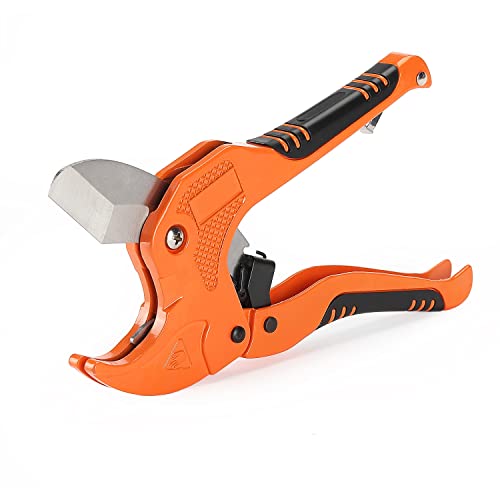
- Ratchet mechanism supports quick, low-effort cuts
- Cuts compatible plastic tubing up to 1-5/8 inches
- Folding handle includes storage buckle and safety lock
Best For: Plastic pipe and tubing repairs
Best Compact Metal-Tubing Cutter
RIDGID Model 118 Close-Quarters Cutter

- AUTOFEED design supports easier cutting
- Handles 1/4- to 1-1/8-inch tubing
- Made for copper, brass, and aluminum tubing
Best For: Professional close-quarters metal-tubing work
Best Cordless Copper Cutter – Milwaukee M12 500 RPM Cutter
For plumbers who want faster, easier cuts, this Milwaukee cordless tool is a strong option among automatic pipe cutters. Its cutting head automatically adjusts to 3/8-inch through 1-inch Type K, L, and M copper pipe, while the sealed head and low-clearance design suit demanding plumbing work.
Best For: Cutting copper tubing quickly in tight plumbing spaces, provided you already own a compatible Milwaukee M12 battery.
Pros:
- Automatic adjustment covers 3/8-inch to 1-inch copper pipe.
- 500 RPM motor is designed to work up to 10 times faster than standard hand cutters or saws.
- Works in clearances as tight as 1 1/2 inches from a wall.
- Sealed, water-resistant head and compatibility with Milwaukee M12 REDLITHIUM batteries.
Cons:
- Battery and charger are not included.
- Designed for Type K, L, and M copper rather than a broad range of pipe materials.
This is a specialized, productivity-focused choice for copper work. Its automatic sizing and compact clearance requirements are particularly useful for repair jobs where a manual cutter would be slower or harder to position.
Best Manual Close-Quarter Cutter – RIDGID Model 101 Tube Cutter
The RIDGID Model 101 is a compact manual option for automatic pipe cutters shoppers who need reliable control in confined areas. It handles 1/4-inch to 1-1/8-inch tubing and works with hard or soft copper, aluminum, brass, and plastic.
Best For: Manual cutting of small-diameter tubing in tight spaces, especially when material versatility matters.
Pros:
- Close-quarters design suits restricted work areas.
- Works with copper, aluminum, brass, and plastic tubing.
- Knurled feed-screw knob helps control cutting pressure.
- Includes a spare cutter wheel and a lifetime warranty against material or workmanship defects.
Cons:
- Manual operation is slower than powered automatic cutters.
- Maximum capacity is 1-1/8 inches.
This lightweight cutter is a practical choice when portability and precise manual control outweigh powered speed. Its broad material compatibility also makes it useful in a general plumbing tool kit.
Best PVC Cutter – Klein Tools Ratcheting PVC Cutter
The Klein Tools 50080 is a hand-powered ratcheting cutter for larger plastic pipe. While it is not an automatic pipe cutter, its ratcheting mechanism and optimized jaws make cutting Schedule 40 and 80 PVC, CPVC, and PEX more manageable up to its 2-inch inside-diameter capacity.
Best For: Homeowners, handymen, plumbers, and electricians cutting common plastic piping up to 2 inches inside diameter.
Pros:
- Cuts pipe up to 2 inches ID and 2-3/8 inches OD.
- Compatible with Schedule 40/80 PVC, CPVC, and PEX.
- Ratcheting blade helps with plastic pipe cutting.
- Soft-molded handles provide a comfortable, secure grip.
Cons:
- Hand-powered rather than cordless or fully automatic.
- Intended for plastic pipe, not metal tubing.
Choose this model when your project centers on PVC, CPVC, or PEX rather than copper. Its larger capacity and ratcheting action make it a practical complement to smaller metal-tubing cutters.
Best High-Capacity Cordless Cutter – DEWALT 20V MAX XR Copper Cutter
The DEWALT DCE154B is a high-capacity cordless choice among automatic pipe cutters, covering 1/4-inch to 1-1/4-inch Type K, L, and M hard or soft copper tubing. Its auto-sizing head, pivoting design, variable-speed trigger, and integrated LED are built for fast, controlled jobsite work.
Best For: High-volume copper cutting where broader capacity, speed, and cordless jobsite features are priorities.
Pros:
- Auto-sizing head cuts multiple copper-tubing diameters without changing parts.
- 1/4-inch to 1-1/4-inch capacity is broader than the listed Milwaukee model.
- Pivoting head rotates 90 degrees for access from different angles.
- Variable-speed trigger, automatic LED, and up to 550 cuts per charge support productivity.
Cons:
- Battery is not listed among the included components.
- At 3.8 pounds, it is heavier than the Milwaukee tool listed here.
- Designed for copper tubing rather than PVC or other pipe materials.
This is the most feature-rich option in the group for repeated copper cuts. Its larger capacity and jobsite-oriented controls make it appealing for professional workflows, especially when paired with the DEWALT 20V MAX battery platform.
Best Budget Ratchet Cutter – Bates PVC Pipe Cutter
If you need automatic pipe cutters for routine plastic-tubing work, the Bates ratchet cutter offers a straightforward, low-effort design. Its ratchet mechanism and triangle-shaped blade edge help make repeated cuts through compatible tubing with only a few presses.
Best For: Handymen, plumbers, electricians, and vehicle mechanics cutting PVC, CPVC, PP, PEX, PE, rubber hose, and multilayer tubing.
Pros:
- Ratchet action helps make cutting quick and easy.
- Manganese-steel construction is designed for hardness, toughness, and durability.
- Comfortable rubber-textured fish-shaped handle with a storage buckle and safety lock.
- Compact design weighs 9.1 ounces and folds for storage.
Cons:
- Not suitable for 2-inch PVC or metal pipes.
- Its maximum stated capacity is 1-5/8 inches.
This is a practical choice when your projects primarily involve plastic pipe and tubing rather than metal. The compact ratchet format and locking handle add convenience for occasional repairs and general maintenance.
Best Compact Metal-Tubing Cutter – RIDGID Model 118 Close-Quarters Cutter
For automatic pipe cutters designed for tight spaces, the RIDGID Model 118 combines a compact close-quarters format with an AUTOFEED mechanism. It is built for cutting smaller copper, brass, and aluminum tubing where a full-size cutter may be difficult to position.
Best For: Professional tubing work on 1/4-inch to 1-1/8-inch copper, brass, and aluminum tubing.
Pros:
- Close-quarters design suits confined work areas.
- AUTOFEED feature helps simplify the cutting process.
- 2-in-1 design supports the stated tubing-cutter configuration.
- Meets listed ANSI, ASME, CE, DIN, RoHS, and UL specifications.
Cons:
- Limited to tubing from 1/4 inch to 1-1/8 inches.
- Designed for copper, brass, and aluminum rather than plastic pipe.
The Model 118 is a specialized option rather than an all-purpose pipe cutter. Its compact profile and automatic feed make it particularly relevant for professional metal-tubing jobs in restricted spaces.
Best Powered Attachment – DEWALT IMPACT CONNECT Copper Pipe Cutter
Among automatic pipe cutters, the DEWALT IMPACT CONNECT stands out as an impact-driver attachment for faster copper-tubing cuts. It is intended to reduce manual effort and can rotate 360 degrees to improve access at awkward angles.
Best For: Residential and commercial jobsites using select DEWALT 20V MAX or other pro-grade 18V impact drivers to cut copper tubing.
Pros:
- Designed for cuts up to 1 inch with the appropriate wheel.
- Claims up to four-times-faster cuts and 100-times-less cutting effort than a manual cutter.
- Quick-change brace switches between cutting pipe and driving screws.
- Includes 1/2-inch and 3/4-inch cutting wheels and offers 360-degree rotation.
Cons:
- Compatibility is limited to select impact drivers.
- The 1-inch cutting wheel is sold separately.
- It is intended for copper rather than general-purpose pipe cutting.
This attachment makes the most sense for professionals who already use a compatible impact driver and frequently cut copper tubing. Its powered operation can reduce fatigue, while the included wheels cover two common sizes.
Best Compact Cutter – HAUTMEC 1/2-Inch Automatic Copper Tube Cutter
For small copper-tube jobs and restricted work areas, this HAUTMEC is a practical choice among automatic pipe cutters. Its compact, spring-loaded design helps produce smooth cuts while the directional grip improves control during turning.
Best For: Cutting 1/2-inch nominal copper, aluminum, brass tubing, and thin-wall conduit in tight spaces.
Pros:
- Automatic-style spring-loaded cutting action helps make smooth cuts with fewer burrs.
- Compact close-quarters design reaches confined areas.
- Heavy-duty zinc alloy body, chrome rollers, and shock-resistant blade support durability.
- Non-slip directional grip improves handling and turning control.
Cons:
- Limited to 1/2-inch nominal capacity, or 5/8-inch outer diameter.
- Not suitable for stainless steel.
This is a focused, easy-to-handle option rather than a general-purpose cutter. Choose it when your projects involve compatible soft tubing and access is more important than broad size coverage.
Best Multi-Size Kit – Spurtar 4-Piece Copper Pipe Cutter Set
This Spurtar set gives DIYers and professionals three dedicated sizes instead of one adjustable tool. The automatic-tightening cutters are designed for fast, clean cuts on compatible thin-wall tubing, while the included deburring tool helps prepare edges for fittings.
Best For: Copper-tubing work involving 1/2-inch, 3/4-inch, or 1-inch soft tubing, especially when a complete hand-tool kit is useful.
Pros:
- Includes dedicated cutters for three common copper-tube sizes.
- Automatic tightening while turning supports consistent cutting.
- Deburring tool helps smooth freshly cut edges and clean pipe interiors.
- Includes spare cutting wheels, a spare deburring blade, and a canvas bag.
Cons:
- Each cutter fits only its specified size.
- Designed for soft or thin-wall tubing under 1 mm thickness.
- Not presented as a stainless-steel cutter.
For users who regularly work with several common copper sizes, this kit offers more coverage and useful cleanup accessories than a single cutter. Its fixed-size design is less flexible, but it keeps each tool simple to use.
Best Organized Set – HAUTMEC 3-Piece Copper Tubing Cutter Set
For plumbing repairs that involve multiple common tube sizes, this HAUTMEC set combines three compact automatic-tightening cutters with replacement parts in a storage case. The spring-loaded wheels are intended for smooth cuts, and the reaming pen supports burr removal afterward.
Best For: DIY and professional plumbing repairs or re-piping projects using 1/2-inch, 3/4-inch, and 1-inch tubing.
Pros:
- Three cutters cover common 1/2-inch, 3/4-inch, and 1-inch sizes.
- Auto-tightening action and chrome rollers support smooth operation.
- Includes a reaming pen, spare cutting wheels, and a spare deburring blade.
- Portable storage case keeps the set organized for transport.
Cons:
- Fixed-size cutters provide less size flexibility than an adjustable cutter.
- The supplied notes do not specify a broader material range beyond the described tubing applications.
This set is a strong practical pick when organization and replacement parts matter. It provides dedicated tools for frequently used sizes, though buyers needing unusual diameters may prefer a more versatile cutter.
How We Picked the Best Automatic Pipe Cutters
We evaluated these Automatic Pipe Cutters by looking at the factors that matter most in real plumbing work: compatible materials, cutting capacity, operating method, portability, access in confined spaces, and expected ease of use. The selection includes powered copper-tubing cutters from Milwaukee and DEWALT, compact RIDGID close-quarters tools, ratcheting PVC cutters, impact-driver accessories, and multi-piece manual sets.
Because “automatic” can describe different mechanisms, check the product design carefully. Some models use a motor or impact driver to rotate the cutting wheel, while others use a ratcheting action that reduces hand effort. Battery-powered tools may be faster for repeated cuts, but manual cutters are often lighter, less expensive, and easier to keep ready.
Quick Comparison
| Best For | Recommended Type | What to Check |
|---|---|---|
| Frequent copper-tube cuts | Cordless powered cutter | Battery platform, diameter range, replacement wheels |
| Tight installation spaces | Close-quarters tubing cutter | Minimum clearance and pipe-size compatibility |
| PVC and plastic pipe | Ratcheting PVC cutter | Maximum outside diameter and blade quality |
| Using tools already on hand | Impact-driver attachment | Required driver, chuck compatibility, and control |
| Occasional repairs | Manual cutter set | Included sizes, deburring tool, and storage |
Key Buying Factors for Automatic Pipe Cutters
Pipe Material and Size
Confirm whether the cutter is intended for copper, aluminum, brass, PVC, or another material. Capacity is commonly listed by nominal pipe size or outside diameter, and those measurements are not interchangeable. A tool rated for 1/2-inch nominal copper tubing may not handle 1/2-inch PVC.
Power and Cutting Speed
Powered models are useful when a job involves many repeated cuts or limited hand access. Cordless tools add speed but require a compatible battery and charger, while impact-driver attachments can be economical if you already own the required driver. Manual and ratcheting designs avoid charging and usually offer more direct control.
Access, Control, and Finish
For pipes installed near walls, cabinets, or fittings, a compact close-quarters cutter can be more valuable than a larger powered model. Look for smooth wheel adjustment, a secure grip, and a clean cut that leaves minimal deformation. A deburring tool or compatible reamer is helpful because freshly cut tubing may have sharp edges or restrict flow.
Maintenance and Replacement Parts
Cutting wheels eventually wear, especially when used on hard or dirty tubing. Check whether replacement wheels are readily available and keep the wheel, rollers, and adjustment mechanism clean. Do not force a cutter beyond its stated capacity.
Who Should Buy Which Automatic Pipe Cutters?
Choose a Milwaukee or DEWALT cordless model if you regularly cut copper tubing and value speed. Pick a RIDGID close-quarters cutter for tight spaces and controlled, compact operation. A Klein Tools or Bates ratcheting cutter is better suited to PVC work, while the DEWALT IMPACT CONNECT attachment makes sense for users who already have a compatible impact driver. For occasional maintenance, the HAUTMEC or Spurtar sets provide useful versatility without committing to a larger powered tool.