The right pipe cutter makes cleaner cuts with less effort than a hacksaw, while reducing the chance of crushed edges and rough burrs. This roundup compares 10 options for copper, aluminum, PVC, PEX, and other common plumbing materials.
Whether you need a compact tool for close-quarters repairs, a ratcheting PVC cutter, or a versatile tubing cutter for larger diameters, use the guide below to match capacity, construction, and cutting style to your projects.
Best 10 Pipe Cutters Picks for 2026
Professional Pick
RIDGID Model 152 Quick-Acting Tubing Cutter

- Cuts tubing from 1/4 to 2-5/8 inches
- Quick-acting design with ergonomic X-cel knob
- Includes fold-away reamer and tool-free wheel change
Best For: Professional plumbing, HVAC, and general metal-tubing work
Heavy-Duty Value
2-Inch Metal Pipe Cutter with Reamer

- Cuts 3/16- to 2-inch outside diameters
- Six ball-bearing rollers help stabilize pipe
- Includes a deburring and reaming tool
Best For: Metal pipe installation and maintenance on a budget
Compact Choice
RIDGID Model 101 Close-Quarters Tubing Cutter

- Designed for tight spaces and small tubing
- Cuts 1/4- to 1-1/8-inch diameters
- Includes a spare cutter wheel
Best For: Small-diameter tubing repairs in confined areas
Plastic Pipe Pick
DOMINOX Ratchet PVC Pipe Cutter

- Cuts PVC, PEX, PPR, PE, and hoses up to 2-1/2 inches
- Ratchet design reduces required hand force
- Uses an SK5 blade and aluminum-alloy body
Best For: Larger plastic plumbing pipe and hose cutting
Best Overall Tubing Cutter
RIDGID Model 150 Constant Swing Cutter

- Cuts copper, brass, aluminum, and thin-wall conduit
- Enclosed feed screw helps resist clogging
- Includes spare wheel and fold-away reamer
Best For: Small-diameter metal tubing and close-to-flare cuts
Best for PVC and PEX
Klein Tools Ratcheting PVC Pipe Cutter

- Cuts PVC, CPVC, and PEX
- Handles up to 2-inch ID pipe
- Comfortable soft-molded handles
Best For: Larger plastic pipe cutting tasks
Best for Tight Spaces
RIDGID Model 118 Close-Quarters Cutter

- Compact 2-in-1 close-quarters design
- AUTOFEED advances the cutter automatically
- Cuts copper, brass, and aluminum tubing
Best For: Professional metal-tubing work in confined spaces
Best Budget Ratchet Cutter
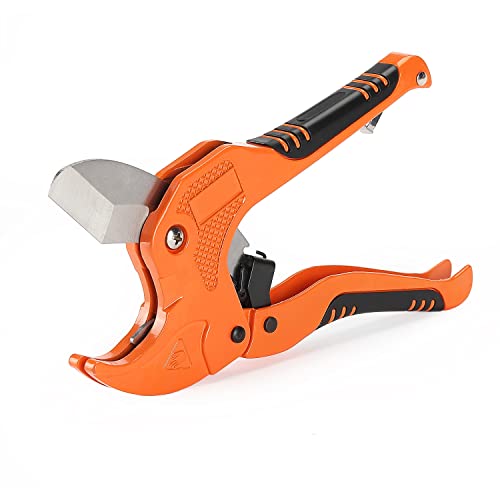
- Ratchet mechanism eases manual cutting
- Handles plastic pipe and multilayer tubing
- Cuts up to 1-5/8 inches; not for metal
Best For: DIY and general plastic-tubing repairs
Best Powered Copper Cutter
Milwaukee M12 Pipe and Tubing Cutter

- Powered cutting at up to 500 RPM
- Automatically adjusts from 3/8 to 1 inch
- Battery and charger sold separately
Best For: Fast, low-clearance copper-pipe work
Best Complete Tube-Cutting Set

- Includes large and mini cutter sizes
- Covers 1/8-inch to 2-inch OD tubing
- Adds a high-speed-steel deburring tool
Best For: Multi-size copper, aluminum, and PVC projects
Professional Pick – RIDGID Model 152 Quick-Acting Tubing Cutter
For demanding pipe cutters work, the RIDGID Model 152 combines a broad 1/4-inch to 2-5/8-inch capacity with a quick-acting design. Its ergonomic X-cel knob, durable construction, and fold-away reamer make it a practical choice for plumbing, HVAC, electrical work, and DIY projects.
Best For: Professionals and serious DIY users cutting a wide range of metal tubing.
Pros:
- Broad 1/4-inch to 2-5/8-inch cutting capacity
- Quick-acting design with smooth thrust-bearing slide assemblies
- Fold-away reamer and tool-free cutter-wheel changes
- Lifetime warranty against material and workmanship defects
Cons:
- Heavier and larger than compact close-quarters cutters
- Hand-powered design requires manual effort on larger tubing
This is a durable, versatile option when you need one tubing cutter for multiple applications and value serviceable features such as the replaceable wheel and built-in reamer.
Heavy-Duty Value – 2-Inch Metal Pipe Cutter with Reamer
This heavy-duty pipe cutter is designed for metal tubing from 3/16 to 2 inches outside diameter. Six ball-bearing rollers help stabilize the pipe, while the included deburring tool helps clean the inside and outside edges after cutting.
Best For: Plumbing, HVAC, automotive, and electrical maintenance involving copper, aluminum, and thin stainless steel pipe.
Pros:
- Handles 3/16-inch to 2-inch outside diameters
- Six rollers provide a firm grip during cutting
- Aluminum-alloy body balances durability with lower weight
- Includes a separate deburring and reaming tool
Cons:
- Small burrs may still occur and require reaming
- Not specified for larger or heavy-wall pipe
With its useful size range and included reamer, this 2-in-1 set offers practical functionality for routine metal pipe installation and repair without adding a separate deburring purchase.
Compact Choice – RIDGID Model 101 Close-Quarters Tubing Cutter
When space is limited, the RIDGID Model 101 is one of the most practical pipe cutters in this group. Its compact body is designed for tight areas and small-diameter tubing, with a 1/4-inch to 1-1/8-inch capacity and a knurled feed-screw knob for controlled pressure.
Best For: Plumbers and maintenance users working on small tubing in confined spaces.
Pros:
- Compact design for close-quarters work
- Works with copper, aluminum, brass, and plastic
- Lightweight at 7.8 ounces
- Includes a spare cutter wheel
Cons:
- Smaller 1/4-inch to 1-1/8-inch capacity
- Close-quarters design is less suitable for large tubing
This cutter prioritizes access and portability over capacity. It is a strong fit for small-diameter repairs where a full-size tubing cutter would be awkward to position.
Plastic Pipe Pick – DOMINOX Ratchet PVC Pipe Cutter
For plastic pipe cutters, the DOMINOX ratchet model is built for PVC, PEX, PPR, PE, rubber hoses, and similar materials up to 2-1/2 inches. Its SK5 blade and ratchet mechanism are intended to make repeated cuts easier while reducing hand and wrist strain.
Best For: Cutting larger plastic plumbing pipes, hoses, and PEX during installation or repair.
Pros:
- Handles plastic pipe and hose up to 2-1/2 inches
- Ratchet mechanism helps apply cutting force progressively
- SK5 blade is designed to resist rusting, bending, and breaking
- Aluminum-alloy handle with ABS covering is sturdy and lightweight
Cons:
- Designed for plastic and similar materials rather than metal pipe
- Requires proper pipe alignment and blade-tightening checks for straight cuts
This is the most specialized option here: choose it when your projects center on larger plastic plumbing materials and you want a ratcheting tool rather than a wheel-style metal tubing cutter.
Best Overall Tubing Cutter – RIDGID Model 150 Constant Swing Cutter
RIDGID 31622 Model 150 Constant Swing Tubing Cutter, 1/8-Inch to 1-1/8-Inch Tube Cutter
Check Price On AmazonIf you need a dependable option among pipe cutters for metal tubing, the RIDGID Model 150 handles copper, brass, aluminum, and thin-wall conduit from 1/8 inch to 1-1/8 inches. Its enclosed feed screw, grooved rollers, and fold-away reamer make it practical for routine installation and repair work.
Best For: Cutting small-diameter metal tubing and making close-to-flare cuts.
Pros:
- Works with copper, brass, aluminum, and thin-wall conduit.
- Enclosed feed screw helps reduce clogging and jamming.
- Large X-CEL knob provides a firmer grip.
- Includes a spare cutter wheel and fold-away reamer.
Cons:
- Its 1/8- to 1-1/8-inch capacity is limited to smaller tubing.
- Designed for hand-powered cutting rather than high-volume powered work.
The Model 150 is a strong all-around choice when you want a compact metal tubing cutter with convenient adjustment and wheel replacement features. Its zinc-alloy construction and lifetime warranty against defects add confidence for ongoing tool use.
Best for PVC and PEX – Klein Tools Ratcheting PVC Pipe Cutter
For plastic pipe projects, the Klein Tools 50080 is one of the more versatile pipe cutters in this group. Its ratcheting design cuts Schedule 40 and 80 PVC, CPVC, and PEX up to 2 inches inside diameter or 2-3/8 inches outside diameter.
Best For: Homeowners, handymen, plumbers, and electricians cutting larger plastic pipes.
Pros:
- Handles PVC, CPVC, and PEX pipe.
- Ratcheting blade supports cuts up to 2 inches ID and 2-3/8 inches OD.
- Soft-molded handles provide a comfortable, secure grip.
- Blade retracts by pulling the handles apart.
Cons:
- Not intended for the metal tubing materials handled by tubing cutters.
- At 1.25 pounds, it is heavier than compact cutter designs.
The 50080 makes sense when your work centers on plastic pipe and you value a ratcheting mechanism over a compact, constant-swing format. Its optimized jaws are designed to hold various pipe sizes securely during cutting.
Best for Tight Spaces – RIDGID Model 118 Close-Quarters Cutter
When access is limited, the RIDGID Model 118 offers a compact alternative to full-size pipe cutters. This 2-in-1 close-quarters cutter has AUTOFEED and is designed for 1/4- to 1-1/8-inch copper, brass, and aluminum tubing.
Best For: Professional metal-tubing work in confined spaces.
Pros:
- Compact design is suited to close-quarters applications.
- AUTOFEED automatically advances the cutter during use.
- Handles copper, brass, and aluminum tubing.
- Ergonomic grip and alloy-steel, aluminum, and metal handle materials.
Cons:
- Its 1/4- to 1-1/8-inch range excludes some very small and large tubing.
- It is specialized for metal tubing rather than PVC or PEX pipe.
The Model 118 is the most targeted choice here for cramped installations where a conventional cutter may be difficult to rotate. Its AUTOFEED feature can also simplify repeated adjustments while working on compatible metal tubing.
Best Budget Ratchet Cutter – Bates PVC Pipe Cutter
If you need practical pipe cutters for routine plastic-tubing work, the Bates PVC Pipe Cutter offers a straightforward manual design. Its ratchet mechanism helps reduce effort, while the cutter is sized for pipes and tubing up to 1-5/8 inches.
Best For: DIYers, handymen, plumbers, electricians, and vehicle mechanics cutting PVC, CPVC, PP, PEX, PE, rubber hose, and multilayer tubing.
Pros:
- Ratchet action supports quick cutting with a few presses.
- Manganese-steel construction is designed for hardness, toughness, and durability.
- Rubber-textured fish-shaped handle provides a comfortable grip.
- Folding handles and a security lock make storage easier and help prevent accidental injury.
Cons:
- Not suitable for 2-inch PVC or metal pipes.
- Manual operation may be less convenient than a powered cutter for larger workloads.
The Bates is a compact, accessible choice among pipe cutters when your projects center on plastic pipe and tubing rather than metal or oversized PVC.
Best Powered Copper Cutter – Milwaukee M12 Pipe and Tubing Cutter
For faster copper-pipe work, this Milwaukee model is one of the more specialized pipe cutters in the group. Its powered motor reaches up to 500 RPM, automatically adjusts across 3/8- to 1-inch copper pipe, and works with Milwaukee M12 RED LITHIUM batteries.
Best For: Plumbing applications involving type K, L, and M copper pipes where low-clearance, powered cutting is useful.
Pros:
- Automatic adjustment accommodates 3/8- to 1-inch copper pipe.
- 500 RPM motor is designed to work up to 10 times faster than standard hand-operated cutters or saws.
- Low-clearance design works with piping as little as 1-1/2 inches from a wall.
- Sealed head helps protect the motor from water, and the tool is compatible with M12 batteries.
Cons:
- Battery and charger are not included; this is a power-tool-only package.
- Its stated capacity is limited to 3/8- to 1-inch copper pipe, making it less versatile for other materials.
This is a strong fit for plumbers who already use Milwaukee M12 batteries and prioritize speed in confined copper-pipe installations.
Best Complete Tube-Cutting Set – Ultimate Tube Cutter Set
This Ultimate Tube Cutter Set gives shoppers a broader selection of pipe cutters for different diameters, plus a dedicated deburring tool. It includes a large cutter for 3/16- to 2-inch outside diameters and a mini cutter for 1/8- to 7/8-inch tubing.
Best For: Professionals and serious DIY users working with copper, aluminum, and PVC pipes in varied sizes.
Pros:
- Two cutter sizes cover a wide range of tube diameters.
- Heat-treated alloy-steel construction is designed for durability and rust resistance.
- Six independent bearings support smoother, more precise cutting.
- Included high-speed-steel deburring tool helps refine cut pipe edges.
Cons:
- The 1.83-pound set is less compact than a single cutter.
- Although designed for multiple materials, the supplied notes do not specify capacity for metal pipe beyond copper and aluminum tubing.
Choose this set when versatility matters more than minimal size: the two cutters and deburring tool cover more steps in a typical tubing project.
How We Picked the Best Pipe Cutters
We focused on practical differences that affect real plumbing and maintenance jobs: cutting capacity, compatible materials, tool design, access in confined spaces, durability, and ease of making a square, clean cut. The selection includes manual wheel cutters, close-quarters models, ratcheting plastic-Pipe Cutters, combination sets, and a cordless option.
Because no single tool suits every pipe, we also considered whether each cutter is best for thin tubing, larger copper or aluminum, rigid PVC, PEX, or repeated professional use. Deburring capability and included accessories were treated as useful advantages rather than substitutes for correct technique.
Quick Comparison of These Pipe Cutters
| Best For | Recommended Type | What to Look For |
|---|---|---|
| General copper and tubing work | Adjustable wheel cutter | Broad diameter range and smooth adjustment |
| Tight spaces | Close-quarters cutter | Compact body and swing or ratcheting action |
| PVC, PEX, and plastic hose | Ratcheting pipe cutter | Sharp replaceable blade and ergonomic handle |
| Several pipe sizes | Multi-tool set | Multiple capacities plus a deburring tool |
| Frequent repetitive cuts | Cordless cutter | Speed, battery compatibility, and control |
Key Buying Factors for Pipe Cutters
Material and Cutting Method
Wheel-style tubing cutters are generally suited to copper, brass, aluminum, and thin-wall metal tubing. Ratcheting blade cutters are usually better for PVC, PEX, PPR, and plastic hose. Check the manufacturer’s material guidance before cutting anything outside the listed range.
Capacity
Measure the pipe’s outside diameter, not just its nominal trade size. A cutter rated from 1/4 to 1-1/8 inches will not handle a 2-inch tube, while an oversized tool may be awkward on small tubing. Choose enough capacity for your largest expected job without sacrificing control.
Access and Ergonomics
For installed plumbing, a close-quarters or constant-swing design can work where a full-turn cutter cannot. Ratcheting handles reduce the need for clearance around plastic pipe. Look for a comfortable grip and an adjustment mechanism that does not slip under load.
Finish Quality and Maintenance
A clean, square cut helps fittings seat properly. After cutting metal tubing, remove the internal and external burrs before assembly. Replace worn cutting wheels or blades, keep moving parts clean, and avoid forcing the tool through material beyond its rating.
Who Should Buy Which Pipe Cutters?
Choose a standard adjustable tubing cutter for general copper, brass, or aluminum repairs. A close-quarters model is the better choice for work inside cabinets, near walls, or between fittings. For plastic plumbing, select a ratcheting PVC cutter sized for your pipe diameter; its blade action is typically faster and cleaner than a metal-tube wheel.
Buy a set if you regularly encounter several diameters and want a dedicated deburring tool. Contractors or high-volume users may prefer the speed of a cordless cutter, provided the battery platform and operating clearance fit their workflow. For occasional household repairs, prioritize simple adjustment, a suitable capacity range, and a replacement blade or wheel that is easy to obtain.