Finding a stud should not require guesswork, especially when a misplaced hole can damage wiring or leave a wall anchor unsupported. The best electronic stud finders combine clear scanning guidance with useful detection modes for wood, metal, and live AC wires.
This roundup compares 10 options ranging from multi-sensor models and rechargeable wall scanners to straightforward stud locators for everyday mounting jobs. Use the guide below to match features, depth, controls, and safety alerts to your project.
Best 10 Electronic Stud Finders Picks for 2026
Most Accurate Pick
Franklin Sensors ProSensor M210

- 13-sensor design for broad detection
- No calibration required
- Deep scan and live-wire detection
Best For: DIYers wanting easy, full-width stud readings
Best Auto-Calibrating Option

- Automatically calibrates while scanning
- Detects wood, metal, and live AC
- Wall-safe felt backing and finger guard
Best For: Fast, repeatable scans on finished walls
Best Guided Scanning

- Three dedicated scanning modes
- LCD, audio, and SpotLite guidance
- Detects studs, metal, and live wires
Best For: Users wanting guided, mode-specific scans
Best Rechargeable Multi-Detector

- Six detection functions
- Rechargeable lithium-ion design
- Deep metal and wire detection
Best For: Multi-material scanning and frequent project use
Most Comprehensive Scan
Franklin Sensors ProSensor M150

- Nine sensors show stud width and centers
- Detects wood and metal up to 1.5 inches deep
- No calibration; includes live-wire detection
Best For: DIYers wanting broad, deep, no-calibration scans
Best Slimline Option

- Center-find technology locates stud centers
- LED arrows and audible alert aid scanning
- Auto-calibration and live-wire detection included
Best For: Routine scans on standard wall surfaces
Best for Edge Finding

- Finds wood and metal stud edges
- StudScan and DeepScan modes add flexibility
- LCD, tone, pointer, and live-wire alerts
Best For: Mounting projects requiring clear stud-edge locations
Reliable Edge Detection
CRAFTSMAN CMHT77633 Stud Finder

- Finds wood and metal stud edges
- Works through wallpaper and fabric
- Shock- and water-resistant body
Best For: Basic drywall stud-edge detection
Feature-Rich Wall Scanning
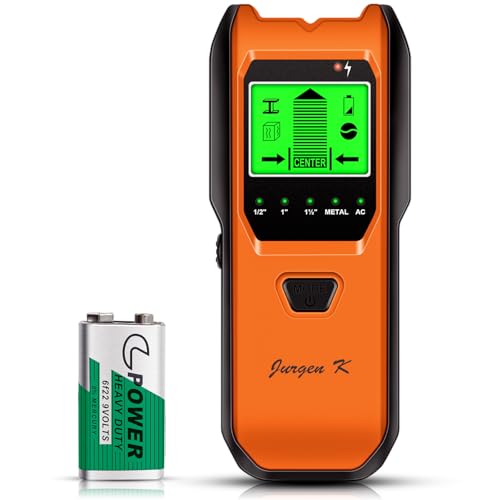
- Five modes for studs, metal, and AC
- Detects centers and edges with LCD guidance
- Includes 9V battery and ergonomic grip
Best For: Multi-material home renovation scanning
Clear Drywall Scanning
Mecurate MSF60A 5-in-1 Scanner

- Standard, deep, metal, and AC modes
- LCD graphics and live-wire alerts
- Includes battery, pouch, and manual
Best For: Single-layer drywall projects
Most Accurate Pick – Franklin Sensors ProSensor M210
For shoppers comparing electronic stud finders, the Franklin Sensors ProSensor M210 stands out with 13 sensors and a display designed to show the full width of a stud. Its no-calibration operation makes it practical for quick scans.
Best For: DIYers who want broad stud-width detection, simple operation, and built-in live-wire detection.
Pros:
- Thirteen sensors are designed for accurate detection.
- Requires no calibration and can scan anywhere on the wall.
- Shows stud width, double studs, and center position with LEDs.
- Includes deep scanning up to 1.7 inches, live-wire detection, and a bubble level.
Cons:
- Two AA batteries are required and not included.
- Its feature set may be more than needed for occasional basic scans.
The M210 is a strong choice when clear full-width readings and minimal setup matter more than keeping the tool as simple as possible.
Best Auto-Calibrating Option – Klein Tools ESF200
The Klein Tools ESF200 is one of the more straightforward electronic stud finders for routine wall work. It automatically calibrates, displays stud edges and width, and scans wood, metal, and live AC wiring without requiring separate material modes.
Best For: DIY users and professionals who want automatic calibration, clear LED guidance, and a wall-safe design.
Pros:
- Detects wood, metal, and live AC wires in a seamless scan.
- Automatic calibration reduces setup between walls.
- Displays full stud width and edges with LED indicators.
- Finger guard and felt backing help protect walls during scanning.
Cons:
- Wood detection is limited to 3/4 inch deep.
- Battery power requires alkaline cells.
With its illuminated power button and automatic operation, the ESF200 is a practical pick for fast, repeatable scans where protecting finished walls is important.
Best Guided Scanning – Zircon MultiScanner A200
The Zircon MultiScanner A200 gives electronic stud finder users several dedicated scanning modes for different wall conditions. Its LCD, audio tone, and SpotLite pointer help guide edge and center marking before drilling.
Best For: DIYers and pros who want guided stud, deep-scan, metal, and live-wire detection.
Pros:
- Offers StudScan, DeepScan, and Metal Scan modes.
- Finds wood and metal stud edges and centers up to 3/4 inch in StudScan mode.
- DeepScan reaches up to 1 1/2 inches.
- WireWarning, LCD guidance, audio, and SpotLite support safer marking.
Cons:
- Requires careful flat-wall calibration before scanning.
- Uses a 9V alkaline battery.
The A200 is well suited to users who prefer mode-specific control and visual marking assistance, provided they follow the calibration process carefully.
Best Rechargeable Multi-Detector – FNIRSI WD-01 Wall Scanner
The FNIRSI WD-01 expands beyond basic electronic stud finders with six detection functions and a rechargeable design. It can locate studs, multiple metal types, live AC wiring, and copper wire while showing readings on an LCD.
Best For: Users who need broad material detection, deeper metal scans, and rechargeable convenience.
Pros:
- Six scan functions cover studs, ferrous and non-ferrous metal, AC, and copper wire.
- Depth mode detects stud edges and centers up to 1.5 inches.
- Metal detection reaches up to 3.9 inches for copper and 4.7 inches for iron.
- Rechargeable operation avoids routine battery replacement.
Cons:
- Its wider range of modes may require more user setup than a basic stud finder.
- Detection depth varies substantially by material and scan mode.
The WD-01 is the most versatile option here for projects involving more than wood studs, especially when rechargeable operation and deeper metal detection are priorities.
Most Comprehensive Scan – Franklin Sensors ProSensor M150
For shoppers comparing electronic stud finders, the Franklin Sensors ProSensor M150 stands out with nine sensors, no-calibration scanning, and a display designed to show the full width of a stud. It detects wood and metal studs up to 1.5 inches deep and includes live-wire detection.
Best For: DIYers who want broad stud-width readings and deep scanning without manual calibration.
Pros:
- Nine sensors help provide detailed readings and show stud centers.
- Scans wood and metal studs up to 1.5 inches deep.
- Requires no calibration and includes live-wire detection.
Cons:
- Two AAA batteries are required but not included.
- Not compatible with rechargeable batteries.
The M150 is a feature-rich option for projects where locating the stud’s full width matters. Its always-on deep scan simplifies the process, while the wire warning adds an extra safety check before drilling.
Best Slimline Option – DEWALT DW0100 Stud Finder
The DEWALT DW0100 is a straightforward choice among electronic stud finders, using center-find technology, directional LED arrows, and an audible alert to guide scans. It detects wood and metal framing up to 3/4 inch deep and includes constant auto-calibration.
Best For: DIY users who want a compact, easy-to-store stud finder for standard wall scans.
Pros:
- Center-find technology helps identify stud centers.
- Directional arrows and an audible alert guide the scan.
- Includes AC/live-wire detection, auto-calibration, and AAA batteries.
Cons:
- Detection depth is limited to 3/4 inch.
- Not designed for concrete, brick, tile, foil-faced materials, or several other surfaces listed by the manufacturer.
- Does not locate non-ferrous or plastic objects such as pipes.
With its slim profile and automatic calibration, the DW0100 is convenient for routine framing work. Its shallower detection range makes it better suited to standard surfaces than thicker or specialized wall materials.
Best for Edge Finding – Zircon StudSensor A100
The Zircon StudSensor A100 is one of the more approachable electronic stud finders for locating stud edges. It offers StudScan and DeepScan modes, an LCD screen, audio tone, SpotLite pointer, and live-wire alerts for added awareness before mounting or drilling.
Best For: DIY projects that require locating both edges of wood or metal studs behind standard or thicker wall surfaces.
Pros:
- Locates stud edges up to 3/4 inch in StudScan mode and up to 1 1/2 inches in DeepScan mode.
- LCD display, audio tone, and SpotLite pointer provide multiple location cues.
- WireWarning detection identifies live, unshielded AC wiring up to 2 inches deep.
Cons:
- Requires a fresh 9V alkaline battery, which is not included.
- Requires correct calibration against the wall before scanning.
The A100 offers useful feedback for mounting shelves, mirrors, cabinets, or TVs, especially when identifying both stud edges is important. Its calibration process takes an extra step, but the two scan modes add flexibility.
Reliable Edge Detection – CRAFTSMAN CMHT77633 Stud Finder
For shoppers comparing electronic stud finders, the CRAFTSMAN CMHT77633 is a straightforward option for locating wood and metal stud edges through up to 3/4 inch of drywall. It can also scan surfaces covered with wallpaper or fabric, making it useful for common wall-hanging projects.
Best For: Homeowners who need basic stud-edge detection on drywall and covered wall surfaces.
Pros:
- Detects the edges of wood and metal studs.
- Works through wallpaper and fabric-covered surfaces.
- Shock-resistant and water-resistant body supports durability.
- Includes a full lifetime warranty.
Cons:
- Its listed detection depth is limited to 3/4 inch.
- Does not list dedicated metal, pipe, or AC-wire scanning modes.
The CRAFTSMAN is best suited to uncomplicated drywall tasks where edge location is the main priority. Its durable construction and lifetime warranty add confidence, but shoppers needing deeper or multi-material scanning may prefer a more feature-rich wall scanner.
Feature-Rich Wall Scanning – Jurgen K 5-in-1 Wall Scanner
Among electronic stud finders, the Jurgen K wall scanner stands out for its five detection modes and backlit LCD display. It is designed to locate stud centers and edges, metal, pipes, and live AC wires at multiple selectable depths.
Best For: DIYers and homeowners who want one scanner for studs, metal, pipes, and live-wire detection.
Pros:
- Offers 1/2-inch, 1-inch, 1.5-inch, metal, and AC scan modes.
- LCD screen shows detected material and position with audio alerts.
- Includes a 9V battery and features an ergonomic non-slip grip.
- Designed for use on surfaces including wallpapered wood floors, painted walls, and soundproof ceilings.
Cons:
- Requires calibration before scanning for best accuracy.
- Its many modes may be more than needed for simple stud-finding tasks.
The Jurgen K is a versatile choice for projects where avoiding hidden hazards matters as much as finding studs. Its display, alarms, and broad detection coverage are useful advantages, though users should follow the calibration process before each scanning task.
Clear Drywall Scanning – Mecurate MSF60A 5-in-1 Scanner
The Mecurate MSF60A is a practical choice among electronic stud finders, offering separate modes for standard and deep stud detection, metal, and live AC wires. Its LCD graphics, audio alerts, included battery, and carrying pouch make it approachable for routine drywall projects.
Best For: DIYers and professionals scanning single-layer drywall for studs, metal, and live wires.
Pros:
- Provides standard, deep, metal, and AC scanning modes.
- Bright LCD graphics show detection information clearly.
- Audio alerts warn when live AC wiring is detected.
- Includes a 9V battery, carrying pouch, and user manual.
Cons:
- Works best on single-layer drywall.
- Not recommended for concrete, brick, tile, or other non-drywall surfaces.
- Requires calibration against the wall before use.
The Mecurate offers useful depth and safety modes at a practical feature level, especially for drywall installation and hanging projects. Its surface limitation is important, so shoppers working on masonry or tile should choose a scanner intended for those materials.
How We Picked the Best Electronic Stud Finders
We focused on the features that matter during real installation work: dependable center and edge detection, useful scanning depth, live-wire and metal detection, readable indicators, comfortable handling, and practical power options. We also considered whether each tool suits occasional household tasks or more frequent DIY and trade use.
Multi-sensor designs can cover more wall area at once, while traditional center-finding models may be simpler to operate. No electronic scanner replaces caution: always verify a location before drilling, especially near outlets, switches, plumbing fixtures, and known wiring paths.
Quick Comparison
- Best for broad, fast scanning: Franklin Sensors ProSensor M210, with a 13-sensor layout.
- Best for versatile detection: Klein Tools ESF200 or Zircon MultiScanner A200, which add metal and live-wire modes.
- Best rechargeable option: FNIRSI WD-01, with multiple scanning functions and a built-in battery.
- Best straightforward choices: DEWALT DW0100, Zircon A100, or CRAFTSMAN CMHT77633 for common mounting tasks.
- Best for extra display features: The multifunction LCD wall scanners from the selected generic-brand options.
Key Buying Factors for Electronic Stud Finders
Detection Modes
Choose a basic stud mode for routine picture hanging and shelving. If you will drill into unfamiliar walls, metal detection and live-AC warnings are valuable additions. Treat wire alerts as warnings rather than precise maps of every cable.
Center and Edge Guidance
Center-finding helps place screws in the strongest part of a stud, while edge detection shows the stud’s boundaries. Tools that provide LED arrows, audible alarms, or on-screen guidance can be easier to follow than a single changing light.
Depth and Wall Materials
Many models are designed around roughly 3/4-inch stud detection, but performance varies with drywall thickness, plaster, tile, insulation, and wall texture. Scan slowly in both directions and confirm a reading before making a hole.
Power and Controls
AAA or other replaceable batteries are convenient for storage and quick replacement. Rechargeable models reduce disposable battery use but must be charged before a project. Large buttons and a clear display are especially helpful when working overhead.
Who Should Buy Which Electronic Stud Finders?
For homeowners mounting shelves, televisions, or cabinets occasionally, a simple center-finding tool such as the DEWALT, Zircon A100, or CRAFTSMAN is usually sufficient. Choose a multi-sensor Franklin model if you want faster coverage and less back-and-forth scanning.
DIYers renovating rooms or drilling in older, unfamiliar walls should prioritize metal and live-wire detection, making the Klein Tools or Zircon MultiScanner models stronger candidates. Pick the FNIRSI or an LCD-equipped wall scanner if you prefer rechargeable power, visual measurements, and broader material scanning.
Whichever model you choose, mark several readings, scan from multiple directions, and use appropriate electrical and drilling precautions. Electronic Stud Finders improve confidence, but careful verification remains the safest final step.