Finding a reliable anchor point behind plaster can be more difficult than scanning modern drywall. Dense surfaces, lath, metal fasteners, and uneven construction can challenge basic stud detectors.
This roundup compares 10 practical options, from battery-free magnetic locators to electronic scanners with wire detection and deeper sensing. Use the guide below to match the right tool to your wall type, project, and safety needs.
Best 10 Stud Finder for Plaster Walls Picks for 2026
Best Overall
Franklin Sensors ProSensor M210

- 13-sensor full-width detection
- Scans up to 1.7 inches deep
- Live-wire detection and built-in level
Best For: General wall scanning and mounting projects
Best Battery-Free Pick
CH Hanson Magnetic Stud Finder

- No batteries or calibration required
- Works through drywall, plaster, and paneling
- Includes a rotating built-in level
Best For: Fastener locating and everyday hanging projects
Best for Thick Walls
Franklin Sensors ProSensor MAX

- Scans up to 2.5 inches deep
- Works through plaster and layered materials
- Includes standard and deep-scan modes
Best For: Thick, layered, or difficult wall surfaces
Best Simple Magnetic Tool
Original StudBuddy Magnetic Stud Finder

- No batteries or calibration needed
- Uses magnets to locate fasteners
- Not intended for lath-and-plaster walls
Best For: Simple drywall and wood projects
Best Multi-Mode Scanner

- Finds wood and metal studs with edge and center guidance
- Offers DeepScan, Metal Scan, and live-wire warnings
- Uses display, tones, and SpotLite Pointer for marking
Best For: Mounting projects that require versatile wall scanning
Best for Thick Plaster
Original StudPoP Moving Magnet

- Provides click-and-pop feedback when a fastener is found
- Works on plaster, tile, wood studs, metal studs, and more
- Needs no batteries and avoids electronic calibration
Best For: Older homes and thick plaster surfaces
Best Full-Width Detection
Franklin Sensors ProSensor M150

- Nine sensors show stud width and centers
- Scans without calibration, including over a stud
- Detects wood and metal studs up to 1.5 inches
Best For: Fast, broad scanning with visual stud-width feedback
Best Magnetic Option

- Rare-earth magnet detects metal studs and fasteners
- Felt backing helps protect plaster surfaces
- Bubble vial and notches aid accurate marking
Best For: Simple magnetic scanning and wall marking
Best Multifunction Scanner
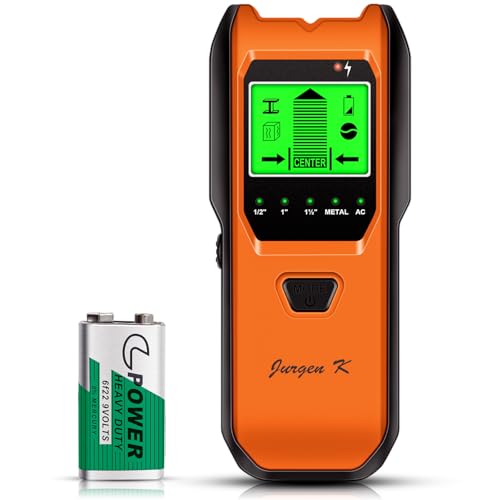
- Scans studs at three depths plus metal and AC
- LCD identifies material and position
- Auto-calibration, audio alerts, and included 9V battery
Best For: Multi-material detection during home projects
Best Deep-Scan Safety Pick

- Stud, metal, pipe, and AC-wire detection modes
- Metal scanning reaches up to 2.36 inches
- Continuous wire alerts and backlit LCD
Best For: Shelf installation and safety-conscious scanning
Best Overall – Franklin Sensors ProSensor M210
If you want a versatile stud finder for plaster walls and other wall surfaces, the Franklin Sensors ProSensor M210 combines 13 sensors with always-on deep scanning. It displays the full width of detected wood or metal studs rather than only locating fasteners, and it requires no calibration before scanning.
Best For: DIYers who want full-width stud detection, stud-center guidance, and added live-wire detection.
Pros:
- 13 sensors help provide broad, accurate detection.
- Detects wood and metal studs up to 1.7 inches deep.
- Shows stud width, double studs, and the center with LED indicators.
- Includes live-wire detection, a bubble level, and pencil caddy.
Cons:
- Requires two AA batteries, which are not included.
- Its listed sensing depth is lower than the ProSensor MAX.
The M210 is a strong all-purpose choice when you need more than a simple magnetic locator. Its full-width display and no-calibration operation make wall scanning straightforward, while the included extras add convenience for mounting and drilling projects.
Best Battery-Free Pick – CH Hanson Magnetic Stud Finder
The CH Hanson Magnetic Stud Finder is a compact, battery-free option for locating fasteners behind drywall, plaster, and paneling. Its rare-earth magnets help identify nails and screws without calibration, while the rotating built-in level assists with marking installation lines.
Best For: Homeowners and contractors who prefer a simple, pocket-sized tool for finding fastener-backed mounting points.
Pros:
- Works without batteries, charging, or calibration.
- Rare-earth magnets locate nails and screws behind several wall materials.
- Rotating bubble level supports horizontal and vertical marking.
- Lightweight design weighs only 0.15 pounds.
Cons:
- Locates nails and screws rather than displaying the full width of a stud.
- Magnetic operation depends on fasteners being present behind the wall.
This is a practical stud finder for plaster walls when convenience and simplicity matter most. It does not provide electronic depth or live-wire scanning, but its no-battery design and integrated level make it useful for shelves, TVs, cabinets, and similar projects.
Best for Thick Walls – Franklin Sensors ProSensor MAX
For challenging surfaces, the Franklin Sensors ProSensor MAX is a deep-scanning stud finder for plaster walls and layered construction. Its 13 larger sensors detect through up to 2.5 inches of drywall, plaster, OSB, plywood, MDF, or large tile, with a second mode intended for thicker or tougher walls.
Best For: Renovation and mounting projects involving thick walls, multiple layers, or dense wall coverings.
Pros:
- Maximum detection depth reaches 2.5 inches.
- Designed to scan through multiple layers and several dense materials.
- Displays full stud width, double studs, and stud centers.
- Offers standard and deep-scan detection modes.
Cons:
- Its larger design weighs 1.1 pounds.
- Battery-powered operation requires batteries.
- Deep scanning may be more capability than needed for simple drywall projects.
The ProSensor MAX is the most capable option here for difficult wall assemblies. Choose it when ordinary stud finders may not reach through the surface; for routine single-layer walls, its extra depth and larger body may be unnecessary.
Best Simple Magnetic Tool – Original StudBuddy Magnetic Stud Finder
The Original StudBuddy is a straightforward magnetic stud finder for drywall and wood that uses powerful magnets to locate screw and nail heads. It needs no batteries, moving parts, or calibration, but the manufacturer specifically says it is not intended for lath-and-plaster walls.
Best For: Basic drywall projects where you want a lightweight, always-ready magnetic locator.
Pros:
- Requires no batteries, moving parts, or calibration.
- Strong magnets stick to detected fastener locations.
- Extremely lightweight at 1.6 ounces.
- Made in the USA from durable materials.
Cons:
- Not intended for lath-and-plaster walls.
- Finds screw and nail locations rather than the full stud width.
- Its best use is drywall and wood construction.
The StudBuddy is appealing for uncomplicated drywall work, but it is not the right choice if your main need is a stud finder for plaster walls—especially lath and plaster. For compatible walls, its simplicity and low weight make it an inexpensive, low-maintenance option.
Best Multi-Mode Scanner – Zircon MultiScanner A200
If you want a versatile stud finder for plaster walls and other surfaces, the Zircon MultiScanner A200 combines wood- and metal-stud detection with metal scanning and live-wire warnings. Its display, audio tone, and SpotLite Pointer help you mark findings before drilling.
Best For: DIYers and pros mounting TVs, shelves, cabinets, mirrors, and fixtures who want multiple scanning modes.
Pros:
- Detects wood and metal stud edges, centers, and direction.
- StudScan reaches up to 3/4 inch, while DeepScan reaches up to 1 1/2 inches.
- Metal Scan and WireWarning help identify metal and live AC wires.
- LCD guidance, audio alerts, and SpotLite Pointer support marking.
Cons:
- Requires careful flat-wall calibration before scanning.
- Uses a 9V alkaline battery, which is not included in the supplied details.
The A200 is a strong all-around choice when you need more than basic stud locating. Follow the calibration instructions closely for the most reliable scan results.
Best for Thick Plaster – Original StudPoP Moving Magnet
The Original StudPoP is a simple, battery-free stud finder for plaster walls that locates metal fasteners rather than relying on a faint magnetic pull. Its clicking and lifting mechanism provides a visible and audible indication when it finds a fastener.
Best For: Older homes and thick plaster, tile, double-layer sheetrock, or other construction where conventional magnetic finders may be difficult to use.
Pros:
- Works across wood studs, metal studs, plaster, tile, and other listed construction types.
- Requires no batteries or electronic calibration.
- Signals metal fasteners with both a click and a raised popper.
- Compact design weighs only 1.12 ounces.
Cons:
- Locates metal fasteners, not the full width of a stud.
- Its effectiveness depends on finding fasteners in the wall.
For thick plaster where magnets are hard to feel, the StudPoP’s mechanical click-and-pop signal is particularly practical. It is best paired with careful marking and measurement when determining stud layout.
Best Full-Width Detection – Franklin Sensors ProSensor M150
The Franklin Sensors ProSensor M150 is a useful stud finder for plaster walls when you want broad stud coverage rather than a single fastener location. Its nine sensors display the full stud width and center, while deep scanning and AC-wire warning add useful drilling guidance.
Best For: Users who want no-calibration scanning and visual full-width detection for wood or metal studs.
Pros:
- Nine sensors help display the full width of studs and double studs.
- Starts scanning anywhere without calibration, including over a stud.
- Deep Scan detects wood and metal studs up to 1.5 inches.
- Includes live-wire detection and a green center LED.
Cons:
- Requires two AAA batteries, which are not included.
- Not compatible with rechargeable batteries.
The M150 is a convenient option for users who prefer a simple press-and-hold operation and a full-width LED readout. Its 1.5-inch sensing depth is helpful when wall layers make basic detection more challenging.
Best Magnetic Option – Compact Magnetic Stud Finder
For a straightforward stud finder for plaster walls, the Klein Tools MSF100 uses a powerful rare-earth magnet to locate metal studs and fasteners in wooden studs. Its felt backing helps protect plaster and drywall while you scan and mark.
Best For: Simple, tool-free detection of metal fasteners and studs during picture hanging, marking, and alignment tasks.
Pros:
- Powerful N52 rare-earth magnet identifies metal studs and fasteners.
- Felt pad backing helps safeguard plaster and drywall surfaces.
- Built-in bubble vial, center notch, and bottom opening support accurate marking.
Cons:
- Manual magnetic design does not provide electronic wood, pipe, or live-wire scanning.
- Detection depends on the presence of metal studs or fasteners.
The MSF100 is a compact choice when you want uncomplicated magnetic detection and careful surface contact. Its level and marking features add useful precision for light-duty wall projects.
Best Multifunction Scanner – 5-in-1 Wall Scanner
This 5-in-1 stud finder for plaster walls offers selectable scanning depths for studs, plus dedicated metal and AC modes. Its LCD shows detected material and position, while audio alerts help indicate edges and centers during a scan.
Best For: DIYers and homeowners who need one scanner for studs, metal, pipes, and live AC wires across walls, floors, or ceilings.
Pros:
- Includes 1/2-inch, 1-inch, 1.5-inch stud modes, metal scanning, and AC scanning.
- Backlit LCD and continuous beeping communicate detected material and position.
- Auto-calibration and ergonomic non-slip grip support convenient operation.
- Includes a 9V battery and low-power indicator.
Cons:
- Requires calibration before use for the intended accuracy.
- Electronic scanning may require more setup than a simple magnetic finder.
With multiple modes and visual and audible feedback, the Jurgen K scanner is the more versatile option for plaster-wall projects where hidden metal, pipes, or wiring may also matter.
Best Deep-Scan Safety Pick – Povlen Wall Scanner
For a stud finder for plaster walls with broader detection coverage, the Povlen scanner offers three stud modes, a deeper metal mode, and AC-wire scanning. Its backlit LCD identifies edges and centers, while continuous wire alerts add a safety-focused feature.
Best For: Hanging shelves or heavier objects when you want stud, metal, pipe, and live-wire detection in one battery-powered tool.
Pros:
- Three stud modes scan up to 1.5 inches, with metal detection up to 2.36 inches.
- AC mode scans up to 2 inches and provides continuous wire alerts.
- Backlit LCD displays stud edges and centers with audio alerts.
- Shock-resistant and dust-resistant design supports regular project use.
Cons:
- Multiple scanning modes may require learning the correct setting for each task.
- Battery-powered operation requires a 9V battery.
The Povlen stands out for its deeper stated metal range and persistent wire alerts. It is a practical choice when plaster-wall installation involves both finding support and checking for hazards.
How We Picked the Best Stud Finder for Plaster Walls
We focused on tools suited to the variables commonly found in plaster construction: wood framing, metal lath or fasteners, uneven surfaces, and concealed electrical wiring. The selection includes magnetic models that locate nails and screws, electronic scanners designed to identify framing and live wires, and multi-function wall scanners with display-based guidance.
We also considered detection depth, marking accuracy, ease of calibration, power requirements, portability, and whether the design helps users distinguish a likely stud from a single fastener. No scanner is a substitute for safe drilling practices, so wire-warning features and careful verification received particular attention.
Quick Comparison
| Type | Best For | Main Advantage | Limitation |
|---|---|---|---|
| Magnetic | Locating plaster fasteners | Simple, battery-free operation | Finds metal, not the full stud width |
| Electronic | Framing and wire detection | More information about wall contents | Requires batteries and proper calibration |
| Deep-scan electronic | Thicker or layered walls | Greater sensing depth | Can be affected by dense materials |
| Multi-function scanner | Mixed materials and DIY projects | Wood, metal, and AC detection in one tool | More settings and potential false readings |
Key Buying Factors for a Stud Finder for Plaster Walls
Detection Method
Magnetic finders are dependable when plaster is attached to wood lath and the tool can detect nails or screws. They are inexpensive and easy to use, but a fastener only indicates a probable framing location. Electronic models can scan for changes in density and may identify stud edges, centers, metal, and live wires.
Depth and Wall Construction
Check the advertised sensing depth, especially if the wall has thick plaster, lath, tile, paneling, or multiple layers. Deep detection is useful, but greater range does not guarantee accuracy through every material. Scan slowly and confirm repeated readings along a vertical line.
Wire and Metal Detection
For shelves, cabinets, and other permanent installations, a live-wire warning is an important safety feature. Metal detection can help reveal lath, pipes, corner reinforcement, or fasteners that may confuse a stud reading. Treat every warning seriously and avoid drilling until the area is verified.
Marking and Usability
A built-in level, clear display, edge-and-center guidance, audible alerts, or a comfortable sensor body can make a noticeable difference. Battery-free designs suit occasional repairs, while electronic models are usually more useful for larger projects involving several walls.
Who Should Buy Which Stud Finder for Plaster Walls?
Choose a magnetic model if you want the simplest, lowest-maintenance way to locate fasteners behind plaster and can verify the stud position with multiple readings. These are especially appealing for light-duty hanging jobs.
Choose an electronic scanner if you need stud-width guidance, deeper sensing, or live-wire and metal detection. This is the better category for mounting cabinets, television brackets, and heavy shelving.
Choose a multi-function wall scanner if your home includes mixed wall materials or you want a display and several detection modes in one tool. Allow extra time to calibrate and interpret readings.
Whichever Stud Finder for Plaster Walls you select, scan from several directions, mark repeated results, and inspect the drilling area for outlets, switches, plumbing, and other clues before making a hole.