Winter adds extra demands to a solar charging system. Lower temperatures can improve panel voltage while snow, shade, shorter days, and battery chemistry make charge control more critical.
This roundup compares 10 solar charge controllers for winter use, from compact PWM regulators to higher-efficiency MPPT models with monitoring, waterproofing, and support for lithium or lead-acid batteries.
Best 10 Solar Charge Controllers for Winter Use Picks for 2026
Best High-Capacity MPPT

- 50A MPPT charging for larger systems
- Bluetooth monitoring and configuration
- Supports synchronized multi-controller charging
Best For: Higher-output 12V or 24V winter solar systems
Best Compact 12V PWM

- 30A PWM controller for 12V systems
- Supports lithium and lead-acid batteries
- Optional temperature compensation for seasonal use
Best For: Compact RV, boat, and off-grid 12V setups
Best Small-System MPPT

- Compact MPPT design for small arrays
- Bluetooth setup and performance monitoring
- Works with 12V and 24V systems
Best For: Space-limited small solar installations
Best Proven PWM Reliability

- Four-stage charging with temperature compensation
- Factory presets simplify installation
- Five-year warranty and extensive protections
Best For: Small 12V systems prioritizing simple, dependable operation
Compact MPPT Choice

- 99% MPPT tracking efficiency
- Bluetooth and LCD monitoring
- Supports 12V/24V systems and multiple battery types
Best For: Compact RV, boat, cabin, and expandable off-grid systems
Weather-Ready Pick

- IP68 waterproof outdoor housing
- MPPT charging for 20W–200W panels
- LCD monitoring and USB/Type-C ports
Best For: Weather-exposed 12V RV, boat, cabin, and shed systems
Simple 12V Option
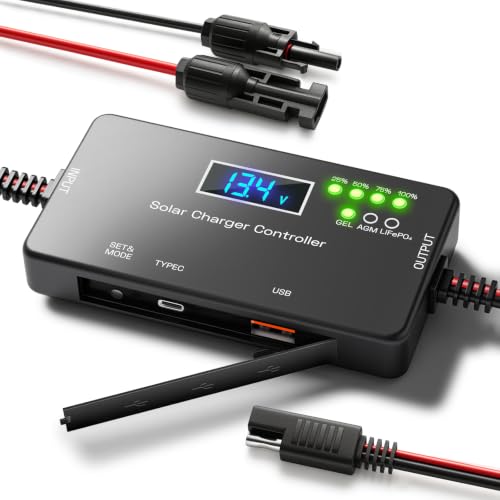
- Supports up to 300W in 12V systems
- LCD battery-level and voltage display
- 22W Type-C and 18W USB charging
Best For: Small 12V RV, boat, shed, and outdoor setups
Weatherproof Compact Choice
20A IP68 PWM Solar Charge Controller
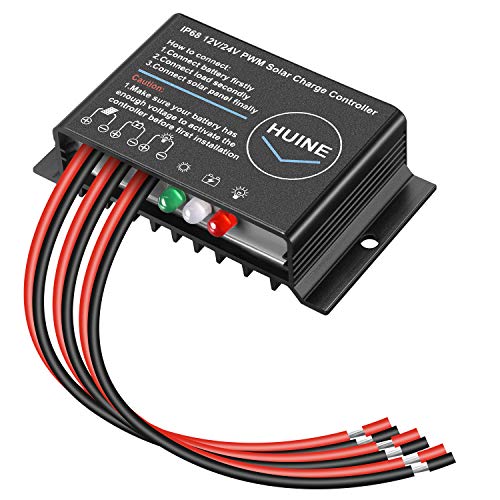
- IP68 waterproof outdoor housing
- Auto-detects 12V or 24V systems
- Compact design with core protections
Best For: Small caravans, boats, lighting, and outdoor systems
Simple RV and Boat Option
SOLPERK 10A Waterproof PWM Controller

- IP67 waterproof 12V/24V design
- Three-stage PWM charging and LED status
- SAE plug-and-play installation
Best For: Small RV, boat, car, and deep-cycle battery systems
Best High-Capacity MPPT – Victron SmartSolar 100V 50A
For larger winter solar setups, the Victron Energy SmartSolar MPPT 100/50 is designed to capture available sunlight efficiently, including during partial shading. Its MPPT tracking, configurable charging, and app connectivity make it a strong option among solar charge controllers for winter use.
Best For: Higher-output 12V or 24V systems that need detailed monitoring and flexible configuration.
Pros:
- 50A MPPT charging helps maximize available solar power.
- Bluetooth connectivity provides real-time data and 30-day performance history through VictronConnect.
- Supports synchronized charging across multiple SmartSolar controllers.
- Configurable load disconnect helps protect a deeply discharged battery.
Cons:
- It has no built-in display.
- Its larger 50A capacity may be unnecessary for small systems.
This is the most capable choice here for expanding winter installations or systems that need app-based oversight. Confirm that the controller’s voltage and current ratings match your panel array and battery bank.
Best Compact 12V PWM – Renogy Wanderer Li 30A
The Renogy Wanderer Li 30A is a compact PWM controller for 12V RV, boat, and off-grid systems. Its selectable battery support, LED status indicators, built-in protections, and optional temperature compensation make it a practical pick among solar charge controllers for winter use.
Best For: Compact 12V installations using LiFePO4, AGM, gel, or flooded batteries.
Pros:
- 30A PWM charging supports small to mid-sized 12V systems.
- Offers chemistry-specific charging for LiFePO4, AGM, gel, and flooded batteries.
- Optional temperature compensation is designed to help address seasonal charging differences.
- Includes reverse-polarity, overcharge, overload, and short-circuit protection.
Cons:
- It is a PWM controller rather than an MPPT model.
- Bluetooth monitoring requires the separately paired BT-1 module.
- Its listed PV input is limited to 25V.
Choose this model when simplicity, compact installation, and 12V compatibility matter more than maximum energy harvest. Check panel voltage carefully, especially if using series-connected modules.
Best Small-System MPPT – Victron SmartSolar 75V 15A
The Victron Energy SmartSolar MPPT 75/15 is a compact choice for smaller 12V or 24V arrays. Its fast MPPT tracking, Bluetooth connectivity, and configurable load output make it worth considering when selecting solar charge controllers for winter use in space-limited systems.
Best For: Smaller solar installations that benefit from MPPT performance and app-based monitoring.
Pros:
- MPPT tracking is designed to maximize power from available sunlight.
- Bluetooth access enables configuration, alerts, and performance-history viewing.
- Can synchronize with other SmartSolar MPPT controllers.
- Its compact 4.7-by-2.1-by-1.8-inch size suits tighter installations.
Cons:
- 15A capacity limits it to smaller solar arrays.
- It lacks a full built-in display.
- The 75V PV rating requires careful panel-voltage matching.
This controller offers a useful balance of compact dimensions and smart MPPT features. It is a better fit for modest winter loads than for high-current battery banks or large panel arrays.
Best Proven PWM Reliability – Morningstar SunSaver 10A
The Morningstar SunSaver 10A is a straightforward PWM controller for smaller 12V battery systems. Four-stage charging, temperature compensation, factory presets, and extensive electronic protection make it a dependable option among solar charge controllers for winter use.
Best For: Small 12V systems where simple operation, load control, and long-term reliability are priorities.
Pros:
- Four-stage PWM charging and temperature compensation support battery care.
- Factory presets simplify installation for sealed or flooded batteries.
- Includes load control, dead-battery recovery, and three-state LED indication.
- Provides reverse-polarity, surge, short-circuit, overload, and high-temperature protection.
Cons:
- Its 10A rating is intended for smaller systems.
- It is a PWM controller without app-based monitoring.
- Battery options are limited to selectable sealed or flooded settings.
For a modest 12V setup, the SunSaver emphasizes uncomplicated installation and protective features rather than advanced monitoring or maximum harvest. Its five-year warranty is an additional consideration for long-term installations.
Compact MPPT Choice – Renogy Rover 2 20A
For shoppers comparing solar charge controllers for winter use, the Renogy Rover 2 combines MPPT efficiency with monitoring features that make it easier to track charging during shorter or changing daylight conditions. It supports 12V and 24V systems and accepts up to 100V Voc solar arrays.
Best For: RVs, vans, boats, cabins, and expandable 12V/24V systems needing compact installation and remote monitoring.
Pros:
- 99% tracking efficiency and MPPT charging help maximize available solar power.
- LCD and built-in Bluetooth provide local and phone-based system monitoring.
- Supports lithium, AGM, gel, flooded, and user-defined battery profiles.
- Can connect with additional Rover 2 controllers for expanded capacity.
Cons:
- It is designed for 12V or 24V battery systems, not other system voltages.
- The 20A rating limits supported charging capacity compared with larger controllers.
The Rover 2 is a versatile option when winter charging performance, system visibility, and future expansion matter. Its compact size is especially useful where installation space is limited.
Weather-Ready Pick – SUNAPEX 15A MPPT
The SUNAPEX 15A is a practical candidate among solar charge controllers for winter use, especially for outdoor setups exposed to rain and moisture. Its MPPT design is intended to capture more available energy from 20W to 200W solar panels, while the LCD shows charging information in real time.
Best For: Outdoor 12V systems in RVs, boats, trailers, cabins, sheds, and similar installations where weather protection is important.
Pros:
- IP68 waterproof housing helps protect against rain, dust, and moisture.
- MPPT charging is designed to reduce energy loss in changing sunlight.
- LCD monitoring displays battery voltage, charging current, level, and status.
- Supports LiFePO4, AGM, gel, flooded, and sealed lead-acid batteries.
Cons:
- It is designed exclusively for 12V battery systems.
- The 15A rating and 200W panel recommendation may not suit larger solar arrays.
Choose this controller when outdoor durability and straightforward monitoring are higher priorities than high system capacity. Its reverse-current protection also helps prevent battery drain after sunset.
Simple 12V Option – 20A PWM Controller
For a straightforward setup, this 20A PWM controller offers an accessible option among solar charge controllers for winter use in small 12V systems. Its LCD provides battery information at a glance, while nighttime anti-leakage protection helps preserve stored power when solar input stops.
Best For: Small 12V RV, boat, shed, or outdoor systems using up to 300W of solar panels and compatible lithium, AGM, or gel batteries.
Pros:
- Supports LiFePO4, AGM, and gel batteries in 12V systems.
- LCD shows voltage and approximate battery levels from 25% to 100%.
- Quick-connect wiring is designed for simpler installation.
- Built-in USB and Type-C ports support direct device charging.
Cons:
- It is a PWM controller rather than an MPPT model.
- It is not compatible with 24V or 36V batteries.
- Its 300W panel limit may be restrictive for larger installations.
This model makes sense for buyers who value simple installation, basic battery visibility, and convenient device charging. For changing winter sunlight, its protections and nighttime anti-leakage feature add practical everyday value, though PWM is less optimized than MPPT.
Best with Extra Features – SA100A 100A Smart Solar Charge Controller
For solar charge controllers for winter use, the SA100A stands out for its high current capacity, MPPT-based tracking, and heat-dissipation updates intended to support charging efficiency at low temperatures. It automatically recognizes 12V, 24V, 36V, or 48V systems and provides LCD monitoring for key operating data.
Best For: Off-grid homes, remote installations, and larger multi-voltage solar systems using compatible lead-acid or LiFePO4 batteries.
Pros:
- Supports 12V/24V/36V/48V systems and up to 100A adjustment capacity.
- MPPT-based tracking with claimed tracking efficiency of at least 99.5%.
- LCD shows battery voltage, PV charging or discharging current, temperature, and error codes.
- Includes adjustable timing and light-control functions, dual USB ports, and multiple protections.
Cons:
- Its high-capacity design may be more than small solar setups need.
- The supplied specifications list a maximum operating temperature of 65°C, so installation still requires adequate ventilation.
The SA100A is the most capable option here for users who want broad system compatibility and detailed monitoring. Verify panel, battery, and wiring requirements before relying on its 100A rating.
Weatherproof Compact Choice – 20A IP68 PWM Solar Charge Controller
For solar charge controllers for winter use in exposed locations, this compact 20A PWM model offers IP68 waterproofing, automatic 12V/24V detection, and basic battery and load protection. Its small frame-mounted design can suit caravans, boats, lighting systems, and other outdoor installations.
Best For: Small outdoor solar systems where waterproof construction, simple status indicators, and compact installation are priorities.
Pros:
- IP68-rated waterproof housing is designed for outdoor use.
- Automatically senses 12V or 24V batteries.
- Provides short-circuit, overcharge, over-discharge, and reverse-protection functions.
- Compact housing, mounting holes, short connection cables, and three LED indicators simplify installation and monitoring.
Cons:
- It uses PWM charging rather than MPPT tracking.
- The 20A capacity is less suited to larger solar arrays.
- The 24-hour working mode may be limiting where more precise load scheduling is needed.
This controller is a practical choice for modest systems exposed to rain or spray. Its winter usefulness comes mainly from weather resistance and protective charging functions, not from specialized cold-weather controls.
Simple RV and Boat Option – SOLPERK 10A Waterproof PWM Controller
For solar charge controllers for winter use on smaller mobile systems, the SOLPERK 10A combines IP67 waterproofing with automatic 12V/24V detection and three-stage PWM charging. Its LED indicators and SAE plug-and-play connection make it approachable for RV, boat, and car installations.
Best For: Small 12V/24V deep-cycle battery systems using AGM, GEL, or flooded batteries and panels within its stated power limits.
Pros:
- IP67 waterproof construction supports outdoor installation.
- Handles up to 150W at 12V or 300W at 24V, with a 10A maximum current.
- Three LED indicators show load, battery, and solar charging status.
- Includes SAE connection, pre-drilled mounting holes, multiple protections, and a 12-month extended warranty.
Cons:
- Its 10A maximum limits it to smaller solar systems.
- Supports AGM, GEL, and flooded batteries in the supplied notes, but lithium compatibility is not listed.
- LED indicators provide less detailed information than an LCD display.
The SOLPERK is a straightforward low-power controller for outdoor vehicles and small battery banks. Check your panel wattage and battery chemistry first, since its capacity and listed compatibility are narrower than the larger controller in this roundup.
How We Picked the Best Solar Charge Controllers for Winter Use
We focused on the specifications that matter most when solar systems operate in cold, variable conditions: charging efficiency, photovoltaic input-voltage headroom, battery compatibility, rated current, protection features, and installation practicality. MPPT controllers generally receive extra consideration because they can extract more usable power when panel voltage is limited by short winter days, shading, or cold-weather system design.
We also included dependable PWM options for smaller 12V systems, where lower cost and straightforward operation may matter more than maximum harvest. Models with Bluetooth, LCD displays, or clear status indicators are useful when batteries and equipment are installed in an RV, boat, shed, or remote cabin.
Quick Comparison
The 50A Victron SmartSolar MPPT is suited to larger 12V or 24V banks, while the Victron 15A model fits compact systems. Renogy’s 20A MPPT offers a useful middle ground with Bluetooth and LCD monitoring. The Renogy Wanderer Li, Morningstar SunSaver, SOLPERK, and other PWM controllers are better matched with simpler, lower-power installations. Waterproof models can be practical for exposed marine, RV, and outdoor mounting locations, but enclosure protection does not replace correct installation or weatherproof cable entry.
Key Buying Factors for Solar Charge Controllers for Winter Use
MPPT Versus PWM
MPPT controllers typically provide better energy recovery and more flexible panel-voltage matching, especially in colder weather when a panel’s open-circuit voltage rises. PWM controllers remain sensible for small, budget-conscious systems with closely matched 12V panels and batteries.
Cold-Weather Voltage and Current Ratings
Check the controller’s maximum PV voltage against the panel array’s cold-weather open-circuit voltage, not only its nominal rating. Leave a safety margin, and confirm that the controller can handle the array’s maximum charging current. Exceeding either limit can damage equipment.
Battery Chemistry and Charging Profiles
Choose a model with the correct settings for LiFePO4, AGM, gel, or flooded lead-acid batteries. Lithium batteries often require a compatible charge profile and may need low-temperature charging protection supplied by the battery’s BMS or an external sensor.
Monitoring, Protection, and Installation
Bluetooth and LCD displays simplify troubleshooting, while low-voltage disconnect, reverse-polarity, overcurrent, and temperature protection can improve system safety. Verify wire size, fuse placement, grounding, ventilation, and the controller’s operating-temperature range before installation.
Who Should Buy Which Solar Charge Controllers for Winter Use?
Choose a higher-current Victron MPPT controller for larger arrays, expandable battery banks, or users who prioritize dependable monitoring and energy harvest. The smaller Victron or Renogy MPPT models suit compact cabins, vans, and backup systems where winter efficiency is important. Select a PWM controller for a basic 12V setup with modest panel output and a tightly matched battery. For boats, RVs, and exposed installations, consider a waterproof-rated option, but confirm its actual PV and battery limits before purchase. If your system faces frequent freezing temperatures, prioritize a controller and battery combination with appropriate temperature compensation or low-temperature charging safeguards rather than relying on the controller alone.