Choosing the right solar charge controller can improve charging efficiency, protect your battery bank, and make an off-grid system easier to monitor. The best option depends on your battery chemistry, solar array voltage, system size, and available installation space.
This roundup compares 10 PWM and MPPT models, including compact 12V controllers, versatile multi-voltage units, and high-current options for larger solar installations.
Best 10 Solar Charge Controllers Picks for 2026
Best Smart MPPT Pick
Victron Energy SmartSolar MPPT 100V 30A

- MPPT tracking helps optimize solar harvest
- Bluetooth app with live data and history
- Supports 12V and 24V battery systems
Best For: Connected RV, marine, and off-grid systems
Best 12V PWM Value

- Supports lithium and lead-acid batteries
- Four-stage charging with safety protections
- Compact IP32-rated housing
Best For: 12V RV and marine installations
Best High-Voltage MPPT
Victron Energy SmartSolar MPPT 150V 45A

- Supports 12V through 48V batteries
- 150V PV input with 45A charging
- Bluetooth monitoring and configuration
Best For: Larger, expandable off-grid solar systems
Best Compact Low-Load Controller
- Supports 12V and 24V systems
- LCD displays key charging information
- Compact design with multiple load modes
Best For: Small RV, marine, and DIY solar systems
High-Capacity Pick
POWLAND 120A MPPT Solar Charge Controller

- 12V–96V automatic voltage detection
- 120A MPPT charging with up to 98% efficiency
- LCD monitoring and multiple protections
Best For: Large, varied-voltage RV and off-grid systems
Connected Choice
Victron Energy SmartSolar MPPT 100/50

- Bluetooth monitoring through VictronConnect
- Supports 12V and 24V systems
- Synchronized charging and configurable load output
Best For: App-connected solar installations
Simple Setup Pick
100A MPPT Solar Charge Controller

- Automatic 12V/24V battery recognition
- LCD monitoring with adjustable settings
- Up to 99% efficiency and built-in protections
Best For: Straightforward home or commercial systems
Smart Monitoring Pick
Victron Energy SmartSolar MPPT 75V 15A

- Bluetooth app monitoring and configuration
- MPPT performance helps in partial shade
- Supports synchronized multi-controller charging
Best For: Small 12V/24V systems needing connected monitoring
Best Heavy-Duty Pick

- 60A capacity with 150V maximum solar input
- Supports 12V–48V battery systems
- LCD operation and optional Bluetooth monitoring
Best For: Larger DIY systems with high-voltage panel arrays
RV and Marine Favorite

- Handles 12V/24V systems up to 30A
- Supports lead-acid and lithium batteries
- Includes protection and adjustable charging features
Best For: RV, marine, cabin, and moderate off-grid setups
Best Smart MPPT Pick – Victron Energy SmartSolar MPPT 100V 30A
Victron Energy SmartSolar MPPT 100V 30 amp 12/24-Volt Solar Charge Controller (Bluetooth)
Check Price On AmazonFor buyers comparing solar charge controllers, the Victron Energy SmartSolar MPPT 100V 30A stands out for app-based monitoring and efficient power tracking. Its MPPT design is built to maximize available solar output, including when panels are partly shaded, while supporting 12V and 24V battery systems.
Best For: RVs, boats, and off-grid systems that benefit from Bluetooth monitoring and intelligent MPPT charging.
Pros:
- MPPT tracking helps maximize available solar power, even with partial shading.
- VictronConnect provides real-time data, performance history, settings, firmware updates, and alarms.
- Supports synchronized operation with multiple SmartSolar MPPT controllers.
- Configurable intelligent load output can disconnect loads when battery voltage is too low.
Cons:
- Its 30A capacity and 100V PV rating may not suit larger solar arrays.
- Bluetooth monitoring depends on using the VictronConnect app.
This is a feature-rich choice for users who want more than basic charging. It is especially appealing when system visibility, expandable controller setups, and MPPT efficiency matter.
Best 12V PWM Value – Renogy Wanderer Li 30A PWM
The Renogy Wanderer Li 30A is a practical 12V PWM option among solar charge controllers, with charging profiles for lithium, AGM, gel, and flooded batteries. It combines LED status monitoring, built-in protections, and a compact design suited to RV and marine installations.
Best For: 12V RV, boat, and off-grid setups using a 30A solar charging system.
Pros:
- Supports LiFePO4, AGM, gel, and flooded battery types.
- Four-stage charging includes bulk, boost, float, and automatic equalization.
- Built-in protection helps guard against reverse polarity, overcharging, overload, and short circuits.
- Compact IP32-rated housing fits tight installation spaces.
Cons:
- This is a PWM controller rather than an MPPT model.
- Designed for 12V systems and listed with a 25V PV input.
- Bluetooth monitoring requires the optional BT-1 module.
Choose this controller when compatibility, straightforward status feedback, and a compact installation are more important than MPPT-level energy harvesting. The 30A rating gives it useful capacity for many smaller 12V systems.
Best High-Voltage MPPT – Victron Energy SmartSolar MPPT 150V 45A
For larger or more flexible battery-bank designs, the Victron Energy SmartSolar MPPT 150V 45A offers a higher PV voltage and 45A charging capacity. It supports 12V, 24V, 36V, and 48V systems and uses Bluetooth-enabled VictronConnect features for setup and monitoring.
Best For: Expandable off-grid systems requiring broad battery-voltage compatibility and a 150V PV input.
Pros:
- Supports 12V, 24V, 36V, and 48V battery systems.
- 150V PV input and 45A capacity suit more demanding solar installations.
- MPPT tracking helps maintain power output during changing sunlight conditions.
- App connectivity provides real-time data, history, configuration, updates, and alarms.
Cons:
- No built-in display is listed.
- Its larger capacity may be unnecessary for small 12V setups.
- Installation requires careful matching of panel and battery specifications.
This is the strongest fit in the group for users planning a higher-capacity or multi-voltage system. Its combination of MPPT performance, app connectivity, and synchronized-controller support leaves room for system growth.
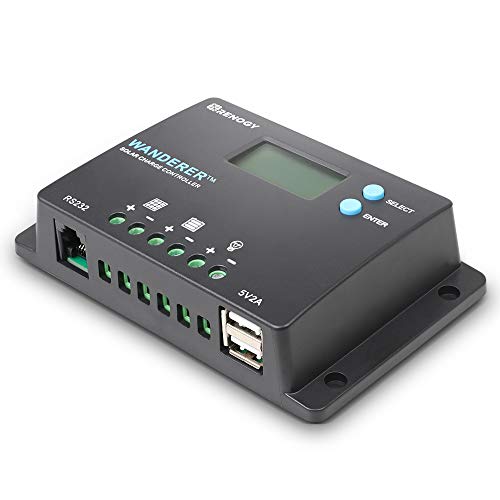
Best Compact Low-Load Controller – Renogy Wanderer 10A PWM
The Renogy Wanderer 10A is a compact PWM choice for smaller solar charging needs. It automatically supports 12V or 24V battery systems, offers four-stage charging for several battery chemistries, and includes an LCD for viewing voltage, current, and system status.
Best For: Small RV, marine, lighting, pump, and DIY off-grid systems with modest power demands.
Pros:
- Works with 12V and 24V battery systems.
- Supports AGM, gel, flooded, and manually selected lithium batteries.
- LCD shows voltage, current, and system status.
- Includes load control modes and protections for overcharge, overload, short circuit, reverse polarity, and temperature concerns.
Cons:
- The 10A rating limits it to smaller solar arrays and loads.
- It uses PWM charging rather than MPPT.
- Bluetooth monitoring requires the optional BT-1 module.
This controller makes sense when installation space is tight and the system’s charging demand is modest. Its LCD and flexible load-control options provide useful functionality without stepping up to a larger controller.
High-Capacity Pick – POWLAND 120A MPPT Solar Charge Controller
For large or varied battery banks, the POWLAND 120A is one of the most flexible solar charge controllers in this roundup. It automatically supports 12V through 96V systems, uses MPPT tracking, and provides an LCD for checking charging data and warnings.
Best For: RVs, off-grid homes, and mobile power stations needing broad voltage compatibility and high charging capacity.
Pros:
- Supports automatic voltage detection from 12V to 96V.
- 120A capacity and MPPT technology rated up to 98% efficiency.
- Includes protection features, three-stage charging, and an LCD dashboard.
Cons:
- The controller is more capability than smaller, simpler systems may require.
- The supplied details do not list a solar-panel maximum power rating.
Its standout advantage is versatility: the wide voltage range and battery support make it adaptable, while the monitoring screen helps with setup and troubleshooting. Confirm your system’s electrical requirements before installation.
Connected Choice – Victron Energy SmartSolar MPPT 100/50
The Victron Energy SmartSolar 100/50 is a well-suited option for buyers who want app-based control of their solar charge controllers. It is designed for 12V or 24V systems, with MPPT tracking, Bluetooth connectivity, synchronized charging, and configurable load output.
Best For: 12V/24V solar systems where remote monitoring, configurable settings, and coordinated charging are priorities.
Pros:
- VictronConnect provides real-time data, 30-day history, settings, firmware updates, and alarms.
- MPPT tracking is designed to optimize output, including during partial shading.
- Multiple units can synchronize charging stages, and the load output can disconnect low-voltage loads.
Cons:
- It supports 12V and 24V systems rather than the wider voltage range of some alternatives.
- There is no built-in display, so monitoring relies on the app.
This is the strongest fit for a connected installation rather than a controller you expect to read directly from its casing. Its app features and synchronization options add useful control for more organized solar setups.
Simple Setup Pick – 100A MPPT Solar Charge Controller
This 100A MPPT model targets buyers who want straightforward setup and on-device visibility from their solar charge controllers. It automatically recognizes 12V or 24V batteries, includes an LCD, and offers adjustable settings intended for lithium battery installations.
Best For: Home or commercial 12V/24V systems seeking simple installation, LCD monitoring, and lithium-battery adjustment options.
Pros:
- 12V/24V auto-recognition simplifies initial setup.
- LCD shows real-time performance information and supports setting adjustments.
- MPPT operation is rated up to 99% efficiency and includes key protection features.
Cons:
- Its automatic recognition is limited to 12V and 24V systems.
- The supplied details do not specify a solar-input voltage limit or maximum panel power.
With its plug-and-play emphasis, LCD interface, and stated lithium-battery tuning support, this controller is practical for users who prefer local controls over app-based monitoring. Verify panel and battery specifications before connecting it.
Smart Monitoring Pick – Victron Energy SmartSolar MPPT 75V 15A
For buyers prioritizing efficient energy harvesting and connected monitoring, this Victron Energy unit is a compact choice among solar charge controllers. Its MPPT tracking is designed to maximize available output, including during partial shading, while Bluetooth connectivity supports setup and performance checks through the VictronConnect app.
Best For: Small 12V or 24V solar systems where app-based monitoring, configurable charging, and efficient MPPT performance matter.
Pros:
- Bluetooth connectivity provides real-time data, performance history, configuration, firmware updates, and alarms through VictronConnect.
- MPPT tracking and intelligent charging algorithms help maximize solar harvest, including in partial shade.
- Supports synchronized operation with multiple SmartSolar MPPT controllers.
- Configurable intelligent load output can disconnect loads when battery voltage falls too low.
Cons:
- Limited to 15A and 12/24V systems, so it is intended for smaller installations.
- The product details describe only an LED or minimal display; detailed monitoring relies on the app.
Choose this model when compact size and smart connectivity are more important than high current capacity. Its synchronized charging and configurable load output also make it a useful building block for a carefully managed small solar setup.
Best Heavy-Duty Pick – Renogy Rover Lite 60A MPPT
This Renogy Rover Lite is built for larger DIY installations that need more current capacity and a higher solar-input ceiling. Among solar charge controllers, its 60A rating, 150V maximum solar input, and 12V-to-48V battery support provide flexibility for expanding systems, while the LCD keeps basic operation accessible without a phone.
Best For: Larger DIY solar setups using 12V, 24V, 36V, or 48V batteries and compatible panel arrays.
Pros:
- 150V maximum solar input can accommodate up to six Renogy 200W monocrystalline panels in series, according to the supplied specifications.
- Supports 12V, 24V, 36V, and 48V battery systems and gel, sealed, flooded, and lithium batteries.
- Designed for full-load operation from -31°F to 113°F, with lithium low-temperature protection and self-cooling.
- Includes an LCD, battery temperature sensor, and mounting screws; Bluetooth monitoring is available with an optional module.
Cons:
- Bluetooth functionality requires a separately purchased module.
- The listing states compatibility only with BT2 Bluetooth modules sold separately.
- Its 60A capacity and high-voltage input may be unnecessary for smaller systems.
This is the stronger fit for buyers planning a higher-output, multi-panel installation rather than a compact RV setup. Verify panel and battery compatibility before purchasing, especially when using lithium batteries or higher-voltage series arrays.
RV and Marine Favorite – Renogy Rover 30A MPPT
The Renogy Rover 30A is a practical option for 12V and 24V installations such as RVs, cabins, and marine systems. This solar charge controller combines automatic voltage detection, adjustable parameters, LCD status information, multiple battery profiles, and protective features for users who want hands-on control without moving to a larger 60A unit.
Best For: RV, marine, and off-grid 12V/24V systems using gel, sealed, flooded, or lithium batteries.
Pros:
- Supports up to 400W at 12V or 800W at 24V, with a maximum panel Voc of 100V.
- MPPT algorithms are designed to maintain harvesting performance in partial shade and cloudy conditions.
- Offers four-stage charging, lithium reactivation, temperature compensation, and support for several battery types.
- Includes surge, reverse-polarity, and overload protection, plus direct DC load control and timer scheduling.
Cons:
- Bluetooth monitoring requires the separately sold BT2 module.
- Its 30A rating and 12V/24V scope limit it compared with higher-capacity controllers.
- The supplied dimensions are relatively large for a compact controller.
For moderate-size mobile or remote systems, this Rover balances battery compatibility, protection, and adjustable charging features well. It is especially appealing when direct DC load management and optional app monitoring are useful, but confirm the array wattage and voltage limits first.
How We Picked These Solar Charge Controllers
We selected controllers that cover common residential, RV, cabin, marine, and backup-power applications. The lineup includes both affordable PWM models and more efficient MPPT designs, with a range of charging capacities from compact 10A units to high-output controllers rated at 100A or more.
We focused on practical specifications: supported battery voltages, solar input limits, battery-chemistry compatibility, display or app-based monitoring, adjustable charging parameters, and installation flexibility. Brand reputation and the availability of features such as Bluetooth connectivity, LCD status screens, and automatic voltage detection were also considered.
Quick Comparison
| Controller type | Best suited for | Main advantage | Typical trade-off |
|---|---|---|---|
| 10A–30A PWM | Small 12V systems and basic lighting | Low purchase price and simple setup | Lower energy harvest than MPPT |
| 15A–50A MPPT | RV, cabin, and medium-size battery banks | Better efficiency and flexible array design | Higher cost |
| 60A–120A MPPT | Large off-grid or backup systems | High charging capacity and broader voltage support | Requires careful wiring, fusing, and heat management |
Key Buying Factors for Solar Charge Controllers
PWM or MPPT
PWM controllers are economical and work well with small systems where panel and battery voltages closely match. MPPT controllers are generally the better choice when maximizing output matters, especially in cold weather, partial shade, or systems using higher-voltage solar arrays.
Current and System Voltage
Choose a controller whose rated charging current exceeds the array’s expected output. Confirm that it supports your battery bank’s nominal voltage, such as 12V, 24V, 36V, or 48V. Larger systems may need multiple controllers or a high-current model designed for the intended battery bank.
Solar Input Limits
Check both maximum PV voltage and allowable solar wattage. Exceeding the controller’s voltage limit can cause permanent damage. Leave a sensible safety margin, particularly in cold climates where panel open-circuit voltage rises.
Battery Compatibility and Configuration
Verify support for flooded, sealed, gel, AGM, or lithium batteries. Lithium systems often require adjustable charging parameters and, depending on the installation, communication with a battery-management system. Temperature compensation can also be valuable for lead-acid batteries.
Monitoring and Installation
LCD displays provide convenient local status information, while Bluetooth or app support allows remote monitoring and configuration. Also check terminal sizes, enclosure ventilation, wire requirements, fuse placement, and whether an external temperature sensor is included.
Who Should Buy Which Solar Charge Controllers?
- Small 12V setups: Choose a compact PWM controller for modest panels, basic lighting, security equipment, or a small battery bank.
- RV and cabin owners: A 15A–50A MPPT controller offers a strong balance of efficiency, adjustability, and manageable installation.
- Lithium battery users: Prioritize models with a dedicated lithium profile or fully adjustable charging settings.
- Large off-grid systems: Consider a 60A–120A MPPT controller only after confirming panel voltage, array wattage, battery-bank voltage, cable sizing, and required overcurrent protection.
- Users who want simple monitoring: Select a controller with an integrated LCD display; choose Bluetooth when remote configuration and performance tracking are more important.
Before buying, compare the controller’s electrical limits with the complete system—not just the panel wattage. A properly sized unit with suitable battery settings and adequate ventilation will deliver safer, more reliable charging over time.