The right solar charge controller helps your RV solar system charge safely, efficiently, and consistently while protecting the battery bank from overcharging. The best choice depends on your panel capacity, battery chemistry, system voltage, and how much monitoring you want.
We selected 10 popular MPPT and PWM controllers for RV owners, from compact 10-amp units to higher-capacity 50-amp models. Use the guide below to compare their strengths and choose a controller that fits your setup.
Best 10 Solar Charge Controller for Rv Picks for 2026
Best Smart MPPT Pick

- MPPT charging helps maximize solar harvest
- Bluetooth app tracks and configures the system
- Supports synchronized multi-controller charging
Best For: Efficient, connected RV solar systems
Best Flush-Mount PWM Option

- Automatic 12V/24V system detection
- LCD display and flush-mount installation
- Supports lithium and traditional battery types
Best For: Integrated RV panels and easy status checks
Best for Larger Solar Arrays

- Higher 50A charging capacity
- MPPT optimization for variable sunlight
- Bluetooth monitoring and multi-controller synchronization
Best For: Larger 12V/24V RV solar systems
Best Compact 12V Value

- Compact 12V PWM design for tight spaces
- Supports lithium, AGM, gel, and flooded batteries
- Includes multiple electrical protection features
Best For: Small 12V RV and marine installations
Best Smart Monitoring Pick
Victron Energy SmartSolar MPPT 75V 15A

- MPPT charging helps maximize available solar power
- Bluetooth app supports monitoring and configuration
- Configurable load output and synchronized charging
Best For: Smaller RV solar systems needing efficient charging and smart monitoring
Best High-Capacity Option
Renogy Rover 40A MPPT Controller

- 40A MPPT capacity suits larger RV solar arrays
- Supports 12V/24V systems and several battery types
- LCD and extensive electrical protection included
Best For: Higher-demand RV systems with lead-acid or lithium batteries
Best Compact Budget Choice
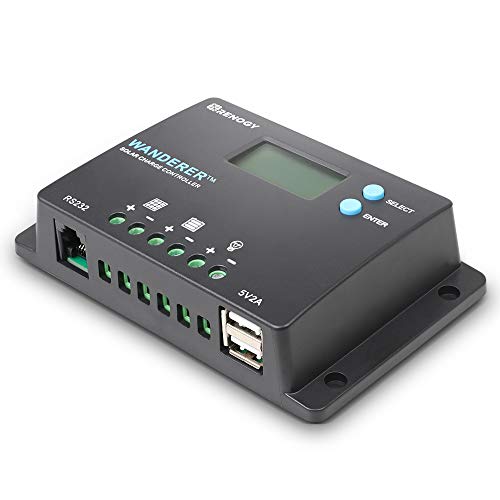
- Compact design fits RV electrical cabinets
- LCD and adjustable load-control modes
- Supports 12V/24V systems and multiple battery types
Best For: Small RV solar arrays and simple DC-load applications
Best Compact 12V Pick
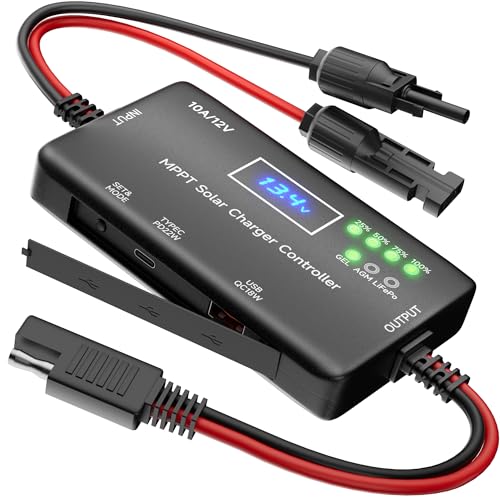
- 10A MPPT charging for 12V systems
- LCD, LED, USB, and Type-C outputs
- Supports LiFePO4, AGM, gel, and lead-acid batteries
Best For: Small 12V RV and portable solar systems
Best Connected 20A Pick
Renogy Rover 2 MPPT Controller

- 20A charging for 12V or 24V systems
- Built-in Bluetooth, LCD, and Renogy app monitoring
- Supports up to 100V PV input and 300W/600W arrays
Best For: Connected RV systems needing flexible monitoring
Best High-Capacity RV Pick
Renogy Rover 30A MPPT Controller

- 30A charging for 12V or 24V systems
- Handles up to 400W/800W PV arrays
- Supports lithium and lead-acid battery types
Best For: Larger RV and off-grid solar installations
Best Smart MPPT Pick – Victron SmartSolar 100V/30A
Victron Energy SmartSolar MPPT 100V 30 amp 12/24-Volt Solar Charge Controller (Bluetooth)
Check Price On AmazonFor RV owners who want efficient charging and app-based visibility, this Victron Energy SmartSolar is a strong solar charge controller for RV systems. Its MPPT tracking is designed to maximize available solar power, including in partial shade, while supporting 12V and 24V battery systems.
Best For: RV solar setups where charging efficiency, Bluetooth monitoring, and configurable load protection matter.
Pros:
- MPPT tracking helps capture more available solar energy, even with partial shading.
- VictronConnect provides real-time data, performance history, settings, firmware updates, and alarms.
- Supports synchronized charging with multiple SmartSolar controllers.
- Includes an intelligent load output with configurable low-voltage disconnect.
Cons:
- Does not include a built-in display, so monitoring relies on the app.
- Its advanced features may be more than needed for a small, basic RV system.
Choose this model when you want a feature-rich MPPT controller that can grow with a more involved RV electrical system. The 30A rating and 12/24V compatibility make it versatile, while Bluetooth adds convenient setup and monitoring.
Best Flush-Mount PWM Option – Renogy Adventurer 30A
The Renogy Adventurer 30A is a practical solar charge controller for RV owners who want an integrated installation and an easy-to-read display. It automatically detects 12V or 24V systems, supports several battery chemistries, and uses PWM charging with multiple charging stages.
Best For: RV installations needing a flush-mount controller, LCD status information, and broad battery compatibility.
Pros:
- Automatically detects 12V/24V systems.
- Supports sealed, gel, flooded, and lithium batteries.
- Flush-mount design and included surface kit suit integrated RV installations.
- Backlit LCD shows charging information, diagnostics, and system status.
Cons:
- PWM charging generally offers less solar-harvesting efficiency than MPPT.
- Some app functionality requires compatible Renogy monitoring hardware.
This is a sensible choice for RV owners prioritizing straightforward installation and on-controller visibility. Its 30A capacity and battery-type support provide flexibility for common 12V and 24V recreational-vehicle systems.
Best for Larger Solar Arrays – Victron SmartSolar 100V/50A
With a 50A output rating, this Victron SmartSolar is suited to RV solar systems that need more charging capacity than a compact controller provides. Its MPPT technology is designed to maximize solar input, and Bluetooth connectivity makes configuration and performance tracking convenient.
Best For: Higher-capacity RV solar installations using 12V or 24V batteries and multiple panels.
Pros:
- 50A rating accommodates a larger charging setup.
- MPPT tracking helps optimize output in changing sunlight and partial shade.
- VictronConnect offers real-time data, 30-day history, configuration, and alarms.
- Multiple units can synchronize charging stages.
Cons:
- No built-in display is included.
- The larger 50A capacity may be unnecessary for a small RV array.
If your RV system is expanding beyond a basic panel-and-battery setup, the higher current rating gives this controller useful headroom. It combines scalable charging with the monitoring and configuration tools associated with Victron’s SmartSolar line.
Best Compact 12V Value – Renogy Wanderer Li 30A
The Renogy Wanderer Li 30A is a compact solar charge controller for RV owners running a 12V system. Its PWM charging profiles support lithium, AGM, gel, and flooded batteries, while LED indicators provide a simple way to check charging stages and system status.
Best For: Compact 12V RV, marine, and off-grid installations that need basic battery-chemistry flexibility.
Pros:
- 30A PWM controller supports lithium, AGM, gel, and flooded batteries.
- Compact dimensions suit tight RV or marine compartments.
- Built-in protections address reverse polarity, overcharging, overload, and short circuits.
- Optional BT-1 module enables app-based monitoring of system data and alerts.
Cons:
- Designed for 12V systems rather than automatic 12V/24V operation.
- PWM technology may be less efficient than MPPT for some solar installations.
- Advanced Bluetooth monitoring requires the separately referenced BT-1 module.
This controller is a good fit when installation space is limited and the RV uses a straightforward 12V battery bank. Its selectable battery support and compact housing make it flexible, while the 30A rating covers many modest RV solar setups.
Best Smart Monitoring Pick – Victron Energy SmartSolar MPPT 75V 15A
For RV owners who want efficient charging and detailed system visibility, the Victron Energy SmartSolar MPPT 75V 15A is a capable solar charge controller for RV installations. Its MPPT tracking is designed to maximize available solar power, including during partial shading, while Bluetooth connectivity supports app-based monitoring and configuration.
Best For: RV solar systems where efficient MPPT charging, Bluetooth monitoring, and configurable load control are priorities.
Pros:
- MPPT tracking helps maximize power output in changing or partially shaded conditions.
- VictronConnect provides real-time data, performance history, settings, firmware updates, and alarms.
- Supports synchronized charging across multiple compatible SmartSolar controllers.
- Includes intelligent load output with configurable low-voltage disconnect.
Cons:
- Its 15A rating is better suited to smaller solar arrays than high-power RV systems.
- The minimal LED display provides less at-a-glance information than a built-in LCD.
This is a compact, feature-rich choice for RVers who value charging efficiency and app-based control. Confirm that the 15A capacity matches your panel array and battery setup before buying.
Best High-Capacity Option – Renogy Rover 40A MPPT Controller
The Renogy Rover 40A is a strong candidate for a solar charge controller for RV systems with larger panel arrays. Its 40A MPPT design, 12V/24V automatic detection, LCD, broad battery compatibility, and multiple electrical protections make it suited to more demanding off-grid setups.
Best For: Larger RV solar installations using 12V or 24V batteries and lead-acid or lithium battery chemistries.
Pros:
- 40A MPPT capacity supports more substantial solar charging systems.
- Automatically detects 12V or 24V battery systems.
- Supports Gel, AGM, flooded, and lithium batteries with chemistry-specific charging stages.
- Includes reverse-polarity, overcharge, overload, short-circuit, and reverse-current protection.
Cons:
- Bluetooth app connectivity requires the separately sold BT-2 accessory.
- Its larger housing may require more installation space than compact controllers.
Choose the Rover 40A when your RV system needs more charging capacity and a built-in LCD. Check array current, battery voltage, available mounting space, and required accessories before installation.
Best Compact Budget Choice – Renogy Wanderer 10A PWM
The Renogy Wanderer 10A is a compact, straightforward solar charge controller for RV use with smaller 12V or 24V systems. Its PWM charging, LCD, load-control modes, battery compatibility, and protective features provide practical control for modest panels, lighting, pumps, and other DC loads.
Best For: Compact RV or marine installations with smaller solar arrays and 12V/24V battery systems.
Pros:
- Compact housing fits RV electrical cabinets and marine control panels.
- Supports AGM, Gel, flooded, and manually configured lithium batteries.
- LCD displays voltage, current, and system status.
- Provides multiple load-control modes and protections against common electrical faults.
Cons:
- The 10A PWM design is less suitable for larger solar arrays than an MPPT controller.
- Bluetooth monitoring requires the separately sold BT-1 module.
- Its IP32 rating is intended for protected installation rather than direct exposure to water.
This Wanderer model is a sensible space-saving option for basic RV solar upgrades. Keep the panel and load sizes within its 10A capacity, and install it in a suitably protected location.
Best Compact 12V Pick – SUNAPEX 10A MPPT Controller
If you need a straightforward solar charge controller for RV use, the SUNAPEX offers 10A MPPT charging for 12V battery systems. Its compact design, LCD status display, USB and Type-C outputs, and SAE connectors make it practical for smaller portable setups.
Best For: RV owners with 12V lead-acid, AGM, gel, or LiFePO4 batteries and modest solar installations.
Pros:
- Supports several 12V battery types, including LiFePO4, AGM, gel, and lead-acid.
- LCD and LED indicators show battery voltage, charging status, and current.
- USB and Type-C ports can charge compatible devices directly.
- Includes multiple protections and a four-stage charging process.
Cons:
- Only suitable for 12V batteries; it cannot be used with 24V or 36V packs.
- Requires correct polarity and does not include a polarity converter.
- Its 10A output is intended for smaller systems rather than high-demand RV arrays.
This is a sensible choice when compact size and simple monitoring matter more than high charging capacity. Confirm that your panel does not already have an integrated controller and that your system is strictly 12V before buying.
Best Connected 20A Pick – Renogy Rover 2 MPPT Controller
The Renogy Rover 2 is a versatile solar charge controller for RV installations that need more capacity and convenient monitoring. It supports 12V or 24V systems, accepts up to 100V of solar input, and combines an LCD with built-in Bluetooth access through the Renogy app.
Best For: RV, van, camper, boat, and cabin owners who want 20A charging with phone-based system monitoring.
Pros:
- Handles up to 300W on 12V systems or 600W on 24V systems.
- Built-in Bluetooth enables remote monitoring and battery preset adjustments without an external dongle.
- Supports lithium, AGM, gel, flooded, and user-defined battery profiles.
- Compact housing fits tighter installation spaces and can operate at full 20A output up to 113°F.
Cons:
- Its 20A capacity may be limiting for larger RV solar arrays.
- Bluetooth and app monitoring depend on using the Renogy ecosystem.
- Installation must stay within the listed 100V PV and system-capacity limits.
Choose the Rover 2 when remote visibility and flexible 12V/24V compatibility are priorities. Its parallel-controller support also gives you a path to expand the system as your energy needs increase.
Best High-Capacity RV Pick – Renogy Rover 30A MPPT Controller
For a larger RV solar setup, the Renogy Rover 30A provides higher-capacity MPPT charging for 12V and 24V battery systems. It supports substantial solar arrays, adjustable charging parameters, LCD monitoring, and compatibility with an optional BT2 Bluetooth module.
Best For: Larger RV, marine, and off-grid systems using gel, sealed, flooded, or lithium batteries.
Pros:
- Supports up to 400W on 12V systems or 800W on 24V systems with PV Voc up to 100V.
- 30A MPPT charging uses multi-peak tracking for partial-shade and cloudy conditions.
- Offers four-stage charging, lithium reactivation, temperature compensation, and multiple safeguards.
- Can power DC appliances and schedule loads; optional BT2 adds app monitoring and alerts.
Cons:
- Bluetooth monitoring requires the separately sold BT2 module.
- Its larger capacity and feature set may be unnecessary for small RV arrays.
- System installation must remain within the specified PV voltage and wattage limits.
The Rover 30A is the strongest match here for demanding RV systems that need expansion room, robust protection, and support for multiple battery chemistries. It is especially appealing when partial shading, temperature swings, or DC loads are part of the installation.
How We Picked the Best Solar Charge Controller for Rv
We focused on controllers that suit common 12V and 24V RV solar systems, including compact setups, larger battery banks, and lithium upgrades. Our comparison considers charging technology, rated amperage, supported battery types, voltage compatibility, display and Bluetooth features, installation practicality, and overall flexibility.
MPPT models generally extract more usable power from solar panels, especially in cool conditions, during partial shade, or when panel voltage is noticeably higher than battery voltage. PWM controllers can still be a practical choice for smaller, budget-conscious systems using compatible panels and batteries.
Quick Comparison
- Best overall flexibility: Victron Energy SmartSolar MPPT models with Bluetooth monitoring.
- Best for larger RV systems: A 40A or 50A MPPT controller, depending on array size and battery bank.
- Best compact MPPT option: A 15A or 20A controller for modest panel arrays.
- Best budget-friendly approach: Renogy PWM controllers for smaller conventional battery systems.
- Best for lithium-focused setups: A controller specifically supporting LiFePO4 charging profiles, such as the Renogy Wanderer Li or compatible MPPT models.
Key Buying Factors for a Solar Charge Controller for Rv
Controller Type and Solar Array Size
Choose the controller’s current rating based on the solar array’s expected charging current, not simply the panel wattage. A 30A controller is often suitable for a moderate 12V RV array, while 40A and 50A units provide more headroom for larger installations. Leave reasonable capacity for future expansion.
Battery Chemistry
Confirm that the controller supports your battery type. Flooded, AGM, gel, and LiFePO4 batteries use different charging profiles. Lithium batteries may require a dedicated lithium setting, adjustable parameters, or a controller recommended by the battery manufacturer.
System Voltage and Panel Limits
Check both battery voltage and maximum solar input voltage. Many listed models support 12V and 24V battery systems, but their panel-voltage limits differ. Exceeding the controller’s solar input rating can cause damage.
Monitoring and Installation
Bluetooth is useful for checking charging performance from a phone, while an LCD provides convenient local readings. Also verify terminal size, cable requirements, grounding arrangement, enclosure location, and whether an appropriate fuse or breaker is included in your installation plan.
Who Should Buy Which Solar Charge Controller for Rv?
Choose a compact PWM controller if you have a small, straightforward RV array and want low cost. Choose MPPT for better energy harvest, longer cable runs, variable weather, or higher-efficiency panels. A 15A or 20A unit fits modest loads; 30A is a versatile middle ground; and 40A or 50A makes more sense for larger arrays and battery banks.
For the easiest remote monitoring, prioritize a Bluetooth-equipped Victron or Renogy model. For lithium conversions, select a controller with confirmed LiFePO4 support and adjustable charging settings. Before buying, match the controller to the panel array, battery specifications, and manufacturer installation requirements rather than choosing by amperage alone.