Finding a stud accurately can mean the difference between a secure installation and unnecessary wall damage. The best stud finders make it easier to locate framing, detect edges or centers, and identify hazards such as live electrical wiring.
We’ve compared 10 popular stud finders, including magnetic models, multi-sensor scanners, and electronic tools with visual or audible alerts, to help you choose the right option for your next project.
Best 10 Stud Finders Picks for 2026
Most Capable Overall
Franklin Sensors ProSensor M210

- 13 sensors show full stud width
- Deep scanning up to 1.7 inches
- Live-wire detection and bubble level
Best For: Detailed wall scanning and mounting projects
Best Battery-Free Pick
CH Hanson Magnetic Stud Finder

- No batteries or calibration required
- Rare-earth magnets locate hidden fasteners
- Rotating level aids precise marking
Best For: Simple mounting and household projects
Best for Guided Scanning

- LCD, tone, and SpotLite Pointer feedback
- Two depth modes up to 1.5 inches
- Live-wire alerts up to 2 inches deep
Best For: Guided edge detection before mounting or drilling
Best Compact Electronic Option
Franklin Sensors ProSensor M90

- Nine sensors show full stud width
- No calibration required
- Deep detection up to 1.5 inches
Best For: Routine DIY mounting in a compact format
Simple Magnetic Pick
StudBuddy Magnetic Stud Finder

- No batteries or calibration needed
- Locates drywall fasteners with strong magnets
- Made in the USA; not for lath-and-plaster
Best For: Quick drywall and wood-stud locating
Multifunction Scanning Pick
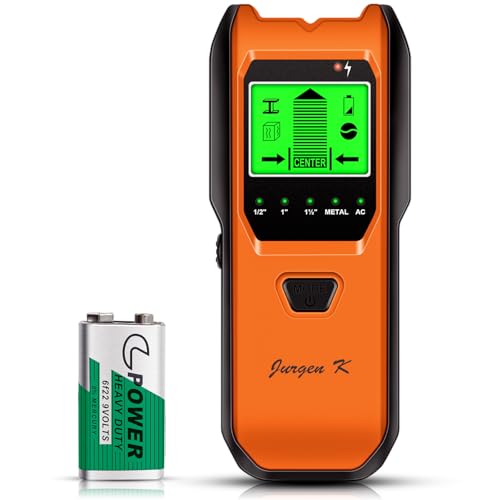
- Scans studs, metal, AC wires, and pipes
- Includes five depth and material modes
- LCD, audio alarm, auto calibration, and 9V battery
Best For: Renovation and installation projects needing broader detection
Durable Edge-Detection Pick
CRAFTSMAN CMHT77633 Stud Finder

- Finds wood and metal stud edges
- Works through wallpaper and fabric
- Shock- and water-resistant with lifetime warranty
Best For: Routine wall projects on covered surfaces
Efficient Center Finding

- Center-find technology with marking channel
- Detects wood and metal up to 3/4 inch
- LED arrows, audible alert, and AC detection
Best For: DIYers scanning suitable wall surfaces
Wall-Safe Multi-Scan

- Shows stud edges and full width with LEDs
- Scans wood, metal, and live AC wires
- Protective backing helps prevent wall marks
Best For: Users wanting versatile, wall-safe scanning
Deep-Scan Versatility

- Five-in-one scanning for studs, metal, and AC
- LCD graphics with audio alerts
- Includes 9V battery, pouch, and manual
Best For: Drywall projects needing multiple scan depths
Most Capable Overall – Franklin Sensors ProSensor M210
For shoppers comparing stud finders, the Franklin Sensors ProSensor M210 is a feature-rich wall scanner designed to show the full width of wood and metal studs. Its 13-sensor layout, always-on deep scanning, and live-wire detection make it well suited to more demanding mounting and drilling tasks.
Best For: Homeowners and DIYers who want broad stud readings, deeper detection, and added safety features.
Pros:
- 13 sensors display the full width of studs and double studs.
- Detects wood and metal studs up to 1.7 inches deep.
- Requires no calibration and includes live-wire detection.
- Built-in bubble level and pencil caddy add convenience.
Cons:
- Two AA batteries are required and are not included.
- Its larger feature set may be more than needed for simple locating jobs.
The M210 is a strong choice when accuracy, coverage, and versatility matter more than minimal size. The illuminated full-width display and no-calibration operation make it practical for mounting projects.
Best Battery-Free Pick – CH Hanson Magnetic Stud Finder
The CH Hanson Magnetic Stud Finder is a compact option for shoppers who prefer simple, battery-free stud finders. Its rare-earth magnets locate nails and screws behind common wall materials, while the rotating level helps with marking installation points.
Best For: Quick household projects such as mounting shelves, TVs, cabinets, mirrors, and artwork.
Pros:
- Requires no batteries, charging, calibration, or setup.
- Rare-earth magnets help locate fasteners behind drywall, plaster, and paneling.
- Built-in rotating level supports horizontal and vertical marking.
- Lightweight, pocket-sized design includes a limited lifetime warranty.
Cons:
- It locates nails and screws rather than electronically displaying the full stud width.
- It does not include electronic live-wire detection.
This is a straightforward choice for users who value reliability and zero battery maintenance. It is especially convenient for basic mounting work where locating hidden fasteners is sufficient.
Best for Guided Scanning – Zircon StudSensor A100
The Zircon StudSensor A100 offers guided electronic scanning for shoppers comparing stud finders with visual and audible feedback. It identifies stud edges in two depth modes and adds WireWarning detection for live, unshielded AC wiring while scanning.
Best For: DIYers who want clear edge detection and step-by-step calibration for mounting or drilling.
Pros:
- LCD screen, audio tone, and SpotLite Pointer help identify stud edges.
- StudScan reaches 3/4 inch, while DeepScan reaches up to 1 1/2 inches.
- WireWarning Detection identifies live, unshielded AC wiring up to 2 inches deep.
- Low-battery indicator helps signal when scanning power is insufficient.
Cons:
- Requires calibration against the wall before scanning.
- One 9V alkaline battery is required and is not included.
- It focuses on locating stud edges rather than showing the full stud width.
The A100 is a practical fit for users who appreciate guided operation and multiple feedback methods. Its two scan modes and wire alerts provide useful flexibility for common wall projects.
Best Compact Electronic Option – Franklin Sensors ProSensor M90
The Franklin Sensors ProSensor M90 is a compact electronic choice for shoppers seeking stud finders that are quick to use without calibration. Its nine sensors show the full width of wood and metal studs, with deep detection reaching up to 1.5 inches.
Best For: Everyday DIY mounting jobs where compact size and simple full-width scanning are priorities.
Pros:
- Nine sensors display stud width, double studs, and stud centers.
- Starts scanning without calibration and detects wood and metal studs.
- Deep detection reaches up to 1.5 inches.
- Compact, lightweight design is easy to handle.
Cons:
- Two AAA batteries are required and are not included.
- It is not compatible with rechargeable batteries.
- It does not list live-wire detection among its features.
The M90 balances a compact form with the convenience of full-width LED scanning. It is a sensible everyday option for users who want simpler operation than a calibrated edge-finding scanner.
Simple Magnetic Pick – StudBuddy Magnetic Stud Finder
If you want a straightforward stud finder for standard drywall, the StudBuddy uses powerful neodymium magnets to locate screw and nail heads attached to wood or metal studs. It requires no batteries, calibration, or moving parts, making it easy to keep ready for quick projects.
Best For: Homeowners who need a simple, battery-free stud finder for drywall and wood construction.
Pros:
- No batteries, calibration, or moving parts required
- Magnetic design points to screw and nail locations
- Made in the USA from durable materials
- Lightweight and easy to use
Cons:
- Not intended for lath-and-plaster walls
- Locates fasteners rather than electronically scanning for wires or pipes
The StudBuddy is a focused choice when you mainly work with drywall. Its simple magnetic operation keeps setup and maintenance to a minimum, though broader renovation tasks may call for a multifunction wall scanner.
Multifunction Scanning Pick – Jurgen K 5-in-1 Wall Scanner
For projects where you need more than basic stud detection, this 5-in-1 stud finder scans for wood studs, metal, AC wires, and pipes. Its LCD display, audio alarm, multiple depth modes, and included 9V battery provide more information for tasks such as mounting TVs, cabinets, or garage racks.
Best For: DIYers and professionals who want multifunction detection for walls, floors, and ceilings.
Pros:
- Detects studs, metal, AC wires, and pipes
- Offers 1/2-inch, 1-inch, 1.5-inch, metal, and AC scan modes
- LCD display and continuous beep indicate detected objects
- Ergonomic grip, auto calibration, and included 9V battery
Cons:
- Requires calibration before use
- Battery replacement is eventually required
- More features may be unnecessary for simple drywall projects
The Jurgen K scanner is the more versatile option in this group. Its multiple scan modes and visual and audible feedback can support more complex installations, provided you follow the calibration procedure before scanning.
Durable Edge-Detection Pick – CRAFTSMAN CMHT77633 Stud Finder
The CRAFTSMAN CMHT77633 is a compact stud finder designed to locate the edges of wood and metal studs through drywall. Its 3/4-inch detection depth works through wallpaper and fabric, while the shock-resistant and water-resistant body is suited to regular project use.
Best For: Everyday wall projects involving drywall, wallpaper, or fabric-covered surfaces.
Pros:
- Locates the edges of wood and metal studs
- Works through wallpaper and fabric
- Detects to 3/4-inch depth through drywall
- Shock-resistant and water-resistant body with a full lifetime warranty
Cons:
- Has a more limited 3/4-inch detection range
- Designed for stud locating rather than multifunction wire, pipe, or metal scanning
This CRAFTSMAN model is a practical middle ground for common wall-hanging tasks. It adds surface versatility and a durable body while keeping the tool focused on locating stud edges rather than offering broader scanning modes.
Efficient Center Finding – DEWALT DW0100
The DEWALT DW0100 is a straightforward choice among stud finders for locating wood and metal framing studs behind suitable wall surfaces. Its center-find technology, directional LED arrows, and audible alert help guide you to a stud while its automatic calibration reduces setup time.
Best For: DIYers who want a slim, battery-powered stud finder with center marking and basic wire-detection features.
Pros:
- Center-find technology helps identify the stud center.
- Detects wood and metal studs up to 3/4 inch deep.
- Includes live AC-wire detection, LED arrows, and an audible alert.
- Constant auto-calibration and a center-marking channel simplify use.
Cons:
- It is not designed for concrete, brick, tile, plaster, carpeting, foil-faced materials, or metallic surfaces.
- It does not locate non-ferrous or plastic objects such as pipes.
- Its 3/4-inch detection depth may be limiting for deeper targets.
The DW0100 emphasizes simple, guided stud location rather than broad material scanning. It is a practical fit for suitable wall surfaces when center marking and live-wire awareness matter.
Wall-Safe Multi-Scan – Klein Tools ESF200
The Klein Tools ESF200 is one of the more versatile stud finders for quickly identifying stud edges and centers. It automatically calibrates and scans for wood, metal, and live AC wires without requiring separate material modes.
Best For: DIYers and professionals who want clear width and edge indications with a wall-protective design.
Pros:
- LED indicators show the full width and edges of studs.
- Automatically calibrates while moving between walls.
- Detects wood to 3/4 inch, ferrous metal to 1-1/2 inches, and AC voltage to 2 inches.
- Finger guard and protective felt backing help prevent wall marks.
Cons:
- The supplied notes do not specify included batteries.
- It may offer more scanning information than needed for simple stud-location tasks.
- Detection depths vary by material, so wood scanning is limited to 3/4 inch.
The ESF200 stands out for combining automatic calibration, multi-material detection, and wall-safe construction. Its edge-and-width indicators can make layout decisions easier when mounting objects.
Deep-Scan Versatility – Mecurate MSF60A
The Mecurate MSF60A gives stud finders shoppers multiple scan depths and a bright LCD display. Its modes cover standard and deep stud scanning, metal detection, and live AC-wire detection, with audio alerts for detected targets.
Best For: DIYers and homeowners who want a multi-mode scanner with on-screen graphics and included accessories.
Pros:
- Offers standard, deep, metal, and AC scanning modes.
- LCD graphics display real-time detection information.
- Detects studs up to 1-1/2 inches, metal up to 2-3/8 inches, and AC voltage up to 2 inches, depending on mode.
- Includes a 9V battery, carrying pouch, and user manual.
Cons:
- Requires calibration against the wall before each use for best accuracy.
- Performs best on single-layer drywall.
- Not recommended for concrete, brick, tile, or other non-drywall surfaces.
The MSF60A is a feature-rich option for projects where adjustable scan depth and an LCD readout are useful. Its material limitations make it best suited to careful drywall work rather than general masonry scanning.
How We Picked the Best Stud Finders
We focused on practical performance, detection features, ease of use, and overall value. The selection includes simple battery-free magnetic locators, center-finding electronic scanners, and multifunction models designed to detect studs, metal, and live AC wiring. We also considered useful details such as display readability, built-in levels, alert systems, detection depth, power requirements, and suitability for occasional or repeated DIY use.
No stud finder should be treated as a guaranteed safety device. Wall construction, moisture, surface materials, wiring depth, and user technique can affect readings. Always verify results before drilling or cutting.
Quick Comparison
| Type | Best For | Main Advantage | Trade-Off |
|---|---|---|---|
| Magnetic | Basic drywall projects | No batteries and simple operation | Usually locates fasteners rather than the full stud |
| Electronic center finder | Mounting shelves, cabinets, and TVs | Helps identify stud centers | Requires calibration and batteries |
| Multi-scan wall scanner | Renovation and mixed-wall materials | Can detect studs, metal, and wiring | More settings and potential for false readings |
| Edge finder | Precise layout work | Shows where a stud begins and ends | May require multiple passes |
Key Buying Factors for Stud Finders
Detection Type and Depth
Magnetic models are inexpensive and dependable for locating drywall screws or nails, but they do not always reveal the entire framing member. Electronic models can identify wood or metal behind the surface and may offer center or edge detection. A 3/4-inch rating is suitable for many common drywall applications, while deeper scanning can be useful for thicker walls or layered materials.
Live-Wire Detection
If you plan to drill near outlets, switches, or plumbing and electrical runs, live-wire detection is a valuable feature. It is an additional warning system, not a substitute for turning off power, checking circuit status, and following safe drilling practices.
Controls, Alerts, and Display
LED arrows, LCD screens, audio alarms, and signal-strength indicators can make readings easier to interpret. Choose a straightforward interface for occasional jobs, or a model with multiple scan modes if you regularly work on different wall materials.
Power and Portability
Battery-free magnetic tools are always ready to use. Electronic scanners generally need AA or AAA batteries, so check whether batteries are included and consider an automatic shutoff or battery indicator for frequent use.
Who Should Buy Which Stud Finders?
- For simple picture hanging: Choose a magnetic locator such as the CH Hanson or StudBuddy when you mainly need to find drywall fasteners.
- For shelves and heavier mounts: Consider a center-finding electronic model from Franklin Sensors, Zircon, DEWALT, or CRAFTSMAN.
- For renovation work: A Klein Tools, Mecurate, or other multifunction scanner is better suited to locating studs, metal, and possible live wires.
- For maximum scanning coverage: Franklin Sensors multi-sensor designs can help identify a wider stud area with fewer passes.