The HVAC industry remains a large and essential part of the building economy, spanning equipment manufacturing, contractor services, installation, maintenance, and energy use.
HVAC industry statistics
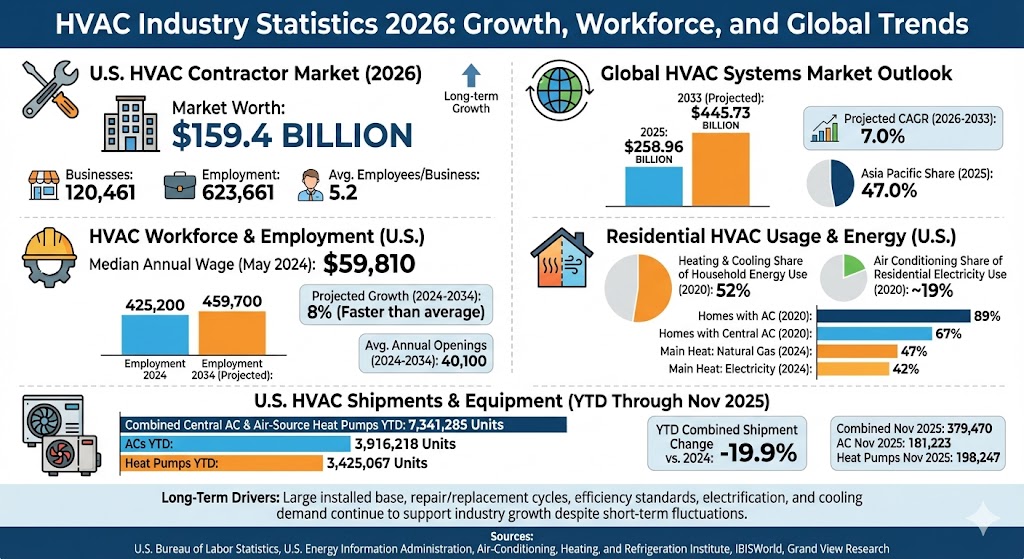
The latest available figures show a U.S. contractor market worth more than $159 billion, a workforce above 620,000 in the contractor segment, and continued long-term growth in heat pumps, cooling demand, and global HVAC system spending.
HVAC industry key statistics
The U.S. heating and air-conditioning contractor industry is worth $159.4 billion in 2026.
There are 120,461 HVAC contractor businesses in the U.S. in 2026.
U.S. HVAC contractor industry employment totals 623,661 in 2026.
The median annual wage for HVACR mechanics and installers was $59,810 in May 2024.
Employment of HVACR mechanics and installers is projected to grow 8% from 2024 to 2034.
About 40,100 HVACR job openings are projected each year, on average, over the decade.
The global HVAC systems market was valued at $258.96 billion in 2025 and is projected to reach $445.73 billion by 2033.
Asia Pacific accounted for 47.0% of global HVAC systems revenue in 2025.
Heating and air conditioning together accounted for 52% of U.S. household energy use in 2020.
Air conditioning alone accounted for about 19% of U.S. residential electricity consumption in 2020.
About 89% of U.S. homes used air conditioning in 2020, and 67% had central air conditioning.
In 2024, 42% of U.S. households used electricity as their main space-heating fuel, while 47% used natural gas.
Through November 2025, U.S. shipments of central air conditioners and air-source heat pumps totaled 7,341,285 units.
U.S. HVAC contractor market statistics
The U.S. contractor side of the HVAC industry is large, fragmented, and still growing. Revenue, business count, and employment all moved higher into 2026, even as growth rates moderated.
Metric
Value
U.S. HVAC contractor market size, 2026
$159.4 billion
U.S. HVAC contractor market size, 2025
$158.4 billion
U.S. HVAC contractor businesses, 2026
120,461
U.S. HVAC contractor employment, 2026
623,661
Average employees per HVAC business
5.2
Global HVAC market statistics
Global HVAC spending is larger than the U.S. contractor market alone and is expected to expand sharply through the early 2030s. Asia Pacific remains the largest regional market.
The HVAC labor market remains strong. Pay is above the median for many installation and repair jobs, and federal employment projections point to faster-than-average growth over the next decade.
Metric
Value
Median annual wage for HVACR mechanics and installers, May 2024
$59,810
Projected employment growth, 2024 to 2034
8%
Average annual openings, 2024 to 2034
40,100
BLS projected occupation employment, 2024
425,200
BLS projected occupation employment, 2034
459,700
Label
Bar
Value
Employment 2024
425,200
Employment 2034
459,700
Max = 459700. Widths: Employment 2024 92.50%, Employment 2034 100.00%
Residential HVAC usage and energy statistics
Residential heating and cooling remain two of the most important drivers of HVAC demand in the U.S. Homes are highly air-conditioned, and fuel choices for heating continue to shift over time.
Metric
Value
Heating and air conditioning share of household energy use, 2020
52%
Air conditioning share of residential electricity use, 2020
19%
U.S. homes using air conditioning, 2020
89%
U.S. homes with central air conditioning, 2020
67%
U.S. households using electricity as main space-heating fuel, 2024
42%
U.S. households using natural gas as main space-heating fuel, 2024
47%
Label
Bar
Value
Homes using air conditioning
89%
Homes with central air conditioning
67%
Households using natural gas for main heat
47%
Households using electricity for main heat
42%
Max = 89. Widths: Homes using air conditioning 100.00%, Homes with central air conditioning 75.28%, Households using natural gas for main heat 52.81%, Households using electricity for main heat 47.19%
HVAC shipments and equipment demand statistics
AHRI shipment data shows that 2025 remained a large-volume year for HVAC equipment, although shipments through November were lower than the same period in 2024. Central air conditioners and heat pumps still combined for more than 7.3 million units year to date.
Metric
Value
Combined U.S. central AC and air-source heat pump shipments, November 2025
379,470
U.S. central air conditioner shipments, November 2025
181,223
U.S. air-source heat pump shipments, November 2025
198,247
Combined U.S. central AC and air-source heat pump shipments, YTD through November 2025
7,341,285
U.S. central air conditioner shipments, YTD through November 2025
3,916,218
U.S. air-source heat pump shipments, YTD through November 2025
3,425,067
YTD combined shipment change vs. 2024
-19.9%
Label
Bar
Value
Combined shipments YTD 2025
7,341,285
Air conditioners YTD 2025
3,916,218
Heat pumps YTD 2025
3,425,067
Max = 7341285. Widths: Combined shipments YTD 2025 100.00%, Air conditioners YTD 2025 53.35%, Heat pumps YTD 2025 46.65%
Conclusion
The HVAC industry is supported by several long-term demand drivers: a large installed base of residential and commercial equipment, ongoing repair and replacement cycles, stricter efficiency standards, electrification trends, and continued cooling demand. While monthly equipment shipments can swing sharply year to year, the larger picture still points to a sizable U.S. contractor market, a growing skilled workforce, and a global HVAC market with strong growth expectations.
Sources
U.S. Bureau of Labor Statistics
U.S. Energy Information Administration
Air-Conditioning, Heating, and Refrigeration Institute