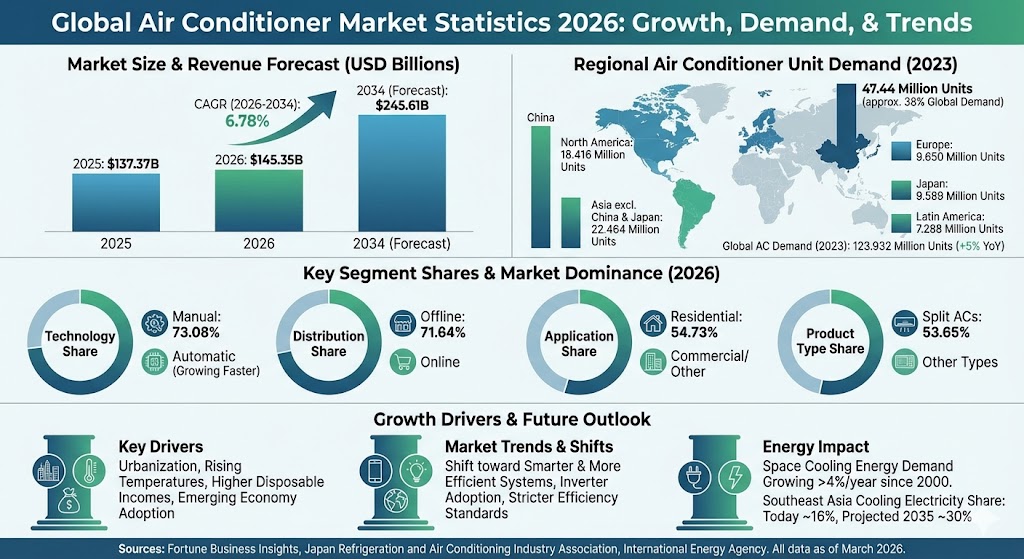
The air conditioner market is expanding steadily as cooling becomes more essential across homes, offices, and commercial buildings. Recent industry estimates place the global market at $145.35 billion in 2026, with revenue projected to rise to $245.61 billion by 2034. On the volume side, world air conditioner demand reached 123.932 million units in 2023, showing that the market is already operating at very large scale.
air conditioner market statistics
The statistics below combine revenue, segment share, and unit demand data to show where the market is today and where growth is concentrating.
Key Air Conditioner Market Statistics
The global air conditioner market is estimated at $145.35 billion in 2026.
The market is forecast to reach $245.61 billion by 2034.
The projected compound annual growth rate is 6.78% from 2026 to 2034.
Asia Pacific held a 52.96% market share in 2025 and is valued at $77.45 billion in 2026.
Split ACs are expected to account for 53.65% of the market in 2026.
The residential segment is expected to hold 54.73% of the market in 2026.
Offline distribution still leads with a 71.64% market share in 2026.
Manual technology holds the largest share at 73.08% in 2026, although automatic units are growing faster.
Global air conditioner demand reached 123.932 million units in 2023, up 5% year over year.
China accounted for 47.44 million units in 2023, or roughly 38% of global demand.
Asia excluding China and Japan totaled 22.464 million units in 2023.
India alone reached 9.231 million units in 2023.
Energy for space cooling has grown by more than 4% per year since 2000.
Global Air Conditioner Market Size
The revenue outlook points to a market that is still in a strong expansion phase. The jump from 2026 to 2034 highlights how rising cooling penetration, replacement demand, and premium product upgrades are expected to keep pushing industry value higher.
Unit demand remains heavily concentrated in Asia, with China far ahead of every other market. Asia outside China and Japan is now the clear number two region, while North America remains a major demand center. Europe and Latin America are substantial but still much smaller than China.
Label
Bar
Value
China
47.44 million units
Asia excl. China & Japan
22.464 million units
North America
18.416 million units
Europe
9.650 million units
Japan
9.589 million units
Latin America
7.288 million units
Max = 47.44 million units. Widths: China 100.00%, Asia excl. China & Japan 47.35%, North America 38.82%, Europe 20.34%, Japan 20.21%, Latin America 15.36%.
Selected Segment Shares
The market is still dominated by mainstream product formats and traditional go-to-market channels. Manual models and offline sales remain the largest categories, while residential demand and split systems continue to define the market’s core volume base.
Label
Bar
Value
Manual technology share (2026)
73.08%
Offline distribution share (2026)
71.64%
Residential application share (2026)
54.73%
Split AC share (2026)
53.65%
Asia Pacific share (2025)
52.96%
Max = 73.08%. Widths: Manual technology share (2026) 100.00%, Offline distribution share (2026) 98.03%, Residential application share (2026) 74.89%, Split AC share (2026) 73.41%, Asia Pacific share (2025) 72.47%.
Additional Air Conditioner Market Statistics
Metric
Value
Asia Pacific market value, 2025
$72.75 billion
Asia Pacific market value, 2026
$77.45 billion
U.S. market value, 2026
$36.61 billion
India air conditioner demand, 2023
9.231 million units
Middle East demand, 2023
4.009 million units
Africa demand, 2023
3.699 million units
Oceania demand, 2023
1.376 million units
Growth in space-cooling energy demand since 2000
More than 4% per year
Share of Southeast Asia building electricity used for cooling today
16%
Projected share of Southeast Asia building electricity used for cooling by 2035
Around 30%
Air Conditioner Market Outlook
The market outlook remains favorable because the major demand drivers are structural rather than temporary. Urbanization, higher disposable income, wider cooling adoption in emerging economies, and hotter seasonal conditions all support long-term demand. At the same time, the mix of the market is shifting toward smarter and more efficient systems, even though manual and offline channels still dominate current market share.
Another reason the market matters is its growing impact on electricity systems. Cooling demand is rising quickly enough that efficiency standards, inverter adoption, and smarter building design are becoming central to both industry competition and public policy. In practical terms, that means the future air conditioner market is likely to grow not only in size, but also in technological complexity.
Sources
Fortune Business Insights, Air Conditioner Market Size, Share | Growth Report [2034], updated March 2026.
Japan Refrigeration and Air Conditioning Industry Association, Estimates of World Air Conditioner Demand, July 2024.
International Energy Agency, Energy Efficiency 2025.
International Energy Agency, Southeast Asia Energy Outlook 2024.
Compare the best handheld thermal cameras for home, HVAC, electrical, and automotive inspections with clear buying tips and practical selection advice.