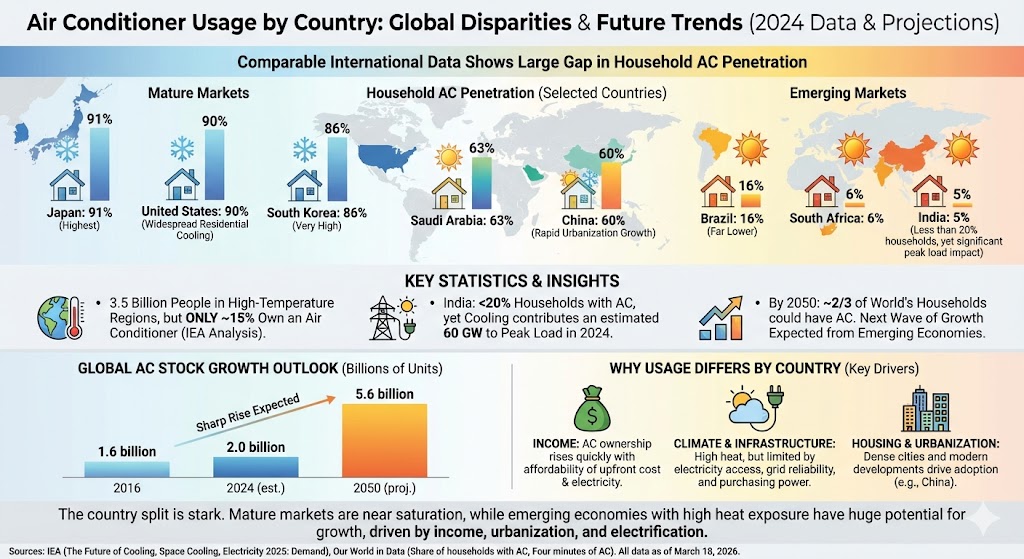
Comparable international air conditioner usage data is usually reported as household air conditioning penetration, meaning the share of homes that have AC. That measure shows a very large gap between mature cooling markets and countries where heat exposure is high but ownership is still low.
air conditioner usage by country statistics
Key air conditioner usage by country statistics
Among selected countries, Japan had the highest household AC penetration at 91%.
The United States followed closely at 90%, showing how widespread residential cooling has become in advanced markets.
South Korea also ranked very high, with 86% of households having air conditioning.
Saudi Arabia stood at 63%, while China reached 60%.
Penetration was far lower in Brazil at 16%, South Africa at 6%, and India at 5%.
IEA analysis says about 3.5 billion people now live in high-temperature regions, but only about 15% of them own an air conditioner.
In India, less than 20% of households have AC, yet cooling still contributed an estimated 60 GW to peak load in 2024.
Global AC stock could reach roughly 5.6 billion units by 2050, and about two-thirds of the world’s households could have AC by then.
Household AC penetration in selected countries
The chart below shows the share of households with air conditioning in selected countries. The spread is wide: some countries are near full penetration, while others remain in the single digits.
Label
Bar
Value
Japan
91%
United States
90%
South Korea
86%
Saudi Arabia
63%
China
60%
Brazil
16%
South Africa
6%
India
5%
Max = 91%. Widths: Japan 100.00%, United States 98.90%, South Korea 94.51%, Saudi Arabia 69.23%, China 65.93%, Brazil 17.58%, South Africa 6.59%, India 5.49%.
What the country data shows
The country split is stark. In mature markets such as Japan, the United States, and South Korea, air conditioning is close to being a standard household appliance. In contrast, countries such as India and South Africa still have very low household penetration even though cooling needs can be intense.
This gap matters because countries with lower ownership often have fast-rising cooling demand once incomes improve, electrification expands, and urbanization increases. That is one reason the next wave of global AC growth is expected to come largely from emerging economies rather than from already saturated markets.
Global AC stock growth outlook
Country-level usage is still uneven, but the long-run trend is clear: global air conditioner stock is expected to rise sharply as cooling becomes more accessible and more necessary.
Why air conditioner usage differs so much by country
Income is one of the biggest reasons. AC ownership usually rises quickly as households can afford the upfront purchase and the ongoing electricity cost.
Climate also matters, but it is not the only factor. Some very hot countries still have low household penetration because electricity access, grid reliability, and purchasing power remain major constraints.
Housing stock and urbanization shape adoption too. Dense cities, modern apartments, and commercial development often make room cooling more common, which helps explain the strong growth in China and other rapidly urbanizing markets.
Sources
International Energy Agency (IEA), The Future of Cooling
International Energy Agency (IEA), Space Cooling
International Energy Agency (IEA), Electricity 2025: Demand
Our World in Data, Share of households with air conditioning
Our World in Data, Four minutes of air conditioning