Air conditioning is one of the biggest electricity uses in buildings, and the numbers get much larger in warmer regions and during heat waves. Recent official U.S. data and International Energy Agency analyses show that cooling already accounts for a major share of building electricity use, while global demand continues to rise as air-conditioner ownership expands.
air conditioning power consumption statistics
Key air conditioning power consumption statistics
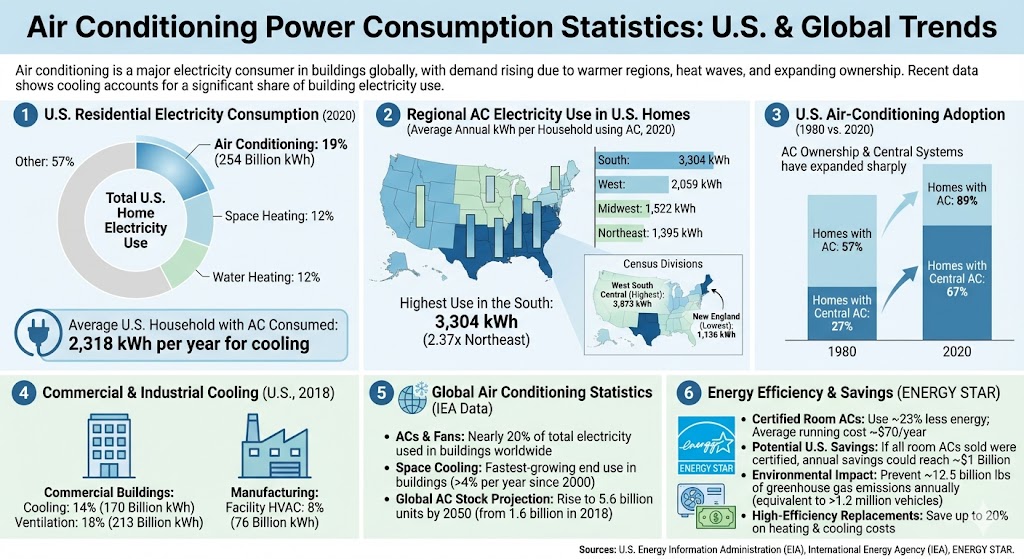
Air conditioning accounted for about 19% of electricity consumption in U.S. homes in 2020, equal to 254 billion kWh.
The average U.S. household that used electricity for air conditioning consumed about 2,318 kWh for cooling in 2020.
Among U.S. census regions, the South had the highest average annual household air-conditioning electricity use at 3,304 kWh per household using AC.
The Northeast averaged 1,395 kWh per household using AC, less than half the South’s level.
At the census-division level, West South Central had the highest average annual AC electricity use at 3,873 kWh per household using AC.
About 89% of U.S. homes used air conditioning in 2020, up from 57% in 1980.
The share of U.S. homes with central air conditioning rose from 27% in 1980 to 67% in 2020.
In U.S. commercial buildings, electricity for cooling accounted for about 14% of total electricity consumption in 2018, or 170 billion kWh.
Commercial-building ventilation used another 213 billion kWh of electricity in 2018, equal to about 18% of total commercial-building electricity use.
In U.S. manufacturing, facility HVAC accounted for about 8% of total electricity use in 2018, or 76 billion kWh.
IEA estimated in The Future of Cooling that air conditioners and electric fans account for nearly 20% of the total electricity used in buildings worldwide.
IEA says energy for space cooling has been the fastest-growing end use in buildings since 2000, growing over 4% per year.
ENERGY STAR says certified room air conditioners use about 23% less energy depending on product class and cost about $70 per year to run on average.
If all room air conditioners sold in the United States were ENERGY STAR certified, annual savings would reach about $1 billion.
How much electricity does air conditioning use in U.S. homes?
EIA’s 2020 Residential Energy Consumption Survey shows that air conditioning was the single largest residential site-electricity end use among the top three household categories it highlights. On an average household basis among homes that used the end use, air conditioning consumed 2,318 kWh per year.
Air conditioning is the largest residential electricity end use among the top three categories
EIA says air conditioning accounted for 19% of residential site electricity consumption in 2020, ahead of space heating and water heating at 12% each.
Label
Bar
Value
Air conditioning
19%
Space heating
12%
Water heating
12%
Max = 19%. Widths: Air conditioning 100.00%, Space heating 63.16%, Water heating 63.16%
Regional air-conditioning electricity use
Cooling demand is highly regional. In 2020, households that used air conditioning in the South consumed 3,304 kWh on average for AC, compared with 2,059 kWh in the West, 1,522 kWh in the Midwest, and 1,395 kWh in the Northeast. That means the South used about 2.37 times as much household AC electricity as the Northeast on average.
Average annual household air-conditioning electricity use is highest in the South
Among homes that used electricity for air conditioning in 2020, the South averaged 3,304 kWh per household, compared with 2,059 in the West, 1,522 in the Midwest, and 1,395 in the Northeast.
Label
Bar
Value
South
3,304 kWh
West
2,059 kWh
Midwest
1,522 kWh
Northeast
1,395 kWh
Max = 3304 kWh. Widths: South 100.00%, West 62.32%, Midwest 46.07%, Northeast 42.22%
Average annual household AC electricity use by U.S. census division
The division-level numbers show an even wider spread. West South Central households averaged 3,873 kWh per year for air conditioning, while New England averaged 1,136 kWh. That is a gap of 2,737 kWh, and West South Central’s average was about 3.41 times New England’s.
Census division
Average annual AC electricity use
New England
1,136 kWh
Middle Atlantic
1,483 kWh
East North Central
1,425 kWh
West North Central
1,728 kWh
South Atlantic
3,112 kWh
East South Central
2,812 kWh
West South Central
3,873 kWh
Mountain
2,918 kWh
Pacific
1,514 kWh
Air-conditioning adoption in U.S. homes
Air-conditioning ownership has become much more common over time. EIA reports that about 89% of U.S. homes used air conditioning in 2020, compared with 57% in 1980. Central air-conditioning systems also expanded sharply, rising from 27% of homes in 1980 to 67% in 2020.
Air-conditioning adoption and central-system adoption both climbed sharply from 1980 to 2020
EIA reports that about 57% of U.S. homes used air conditioning in 1980 versus about 89% in 2020, while central air-conditioning systems rose from 27% to 67%.
Label
Bar
Value
Homes with AC in 1980
57%
Homes with AC in 2020
89%
Homes with central AC in 1980
27%
Homes with central AC in 2020
67%
Max = 89%. Widths: Homes with AC in 1980 64.04%, Homes with AC in 2020 100.00%, Homes with central AC in 1980 30.34%, Homes with central AC in 2020 75.28%
Commercial and industrial cooling electricity statistics
Cooling accounted for about 170 billion kWh of electricity use in U.S. commercial buildings in 2018.
That commercial cooling total represented about 14% of all electricity used in commercial buildings.
Ventilation in commercial buildings used another 213 billion kWh, or about 18% of total electricity consumption.
Facility HVAC in U.S. manufacturing accounted for about 76 billion kWh of electricity use in 2018.
That manufacturing HVAC total represented about 8% of all electricity used at U.S. manufacturing facilities.
Global air conditioning electricity statistics
IEA estimated in The Future of Cooling that using air conditioners and electric fans to stay cool accounts for nearly 20% of the total electricity used in buildings worldwide.
IEA projected the global stock of air conditioners in buildings will rise to 5.6 billion by 2050, up from 1.6 billion in 2018.
Energy for space cooling has grown over 4% per year since 2000, making it the fastest-growing end use in buildings.
Under today’s policy settings, IEA says space cooling is rising by almost 4% annually to 2035.
IEA also says that if every air conditioner bought since 2019 had been the most efficient available, the world could have avoided electricity-demand growth equivalent to the demand growth from data centres over the same period.
Energy-efficiency statistics for air conditioners
ENERGY STAR certified room air conditioners use approximately 23% less energy depending on the product class.
ENERGY STAR says certified room air conditioners cost about $70 per year to run on average.
If all room air conditioners sold in the United States were ENERGY STAR certified, annual consumer savings would reach approximately $1 billion.
The same shift would prevent about 12.5 billion pounds of greenhouse gas emissions annually, equivalent to emissions from more than 1.2 million vehicles.
ENERGY STAR says properly installed high-efficiency replacement air conditioners and heat pumps can save up to 20% on heating and cooling costs.
Sources
U.S. Energy Information Administration, FAQ: https://www.eia.gov/tools/faqs/faq.php?id=1174&t=1
U.S. Energy Information Administration, Electricity use in homes: https://www.eia.gov/energyexplained/use-of-energy/electricity-use-in-homes.php
U.S. Energy Information Administration, 2020 RECS consumption tables: https://www.eia.gov/consumption/residential/data/2020/index.php?view=consumption
U.S. Energy Information Administration, Nearly 90% of U.S. households used air conditioning in 2020: https://www.eia.gov/todayinenergy/detail.php?id=52558
International Energy Agency, The Future of Cooling: https://www.iea.org/reports/the-future-of-cooling
International Energy Agency, Staying cool without overheating the energy system: https://www.iea.org/commentaries/staying-cool-without-overheating-the-energy-system
International Energy Agency, Energy Efficiency 2025 executive summary: https://www.iea.org/reports/energy-efficiency-2025/executive-summary
ENERGY STAR, Room Air Conditioners: https://www.energystar.gov/products/room_air_conditioners
ENERGY STAR, When is it time to replace?: https://www.energystar.gov/saveathome/heating-cooling/replace